

Chromosome Diversification in Antarctic Fish (Notothenioidei)
281
permanently cold Antarctic waters, where thermal invariability prevents a
temperature-dependent sex determination [24].
Intraspecific Polymorphism in Trematomus hansoni
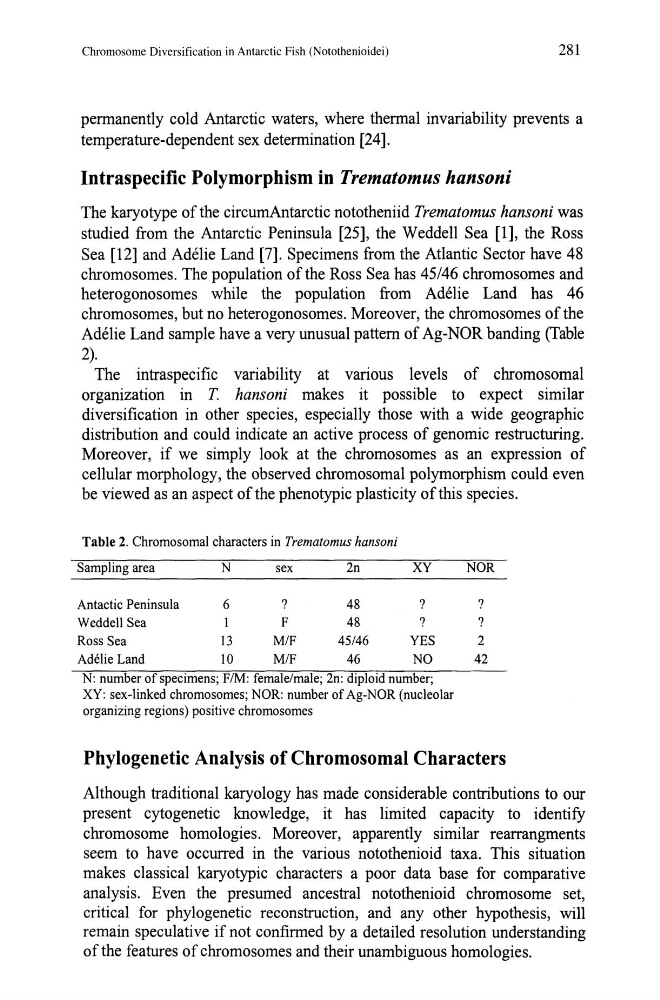
The karyotype of the circumAntarctic nototheniid Trematomus hansoni was
studied from the Antarctic Peninsula [25], the Weddell Sea [1], the Ross
Sea [12] and Adelie Land [7]. Specimens from the Atlantic Sector have 48
chromosomes. The population of the Ross Sea has 45/46 chromosomes and
heterogonosomes while the population from Adelie Land has 46
chromosomes, but no heterogonosomes. Moreover, the chromosomes of the
Adelie Land sample have a very unusual pattern of Ag-NOR banding (Table
2).
The intraspecific variability at various levels of chromosomal
organization in T. hansoni makes it possible to expect similar
diversification in other species, especially those with a wide geographic
distribution and could indicate an active process of genomic restructuring.
Moreover, if we simply look at the chromosomes as an expression of
cellular morphology, the observed chromosomal polymorphism could even
be viewed as an aspect of the phenotypic plasticity of this species.
Table 2. Chromosomal characters in Trematomus hansoni
Sampling area
N
sex
2n
XY
Antactic Peninsula
6
?
48
?
Weddell Sea
1
F
48
?
Ross Sea
13
M/F
45/46
YES
Addie Land
10
MIF
46
NO
N: number of specimens; FIM: female/male; 2n: diploid number;
XY: sex-linked chromosomes; NOR: number of Ag-NOR (nucleolar
organizing regions) positive chromosomes
NOR
?
?
2
42
Phylogenetic Analysis of Chromosomal Characters
Although traditional karyology has made considerable contributions to our
present cytogenetic knowledge, it has limited capacity to identify
chromosome homologies. Moreover, apparently similar rearrangments
seem to have occurred in the various notothenioid taxa. This situation
makes classical karyotypic characters a poor data base for comparative
analysis. Even the presumed ancestral notothenioid chromosome set,
critical for phylogenetic reconstruction, and any other hypothesis, will
remain speculative if not confirmed by a detailed resolution understanding
of the features of chromosomes and their unambiguous homologies.
281
permanently cold Antarctic waters, where thermal invariability prevents a
temperature-dependent sex determination [24].
Intraspecific Polymorphism in Trematomus hansoni
The karyotype of the circumAntarctic nototheniid Trematomus hansoni was
studied from the Antarctic Peninsula [25], the Weddell Sea [1], the Ross
Sea [12] and Adelie Land [7]. Specimens from the Atlantic Sector have 48
chromosomes. The population of the Ross Sea has 45/46 chromosomes and
heterogonosomes while the population from Adelie Land has 46
chromosomes, but no heterogonosomes. Moreover, the chromosomes of the
Adelie Land sample have a very unusual pattern of Ag-NOR banding (Table
2).
The intraspecific variability at various levels of chromosomal
organization in T. hansoni makes it possible to expect similar
diversification in other species, especially those with a wide geographic
distribution and could indicate an active process of genomic restructuring.
Moreover, if we simply look at the chromosomes as an expression of
cellular morphology, the observed chromosomal polymorphism could even
be viewed as an aspect of the phenotypic plasticity of this species.
Table 2. Chromosomal characters in Trematomus hansoni
Sampling area
N
sex
2n
XY
Antactic Peninsula
6
?
48
?
Weddell Sea
1
F
48
?
Ross Sea
13
M/F
45/46
YES
Addie Land
10
MIF
46
NO
N: number of specimens; FIM: female/male; 2n: diploid number;
XY: sex-linked chromosomes; NOR: number of Ag-NOR (nucleolar
organizing regions) positive chromosomes
NOR
?
?
2
42
Phylogenetic Analysis of Chromosomal Characters
Although traditional karyology has made considerable contributions to our
present cytogenetic knowledge, it has limited capacity to identify
chromosome homologies. Moreover, apparently similar rearrangments
seem to have occurred in the various notothenioid taxa. This situation
makes classical karyotypic characters a poor data base for comparative
analysis. Even the presumed ancestral notothenioid chromosome set,
critical for phylogenetic reconstruction, and any other hypothesis, will
remain speculative if not confirmed by a detailed resolution understanding
of the features of chromosomes and their unambiguous homologies.