

264
L. Bargelloni and G. Lecointre
opinion, the concordance of molecular and morphological analyses on the
new phylogenetic position of E. maclovinus is extremely interesting for
the study of notothenioid evolution. In fact, this species might be regarded
as a much less distant outgroup (compared to bovichtids) and could be
utilized as such in future evolutionary studies.
The evidence for a revised systematic position of E. maclovinus brings
up the problem of the taxonomic status of the family Nototheniidae. This
is the most speciose notothenioid family, with more than 49 species. So
far, nototheniids have been assumed to be monophyletic and divided into
four subfamilies (see Table 1). In order to test the monophyly of the entire
family as well as the intrafamily relationships, we conducted a comparison
between the most parsimonious phylogenetic tree (Fig. 1) and the tree(s)
which can be obtained forcing the topology to follow the phylogenetic
relationships within nototheniids which have been previously proposed.
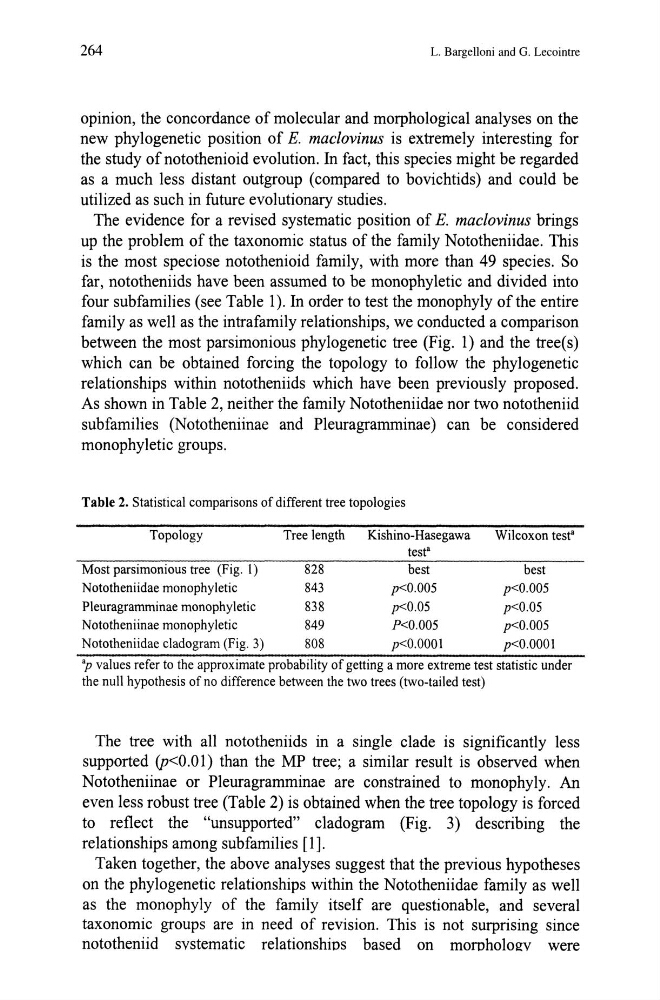
As shown in Table 2, neither the family Nototheniidae nor two nototheniid
subfamilies (Nototheniinae and Pleuragramminae) can be considered
monophyletic groups.
Table 2. Statistical comparisons of different tree topologies
Topology
Tree length
Kishino-Hasegawa
testa
Most parsimonious tree (Fig. I)
828
best
Nototheniidae monophyletic
843
p<0.005
Pleuragramrninae monophyletic
838
p<0.05
Nototheniinae monophyletic
849
P<0.005
Nototheniidae c1adogram (Fig. 3)
808
p
best
p<0.005
p<0.05
p<0.005
p
the null hypothesis of no difference between the two trees (two-tailed test)
The tree with all nototheniids in a single clade is significantly less
supported (p
even less robust tree (Table 2) is obtained when the tree topology is forced
to reflect the "unsupported" cladogram (Fig. 3) describing the
relationships among subfamilies [1].
Taken together, the above analyses suggest that the previous hypotheses
on the phylogenetic relationships within the Nototheniidae family as well
as the monophyly of the family itself are questionable, and several
taxonomic groups are in need of revision. This is not surprising since
nototheniid svstematic relationships based on morphologv were
L. Bargelloni and G. Lecointre
opinion, the concordance of molecular and morphological analyses on the
new phylogenetic position of E. maclovinus is extremely interesting for
the study of notothenioid evolution. In fact, this species might be regarded
as a much less distant outgroup (compared to bovichtids) and could be
utilized as such in future evolutionary studies.
The evidence for a revised systematic position of E. maclovinus brings
up the problem of the taxonomic status of the family Nototheniidae. This
is the most speciose notothenioid family, with more than 49 species. So
far, nototheniids have been assumed to be monophyletic and divided into
four subfamilies (see Table 1). In order to test the monophyly of the entire
family as well as the intrafamily relationships, we conducted a comparison
between the most parsimonious phylogenetic tree (Fig. 1) and the tree(s)
which can be obtained forcing the topology to follow the phylogenetic
relationships within nototheniids which have been previously proposed.
As shown in Table 2, neither the family Nototheniidae nor two nototheniid
subfamilies (Nototheniinae and Pleuragramminae) can be considered
monophyletic groups.
Table 2. Statistical comparisons of different tree topologies
Topology
Tree length
Kishino-Hasegawa
testa
Most parsimonious tree (Fig. I)
828
best
Nototheniidae monophyletic
843
p<0.005
Pleuragramrninae monophyletic
838
p<0.05
Nototheniinae monophyletic
849
P<0.005
Nototheniidae c1adogram (Fig. 3)
808
p
best
p<0.005
p<0.05
p<0.005
p
the null hypothesis of no difference between the two trees (two-tailed test)
The tree with all nototheniids in a single clade is significantly less
supported (p
even less robust tree (Table 2) is obtained when the tree topology is forced
to reflect the "unsupported" cladogram (Fig. 3) describing the
relationships among subfamilies [1].
Taken together, the above analyses suggest that the previous hypotheses
on the phylogenetic relationships within the Nototheniidae family as well
as the monophyly of the family itself are questionable, and several
taxonomic groups are in need of revision. This is not surprising since
nototheniid svstematic relationships based on morphologv were