

262
L. Bargelloni and G. Lecointre
infinite degrees of freedom. Divergence times between taxa were
calculated as the ratio of genetic distance (or mean genetic distance, when
comparing clades with more than one taxon) and divergence rate. A more
detailed description of methods will be presented elsewere (Bargelloni et
al., unpublished).
Phylogenetic Evidence from Molecular Data: Monophyly,
Paraphyly and Artefacts
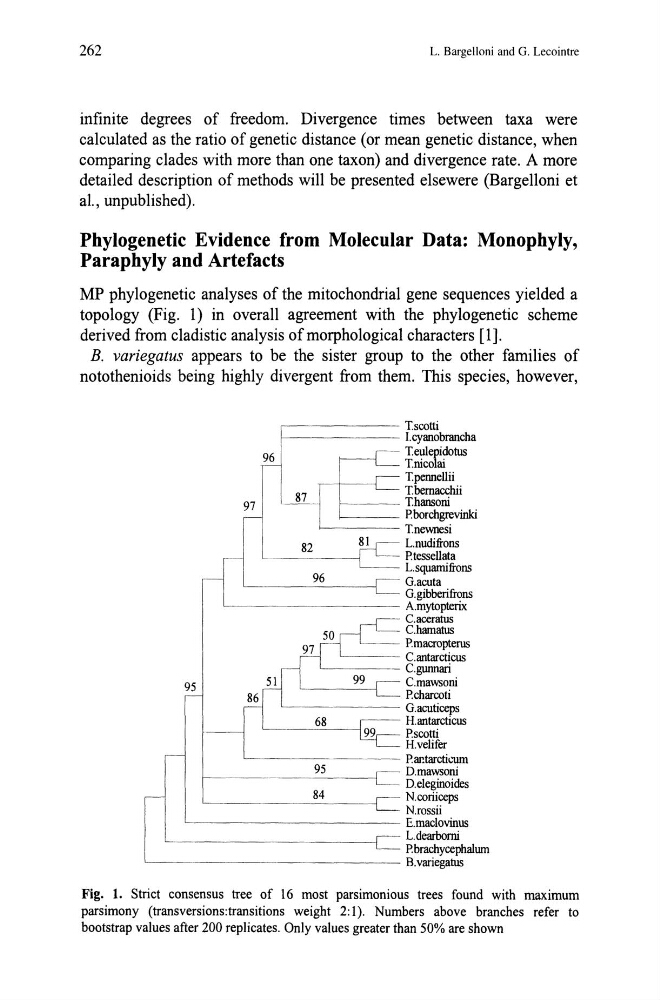
MP phylogenetic analyses of the mitochondrial gene sequences yielded a
topology (Fig. 1) in overall agreement with the phylogenetic scheme
derived from cladistic analysis of morphological characters [1].
B. variegatus appears to be the sister group to the other families of
notothenioids being highly divergent from them. This species, however,
95
97
96
Tscotti
f - - - - - - - Lcyanobrancha
~
i:~~dOtus
T pennellii
87
Tbernacchii
- - - Thansoni
P. borchgrevinki
-
Tnewnesi
82
81 C L.nudifrons
------I~ P.tessellata
L. squarnifrons
_ _ _ 9_6 __ -= G.acuta
- G.gibberifrons
1 [~~~~:rix 50
C.harnatus
97
P.macrop~erus
i '
C.antarctlcus
.
C.gunnan
'----___ 9_9 -jr---- c.mawsoni
L_ P.charcoti
- - - - - - G.acuticeps
~
H.antarcticus
~-----j 99
P.scotti
- H.velifer
68
- - - - - - - - P.ar..tarcticum
95
r--- D.mawsoni
------I~ D.eleginoides
L.. _ _ _ _ _ _ _ 8_4 ___ ---1,- N.coriiceps
L-. N.rossii
E.maclovinus
, - L. dearborni
------j~ P'brachycephalum
'---- - - - - - - - - - - - - - B.variegatus
Fig. 1. Strict consensus tree of 16 most parsimonious trees found with maximum
parsimony (transversions:transitions weight 2: 1). Numbers above branches refer to
bootstrap values after 200 replicates. Only values greater than 50% are shown
L. Bargelloni and G. Lecointre
infinite degrees of freedom. Divergence times between taxa were
calculated as the ratio of genetic distance (or mean genetic distance, when
comparing clades with more than one taxon) and divergence rate. A more
detailed description of methods will be presented elsewere (Bargelloni et
al., unpublished).
Phylogenetic Evidence from Molecular Data: Monophyly,
Paraphyly and Artefacts
MP phylogenetic analyses of the mitochondrial gene sequences yielded a
topology (Fig. 1) in overall agreement with the phylogenetic scheme
derived from cladistic analysis of morphological characters [1].
B. variegatus appears to be the sister group to the other families of
notothenioids being highly divergent from them. This species, however,
95
97
96
Tscotti
f - - - - - - - Lcyanobrancha
~
i:~~dOtus
T pennellii
87
Tbernacchii
- - - Thansoni
P. borchgrevinki
-
Tnewnesi
82
81 C L.nudifrons
------I~ P.tessellata
L. squarnifrons
_ _ _ 9_6 __ -= G.acuta
- G.gibberifrons
1 [~~~~:rix 50
C.harnatus
97
P.macrop~erus
i '
C.antarctlcus
.
C.gunnan
'----___ 9_9 -jr---- c.mawsoni
L_ P.charcoti
- - - - - - G.acuticeps
~
H.antarcticus
~-----j 99
P.scotti
- H.velifer
68
- - - - - - - - P.ar..tarcticum
95
r--- D.mawsoni
------I~ D.eleginoides
L.. _ _ _ _ _ _ _ 8_4 ___ ---1,- N.coriiceps
L-. N.rossii
E.maclovinus
, - L. dearborni
------j~ P'brachycephalum
'---- - - - - - - - - - - - - - B.variegatus
Fig. 1. Strict consensus tree of 16 most parsimonious trees found with maximum
parsimony (transversions:transitions weight 2: 1). Numbers above branches refer to
bootstrap values after 200 replicates. Only values greater than 50% are shown