

240
M. Maffia et al.
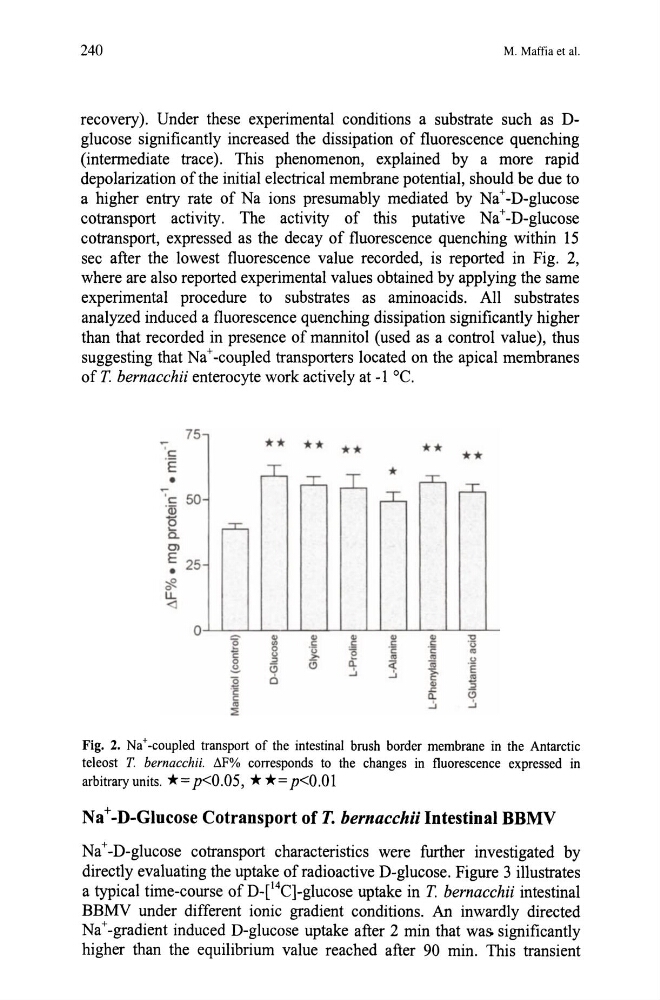
recovery). Under these experimental conditions a substrate such as Dglucose significantly increased the dissipation of fluorescence quenching
(intermediate trace). This phenomenon, explained by a more rapid
depolarization of the initial electrical membrane potential, should be due to
a higher entry rate of Na ions presumably mediated by Na+-D-glucose
cotransport activity. The activity of this putative Na+-D-glucose
cotransport, expressed as the decay of fluorescence quenching within 15
sec after the lowest fluorescence value recorded, is reported in Fig. 2,
where are also reported experimental values obtained by applying the same
experimental procedure to substrates as aminoacids. All substrates
analyzed induced a fluorescence quenching dissipation significantly higher
than that recorded in presence of mannitol (used as a control value), thus
suggesting that Na+-coupled transporters located on the apical membranes
of T bernacchii enterocyte work actively at -1°C.
75
";"
c
'E
** **
**
**
**
*
•
";"
50
c
~ a.
Ol
E 25
•
~
0
LL
~
~
.,
.,
.,
.,
..,
.S
"
"
co
'u
.to
0
u
~
"2
'2
!II
c:
U
~
!II
'"
U
0
.2
l!)
Q.
~
iii
'e
.!:!.
l!)
~
>.
;g
0
"
.f!l
., .2
.<:
c:
Q.
l!)
" !II
~
...:.
::i:
Fig. 2. Na + -coupled transport of the intestinal brush border membrane in the Antarctic
teleost T bernacchii. 6F% corresponds to the changes in fluorescence expressed in
arbitrary units. *= p
N a + -D-Glucose Cotransport of T. bernacchii Intestinal BBMV
Na + -D-glucose cotransport characteristics were further investigated by
directly evaluating the uptake of radioactive D-glucose. Figure 3 illustrates
a typical time-course of D-C 4 C]-glucose uptake in T bernacchii intestinal
BBMV under different ionic gradient conditions. An inwardly directed
Na+-gradient induced D-glucose uptake after 2 min that was. significantly
higher than the equilibrium value reached after 90 min. This transient
M. Maffia et al.
recovery). Under these experimental conditions a substrate such as Dglucose significantly increased the dissipation of fluorescence quenching
(intermediate trace). This phenomenon, explained by a more rapid
depolarization of the initial electrical membrane potential, should be due to
a higher entry rate of Na ions presumably mediated by Na+-D-glucose
cotransport activity. The activity of this putative Na+-D-glucose
cotransport, expressed as the decay of fluorescence quenching within 15
sec after the lowest fluorescence value recorded, is reported in Fig. 2,
where are also reported experimental values obtained by applying the same
experimental procedure to substrates as aminoacids. All substrates
analyzed induced a fluorescence quenching dissipation significantly higher
than that recorded in presence of mannitol (used as a control value), thus
suggesting that Na+-coupled transporters located on the apical membranes
of T bernacchii enterocyte work actively at -1°C.
75
";"
c
'E
** **
**
**
**
*
•
";"
50
c
~ a.
Ol
E 25
•
~
0
LL
~
~
.,
.,
.,
.,
..,
.S
"
"
co
'u
.to
0
u
~
"2
'2
!II
c:
U
~
!II
'"
U
0
.2
l!)
Q.
~
iii
'e
.!:!.
l!)
~
>.
;g
0
"
.f!l
., .2
.<:
c:
Q.
l!)
" !II
~
...:.
::i:
Fig. 2. Na + -coupled transport of the intestinal brush border membrane in the Antarctic
teleost T bernacchii. 6F% corresponds to the changes in fluorescence expressed in
arbitrary units. *= p
Na + -D-glucose cotransport characteristics were further investigated by
directly evaluating the uptake of radioactive D-glucose. Figure 3 illustrates
a typical time-course of D-C 4 C]-glucose uptake in T bernacchii intestinal
BBMV under different ionic gradient conditions. An inwardly directed
Na+-gradient induced D-glucose uptake after 2 min that was. significantly
higher than the equilibrium value reached after 90 min. This transient