

Ion and Metabolite Transport Through the Intestinal Membranes of T. bernacchii
239
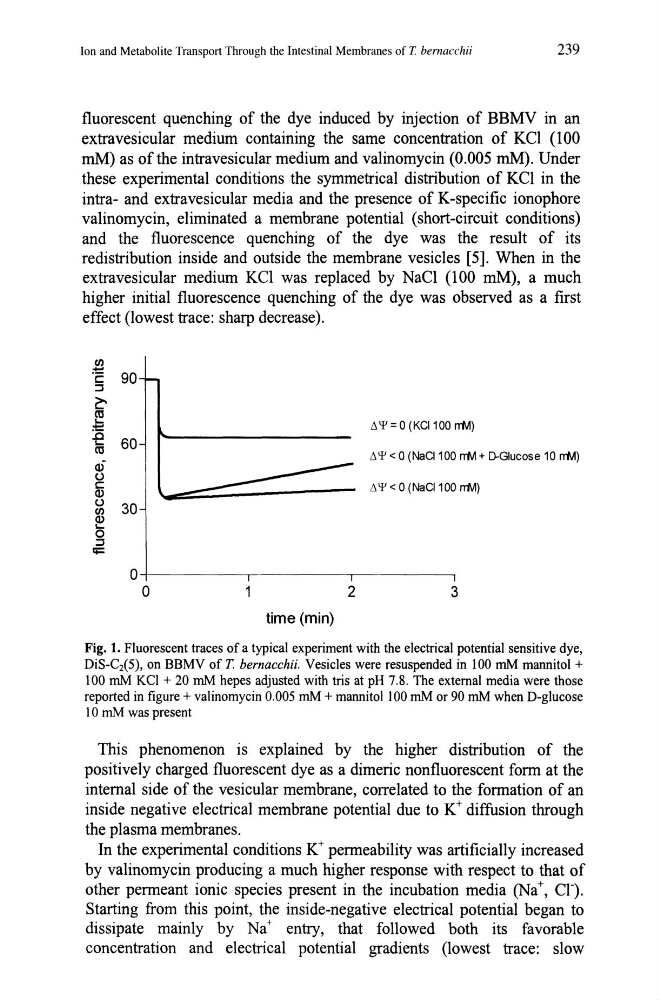
fluorescent quenching of the dye induced by injection of BBMV in an
extravesicular medium containing the same concentration of KCI (100
mM) as of the intravesicular medium and valinomycin (0.005 mM). Under
these experimental conditions the symmetrical distribution of KCI in the
intra- and extravesicular media and the presence of K-specific ionophore
valinomycin, eliminated a membrane potential (short-circuit conditions)
and the fluorescence quenching of the dye was the result of its
redistribution inside and outside the membrane vesicles [5]. When in the
extravesicular medium KCl was replaced by NaCl (100 mM), a much
higher initial fluorescence quenching of the dye was observed as a first
effect (lowest trace: sharp decrease) .
.!!l
'c 90
:::I
~
~
-
:e 60
ttl
(])
() 30
~
o
:::I
Ii=
L'.'¥=O (KC1100 rrM)
L'.'¥< 0 (NaCI 100 rrM+ D-Glucose 10 rrM)
L' . '¥ < 0 (NaCI1 00 rrM)
O+-----------~--------~----------~
o
2
3
time (min)
Fig. 1. Fluorescent traces of a typical experiment with the electrical potential sensitive dye,
DiS-Cz(5), on BBMV of T. bernacchii. Vesicles were resuspended in 100 mM mannitol +
100 mM KCl + 20 mM hepes adjusted with tris at pH 7.S. The external media were those
reported in figure + valinomycin 0.005 mM + mannitol 100 mM or 90 mM when D-glucose
10 mM was present
This phenomenon is explained by the higher distribution of the
positively charged fluorescent dye as a dimeric nonfluorescent form at the
internal side of the vesicular membrane, correlated to the formation of an
inside negative electrical membrane potential due to K+ diffusion through
the plasma membranes.
In the experimental conditions K+ permeability was artificially increased
by valinomycin producing a much higher response with respect to that of
other permeant ionic species present in the incubation media (Na +, Cil
Starting from this point, the inside-negative electrical potential began to
dissipate mainly by Na+ entry, that followed both its favorable
concentration and electrical potential gradients (lowest trace: slow
239
fluorescent quenching of the dye induced by injection of BBMV in an
extravesicular medium containing the same concentration of KCI (100
mM) as of the intravesicular medium and valinomycin (0.005 mM). Under
these experimental conditions the symmetrical distribution of KCI in the
intra- and extravesicular media and the presence of K-specific ionophore
valinomycin, eliminated a membrane potential (short-circuit conditions)
and the fluorescence quenching of the dye was the result of its
redistribution inside and outside the membrane vesicles [5]. When in the
extravesicular medium KCl was replaced by NaCl (100 mM), a much
higher initial fluorescence quenching of the dye was observed as a first
effect (lowest trace: sharp decrease) .
.!!l
'c 90
:::I
~
~
-
:e 60
ttl
(])
() 30
~
o
:::I
Ii=
L'.'¥=O (KC1100 rrM)
L'.'¥< 0 (NaCI 100 rrM+ D-Glucose 10 rrM)
L' . '¥ < 0 (NaCI1 00 rrM)
O+-----------~--------~----------~
o
2
3
time (min)
Fig. 1. Fluorescent traces of a typical experiment with the electrical potential sensitive dye,
DiS-Cz(5), on BBMV of T. bernacchii. Vesicles were resuspended in 100 mM mannitol +
100 mM KCl + 20 mM hepes adjusted with tris at pH 7.S. The external media were those
reported in figure + valinomycin 0.005 mM + mannitol 100 mM or 90 mM when D-glucose
10 mM was present
This phenomenon is explained by the higher distribution of the
positively charged fluorescent dye as a dimeric nonfluorescent form at the
internal side of the vesicular membrane, correlated to the formation of an
inside negative electrical membrane potential due to K+ diffusion through
the plasma membranes.
In the experimental conditions K+ permeability was artificially increased
by valinomycin producing a much higher response with respect to that of
other permeant ionic species present in the incubation media (Na +, Cil
Starting from this point, the inside-negative electrical potential began to
dissipate mainly by Na+ entry, that followed both its favorable
concentration and electrical potential gradients (lowest trace: slow