

Atrial Natriuretic Peptides in Antarctic Fish
219
The low or absent ANP-like immunostaining in the ventricles of Antarctic
teleosts resembles the observations made in mammals, in which the
concentration of ANP in the ventricles is very low compared with that in
the atria [25]. It may be that ANP, synthesized in the ventricle, is secreted
without being concentrated in granules, while atrial cardiocytes store most
of the ANP that is synthesized. However, ultrastructural studies showed in
the ventricle of the Antarctic, icefish Chaenocephalus aceratus numerous
granulated cells [26]. Two molecular forms of natriuretic peptides have
been identified in the eel ventricles and named ventricular natriuretic
peptides (VNP 1-36 and VNP 1-25); the two forms slightly differ from the
atrial natriuretic peptide [27]. The low immunoreactivity observed in the
ventricular chamber of the teleosts investigated may reflect the presence of
a VNP with a lower crossreactivity to the atrial natriuretic peptide antibody.
All the blood from the heart courses forward into a ventral aorta through
the conus arteriosus that possesses a myocardial musculature. The bulbus
arteriosus follows the conus and develops as a proximal part of the ventral
aorta. In Antarctic teleosts the conus is much reduced. In the Antarctic
fishes examined, the myocytes of the conus showed a very clear ANP
immunoreactivity, particularly intense in the perinuclear zone. There was
less intense staining in the bulbus arteriosus [24].
Ir-Like ANP in Kidney, Gills, Urinary Bladder and Skin
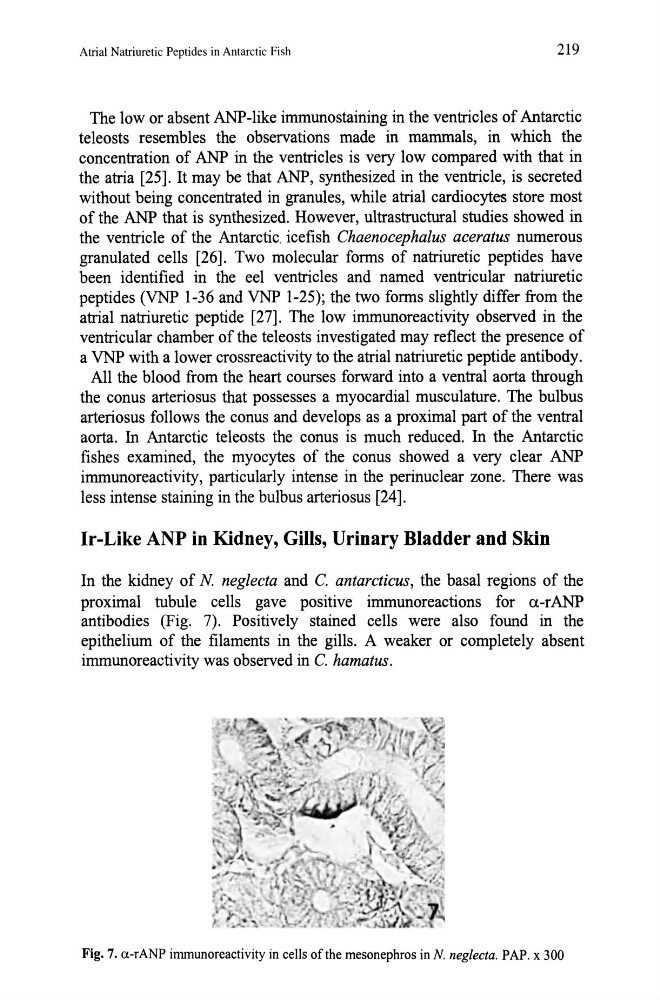
In the kidney of N neglecta and C. antarcticus, the basal regions of the
proximal tubule cells gave positive immunoreactions for a-rANP
antibodies (Fig. 7). Positively stained cells were also found in the
epithelium of the filaments in the gills. A weaker or completely absent
immunoreactivity was observed in C. hamatus.
Fig. 7. a-rANP immunoreactivity in cells of the mesonephros in N. negiecta, PAP. x 300
219
The low or absent ANP-like immunostaining in the ventricles of Antarctic
teleosts resembles the observations made in mammals, in which the
concentration of ANP in the ventricles is very low compared with that in
the atria [25]. It may be that ANP, synthesized in the ventricle, is secreted
without being concentrated in granules, while atrial cardiocytes store most
of the ANP that is synthesized. However, ultrastructural studies showed in
the ventricle of the Antarctic, icefish Chaenocephalus aceratus numerous
granulated cells [26]. Two molecular forms of natriuretic peptides have
been identified in the eel ventricles and named ventricular natriuretic
peptides (VNP 1-36 and VNP 1-25); the two forms slightly differ from the
atrial natriuretic peptide [27]. The low immunoreactivity observed in the
ventricular chamber of the teleosts investigated may reflect the presence of
a VNP with a lower crossreactivity to the atrial natriuretic peptide antibody.
All the blood from the heart courses forward into a ventral aorta through
the conus arteriosus that possesses a myocardial musculature. The bulbus
arteriosus follows the conus and develops as a proximal part of the ventral
aorta. In Antarctic teleosts the conus is much reduced. In the Antarctic
fishes examined, the myocytes of the conus showed a very clear ANP
immunoreactivity, particularly intense in the perinuclear zone. There was
less intense staining in the bulbus arteriosus [24].
Ir-Like ANP in Kidney, Gills, Urinary Bladder and Skin
In the kidney of N neglecta and C. antarcticus, the basal regions of the
proximal tubule cells gave positive immunoreactions for a-rANP
antibodies (Fig. 7). Positively stained cells were also found in the
epithelium of the filaments in the gills. A weaker or completely absent
immunoreactivity was observed in C. hamatus.
Fig. 7. a-rANP immunoreactivity in cells of the mesonephros in N. negiecta, PAP. x 300