

Vascular Adaptations for Blood Supply to Locomotory Muscles of Icefish
193
Oncorhynchus mykiss [14] gives estimates of TPR of 67.3x10 3 and
629x103 dynes- 1 sec- 1 cm- 5 , respectively. Using dorsal aortic blood
pressure means that we actually calculate postbranchial, rather than total
peripheral resistance in fishes. The systemic resistance of icefish is
therefore <10% that of rainbow trout at their preferred (optimal)
temperatures of 0 and 11°C, respectively. The reduced skeletal muscle
mass in icefish compared with trout (40% vs. 60% body weight,
respectively) suggests the difference in total vascular resistance located in
muscle is somewhat less. Given that both the conduit arterial system and
high resistance vessels show, adaptations to maximize muscle perfusion,
we may also try to estimate the influence of capillary size on the potential
microvascular blood flow (Q). Comparative values can be obtained from
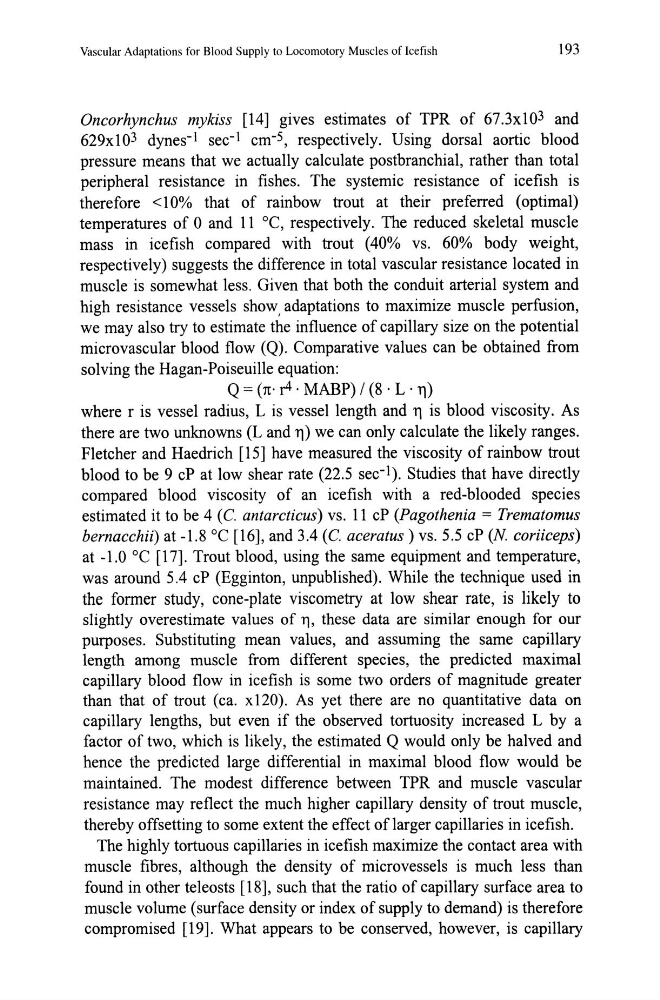
solving the Hagan-Poiseuille equation:
Q = (n' r4. MABP) / (8' L '11)
where r is vessel radius, L is vessel length and 11 is blood viscosity. As
there are two unknowns (L and 11) we can only calculate the likely ranges.
Fletcher and Haedrich [15] have measured the viscosity of rainbow trout
blood to be 9 cP at low shear rate (22.5 sec-I). Studies that have directly
compared blood viscosity of an icefish with a red-blooded species
estimated it to be 4 (C antarcticus) vs. 11 cP (Pagothenia = Trematomus
bernacchii) at -1.8 °C [16], and 3.4 (C aceratus) vs. 5.5 cP (N. coriiceps)
at -1.0 °C [17]. Trout blood, using the same equipment and temperature,
was around 5.4 cP (Egginton, unpublished). While the technique used in
the former study, cone-plate viscometry at low shear rate, is likely to
slightly overestimate values of 11, these data are similar enough for our
purposes. Substituting mean values, and assuming the same capillary
length among muscle from different species, the predicted maximal
capillary blood flow in icefish is some two orders of magnitude greater
than that of trout (ca. xI20). As yet there are no quantitative data on
capillary lengths, but even if the observed tortuosity increased L by a
factor of two, which is likely, the estimated Q would only be halved and
hence the predicted large differential in maximal blood flow would be
maintained. The modest difference between TPR and muscle vascular
resistance may reflect the much higher capillary density of trout muscle,
thereby offsetting to some extent the effect of larger capillaries in icefish.
The highly tortuous capillaries in icefish maximize the contact area with
muscle fibres, although the density of microvessels is much less than
found in other teleosts [18], such that the ratio of capillary surface area to
muscle volume (surface density or index of supply to demand) is therefore
compromised [19]. What appears to be conserved, however, is capillary
193
Oncorhynchus mykiss [14] gives estimates of TPR of 67.3x10 3 and
629x103 dynes- 1 sec- 1 cm- 5 , respectively. Using dorsal aortic blood
pressure means that we actually calculate postbranchial, rather than total
peripheral resistance in fishes. The systemic resistance of icefish is
therefore <10% that of rainbow trout at their preferred (optimal)
temperatures of 0 and 11°C, respectively. The reduced skeletal muscle
mass in icefish compared with trout (40% vs. 60% body weight,
respectively) suggests the difference in total vascular resistance located in
muscle is somewhat less. Given that both the conduit arterial system and
high resistance vessels show, adaptations to maximize muscle perfusion,
we may also try to estimate the influence of capillary size on the potential
microvascular blood flow (Q). Comparative values can be obtained from
solving the Hagan-Poiseuille equation:
Q = (n' r4. MABP) / (8' L '11)
where r is vessel radius, L is vessel length and 11 is blood viscosity. As
there are two unknowns (L and 11) we can only calculate the likely ranges.
Fletcher and Haedrich [15] have measured the viscosity of rainbow trout
blood to be 9 cP at low shear rate (22.5 sec-I). Studies that have directly
compared blood viscosity of an icefish with a red-blooded species
estimated it to be 4 (C antarcticus) vs. 11 cP (Pagothenia = Trematomus
bernacchii) at -1.8 °C [16], and 3.4 (C aceratus) vs. 5.5 cP (N. coriiceps)
at -1.0 °C [17]. Trout blood, using the same equipment and temperature,
was around 5.4 cP (Egginton, unpublished). While the technique used in
the former study, cone-plate viscometry at low shear rate, is likely to
slightly overestimate values of 11, these data are similar enough for our
purposes. Substituting mean values, and assuming the same capillary
length among muscle from different species, the predicted maximal
capillary blood flow in icefish is some two orders of magnitude greater
than that of trout (ca. xI20). As yet there are no quantitative data on
capillary lengths, but even if the observed tortuosity increased L by a
factor of two, which is likely, the estimated Q would only be halved and
hence the predicted large differential in maximal blood flow would be
maintained. The modest difference between TPR and muscle vascular
resistance may reflect the much higher capillary density of trout muscle,
thereby offsetting to some extent the effect of larger capillaries in icefish.
The highly tortuous capillaries in icefish maximize the contact area with
muscle fibres, although the density of microvessels is much less than
found in other teleosts [18], such that the ratio of capillary surface area to
muscle volume (surface density or index of supply to demand) is therefore
compromised [19]. What appears to be conserved, however, is capillary