

Metallothionein in Antarctic Fish
159
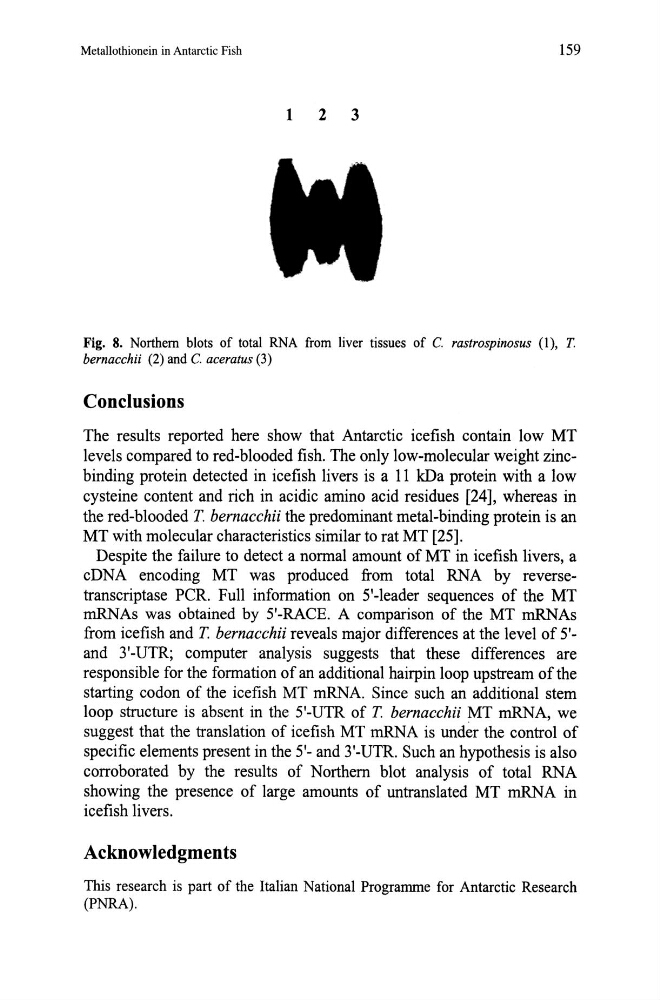
1 2 3
Fig. 8. Northern blots of total RNA from liver tissues of C. rastrospinosus (1), T
bernacchii (2) and C. aceratus (3)
Conclusions
The results reported here show that Antarctic icefish contain low MT
levels compared to red-blooded fish. The only low-molecular weight zincbinding protein detected in icefish livers is a 11 kDa protein with a low
cysteine content and rich in acidic amino acid residues [24], whereas in
the red-blooded T. bernacchii the predominant metal-binding protein is an
MT with molecular characteristics similar to rat MT [25].
Despite the failure to detect a normal amount of MT in icefish livers, a
cDNA encoding MT was produced from total RNA by reversetranscriptase peR. Full information on 5'-leader sequences of the MT
mRNAs was obtained by 5'-RACE. A comparison of the MT mRNAs
from icefish and T. bernacchii reveals major differences at the level of 5'and 3'-UTR; computer analysis suggests that these differences are
responsible for the formation of an additional hairpin loop upstream of the
starting codon of the icefish MT mRNA. Since such an additional stem
loop structure is absent in the 5'-UTR of T. bernacchii MT mRNA, we
suggest that the translation of ice fish MT mRNA is under the control of
specific elements present in the 5'- and 3'-UTR. Such an hypothesis is also
corroborated by the results of Northern blot analysis of total RNA
showing the presence of large amounts of untranslated MT mRNA in
icefish livers.
Acknowledgments
This research is part of the Italian National Programme for Antarctic Research
(PNRA).
159
1 2 3
Fig. 8. Northern blots of total RNA from liver tissues of C. rastrospinosus (1), T
bernacchii (2) and C. aceratus (3)
Conclusions
The results reported here show that Antarctic icefish contain low MT
levels compared to red-blooded fish. The only low-molecular weight zincbinding protein detected in icefish livers is a 11 kDa protein with a low
cysteine content and rich in acidic amino acid residues [24], whereas in
the red-blooded T. bernacchii the predominant metal-binding protein is an
MT with molecular characteristics similar to rat MT [25].
Despite the failure to detect a normal amount of MT in icefish livers, a
cDNA encoding MT was produced from total RNA by reversetranscriptase peR. Full information on 5'-leader sequences of the MT
mRNAs was obtained by 5'-RACE. A comparison of the MT mRNAs
from icefish and T. bernacchii reveals major differences at the level of 5'and 3'-UTR; computer analysis suggests that these differences are
responsible for the formation of an additional hairpin loop upstream of the
starting codon of the icefish MT mRNA. Since such an additional stem
loop structure is absent in the 5'-UTR of T. bernacchii MT mRNA, we
suggest that the translation of ice fish MT mRNA is under the control of
specific elements present in the 5'- and 3'-UTR. Such an hypothesis is also
corroborated by the results of Northern blot analysis of total RNA
showing the presence of large amounts of untranslated MT mRNA in
icefish livers.
Acknowledgments
This research is part of the Italian National Programme for Antarctic Research
(PNRA).