

142
H.W. Detrich
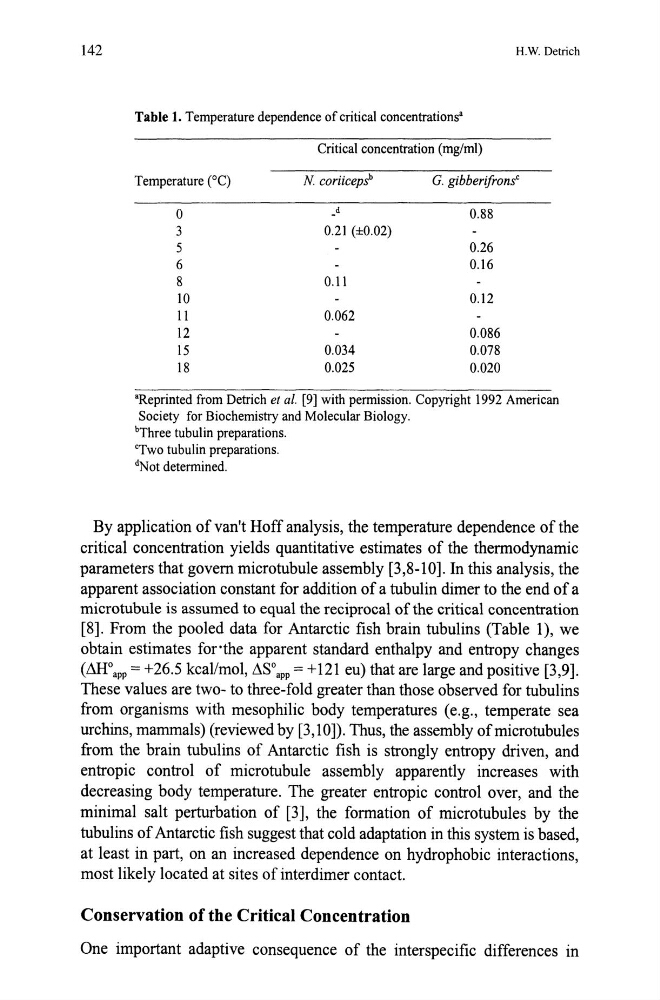
Table 1. Temperature dependence of critical concentrations·
Critical concentration (mg/ml)
Temperature caC)
N. coriicepsb
G. gibberifrons c
0
- d
0.88
3
0.21 (±0.02)
5
0.26
6
0.16
8
0.11
10
0.12
11
0.062
12
0.086
15
0.034
0.078
18
0.025
0.020
·Reprinted from Detrich et al. [9] with permission. Copyright 1992 American
Society for Biochemistry and Molecular Biology.
bThree tubulin preparations.
cTwo tubulin preparations.
dNot determined.
By application of van't Hoff analysis, the temperature dependence of the
critical concentration yields quantitative estimates of the thermodynamic
parameters that govern microtubule assembly [3,8-10]. In this analysis, the
apparent association constant for addition of a tubulin dimer to the end of a
microtubule is assumed to equal the reciprocal of the critical concentration
[8]. From the pooled data for Antarctic fish brain tubulins (Table 1), we
obtain estimates for "the apparent standard enthalpy and entropy changes
(MIoapp = +26.5 kcal/mol, ,1Soapp = +121 eu) that are large and positive [3,9].
These values are two- to three-fold greater than those observed for tubulins
from organisms with mesophilic body temperatures (e.g., temperate sea
urchins, mammals) (reviewed by [3,10]). Thus, the assembly of micro tubules
from the brain tubulins of Antarctic fish is strongly entropy driven, and
entropic control of microtubule assembly apparently increases with
decreasing body temperature. The greater entropic control over, and the
minimal salt perturbation of [3], the formation of microtubules by the
tubulins of Antarctic fish suggest that cold adaptation in this system is based,
at least in part, on an increased dependence on hydrophobic interactions,
most likely located at sites of interdimer contact.
Conservation of the Critical Concentration
One important adaptive consequence of the interspecific differences in
H.W. Detrich
Table 1. Temperature dependence of critical concentrations·
Critical concentration (mg/ml)
Temperature caC)
N. coriicepsb
G. gibberifrons c
0
- d
0.88
3
0.21 (±0.02)
5
0.26
6
0.16
8
0.11
10
0.12
11
0.062
12
0.086
15
0.034
0.078
18
0.025
0.020
·Reprinted from Detrich et al. [9] with permission. Copyright 1992 American
Society for Biochemistry and Molecular Biology.
bThree tubulin preparations.
cTwo tubulin preparations.
dNot determined.
By application of van't Hoff analysis, the temperature dependence of the
critical concentration yields quantitative estimates of the thermodynamic
parameters that govern microtubule assembly [3,8-10]. In this analysis, the
apparent association constant for addition of a tubulin dimer to the end of a
microtubule is assumed to equal the reciprocal of the critical concentration
[8]. From the pooled data for Antarctic fish brain tubulins (Table 1), we
obtain estimates for "the apparent standard enthalpy and entropy changes
(MIoapp = +26.5 kcal/mol, ,1Soapp = +121 eu) that are large and positive [3,9].
These values are two- to three-fold greater than those observed for tubulins
from organisms with mesophilic body temperatures (e.g., temperate sea
urchins, mammals) (reviewed by [3,10]). Thus, the assembly of micro tubules
from the brain tubulins of Antarctic fish is strongly entropy driven, and
entropic control of microtubule assembly apparently increases with
decreasing body temperature. The greater entropic control over, and the
minimal salt perturbation of [3], the formation of microtubules by the
tubulins of Antarctic fish suggest that cold adaptation in this system is based,
at least in part, on an increased dependence on hydrophobic interactions,
most likely located at sites of interdimer contact.
Conservation of the Critical Concentration
One important adaptive consequence of the interspecific differences in