

140
H.W. Detrich
Functional Adaptation of Antarctic Fish Tubulin
Microtubule Formation by Purified Brain Tubulin
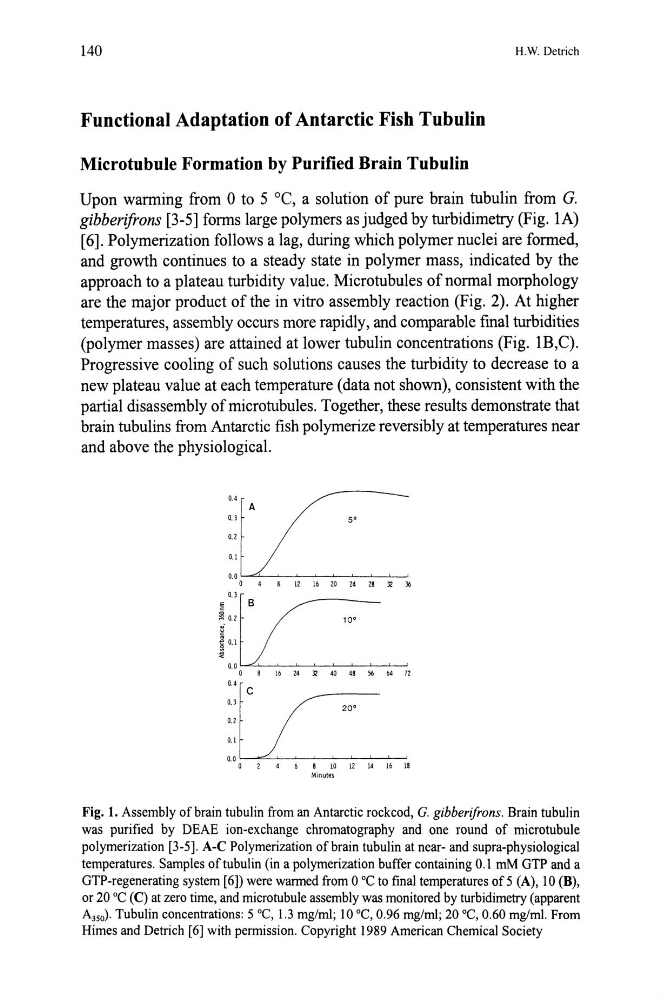
Upon warming from 0 to 5°C, a solution of pure brain tubulin from G.
gibberifrons [3-5] forms large polymers as judged by turbidimetry (Fig. lA)
[6]. Polymerization follows a lag, during which polymer nuclei are formed,
and growth continues to a steady state in polymer mass, indicated by the
approach to a plateau turbidity value. Microtubules of normal morphology
are the major product of the in vitro assembly reaction (Fig. 2). At higher
temperatures, assembly occurs more rapidly, and comparable [mal turbidities
(polymer masses) are attained at lower tubulin concentrations (Fig. lB,C).
Progressive cooling of such solutions causes the turbidity to decrease to a
new plateau value at each temperature (data not shown), consistent with the
partial disassembly of microtubules. Together, these results demonstrate that
brain tubulins from Antarctic fish polymerize reversibly at temperatures near
and above the physiological.
0.4
A
0.3
5'
0.1
0.1
o. 0 L......o"-'--~'--'------"----"~----"
0 4 8 1 1 1 6 1 0 1 4 1 8 3 1 3 6
UL mo ~.
o 8 16 ~ ~ ~ ~ ~ ~ n
04 ~
~:fC L. ,,0 .
o 2 4 6 8 ill a M U g
Minutes
Fig. 1. Assembly of brain tubulin from an Antarctic rockcod, G. gibberifrons. Brain tubulin
was purified by DEAE ion-exchange chromatography and one round of microtubule
polymerization [3-5]. A-C Polymerization of brain tubulin at near- and supra-physiological
temperatures. Samples of tubulin (in a polymerization buffer containing 0.1 mM GTP and a
GTP-regenerating system [6]) were warmed from 0 DC to final temperatures of 5 (A), 10(8),
or 20 DC (C) at zero time, and microtubule assembly was monitored by turbidimetry (apparent
A3s0)' Tubulin concentrations: 5 DC, 1.3 mg/ml; 10 DC, 0.96 mg/ml; 20 DC, 0.60 mglml. From
Himes and Detrich [6] with permission. Copyright 1989 American Chemical Society
H.W. Detrich
Functional Adaptation of Antarctic Fish Tubulin
Microtubule Formation by Purified Brain Tubulin
Upon warming from 0 to 5°C, a solution of pure brain tubulin from G.
gibberifrons [3-5] forms large polymers as judged by turbidimetry (Fig. lA)
[6]. Polymerization follows a lag, during which polymer nuclei are formed,
and growth continues to a steady state in polymer mass, indicated by the
approach to a plateau turbidity value. Microtubules of normal morphology
are the major product of the in vitro assembly reaction (Fig. 2). At higher
temperatures, assembly occurs more rapidly, and comparable [mal turbidities
(polymer masses) are attained at lower tubulin concentrations (Fig. lB,C).
Progressive cooling of such solutions causes the turbidity to decrease to a
new plateau value at each temperature (data not shown), consistent with the
partial disassembly of microtubules. Together, these results demonstrate that
brain tubulins from Antarctic fish polymerize reversibly at temperatures near
and above the physiological.
0.4
A
0.3
5'
0.1
0.1
o. 0 L......o"-'--~'--'------"----"~----"
0 4 8 1 1 1 6 1 0 1 4 1 8 3 1 3 6
UL mo ~.
o 8 16 ~ ~ ~ ~ ~ ~ n
04 ~
~:fC L. ,,0 .
o 2 4 6 8 ill a M U g
Minutes
Fig. 1. Assembly of brain tubulin from an Antarctic rockcod, G. gibberifrons. Brain tubulin
was purified by DEAE ion-exchange chromatography and one round of microtubule
polymerization [3-5]. A-C Polymerization of brain tubulin at near- and supra-physiological
temperatures. Samples of tubulin (in a polymerization buffer containing 0.1 mM GTP and a
GTP-regenerating system [6]) were warmed from 0 DC to final temperatures of 5 (A), 10(8),
or 20 DC (C) at zero time, and microtubule assembly was monitored by turbidimetry (apparent
A3s0)' Tubulin concentrations: 5 DC, 1.3 mg/ml; 10 DC, 0.96 mg/ml; 20 DC, 0.60 mglml. From
Himes and Detrich [6] with permission. Copyright 1989 American Chemical Society