

c
o
'iii
Ul
E
Ul
c
o
t/'\/
:,' .. '
. . . . . . . . . . . . . . . . . . . . . . . . .
400 450 500 550 600 650 700 750
Wavelength (mm)
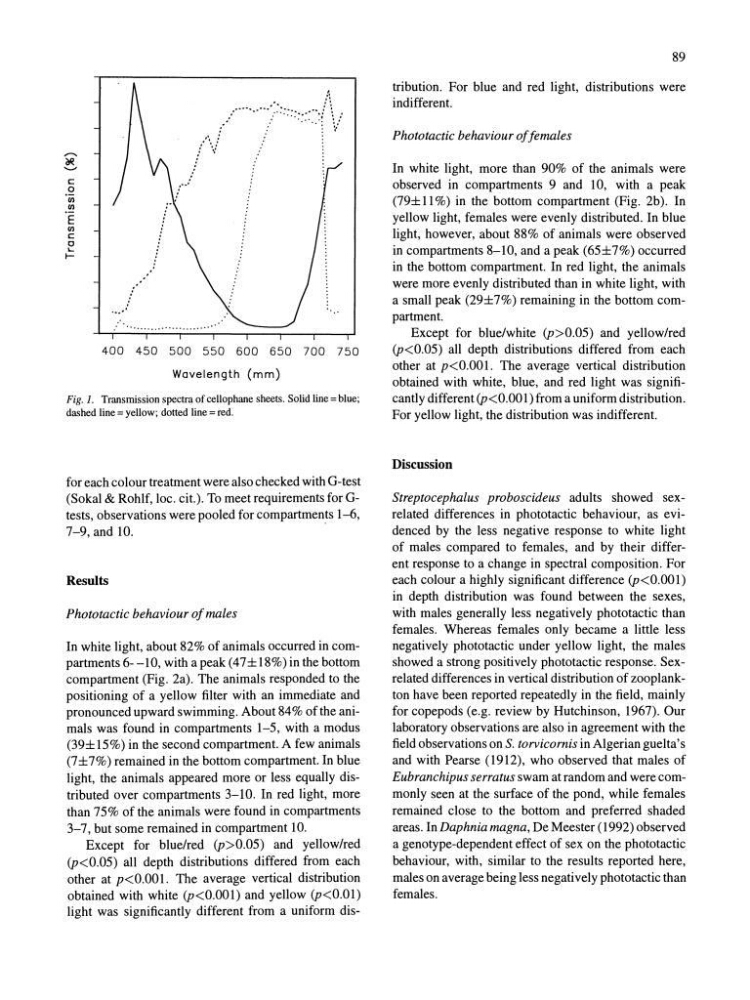
Fig. 1. Transmission spectra of cellophane sheets. Solid line = blue;
dashed line = yellow; dotted line = red.
for each colour treatment were also checked with G-test
(Sokal & Rohlf, loco cit.). To meet requirements for Gtests, observations were pooled for compartments 1-6,
7-9, and 10.
Results
Phototactic behaviour of males
In white light, about 82% of animals occurred in compartments 6- -10, with a peak (47±18%) in the bottom
compartment (Fig. 2a). The animals responded to the
positioning of a yellow filter with an immediate and
pronounced upward swimming. About 84% of the animals was found in compartments 1-5, with a modus
(39± 15%) in the second compartment. A few animals
(7±7%) remained in the bottom compartment. In blue
light, the animals appeared more or less equally distributed over compartments 3-10. In red light, more
than 75% of the animals were found in compartments
3-7, but some remained in compartment 10.
Except for bluelred (p>0.05) and yellow/red
(p<0.05) all depth distributions differed from each
other at p
light was significantly different from a uniform dis89
tribution. For blue and red light, distributions were
indifferent.
Phototactic behaviour offemales
In white light, more than 90% of the animals were
observed in compartments 9 and 10, with a peak
(79±11%) in the bottom compartment (Fig. 2b). In
yellow light, females were evenly distributed. In blue
light, however, about 88% of animals were observed
in compartments 8-10, and a peak (65±7%) occurred
in the bottom compartment. In red light, the animals
were more evenly distributed than in white light, with
a small peak (29±7%) remaining in the bottom compartment.
Except for blue/white (p>0.05) and yellow/red
(p<0.05) all depth distributions differed from each
other at p
For yellow light, the distribution was indifferent.
Discussiou
Streptocephalus proboscideus adults showed sexrelated differences in phototactic behaviour, as evidenced by the less negative response to white light
of males compared to females, and by their different response to a change in spectral composition. For
each colour a highly significant difference (p<0.001)
in depth distribution was found between the sexes,
with males generally less negatively phototactic than
females. Whereas females only became a little less
negatively phototactic under yellow light, the males
showed a strong positively phototactic response. Sexrelated differences in vertical distribution of zooplankton have been reported repeatedly in the field, mainly
for copepods (e.g. review by Hutchinson, 1967). Our
laboratory observations are also in agreement with the
field observations on S. torvicornis in Algerian guelta's
and with Pearse (1912), who observed that males of
Eubranchipus serratus swam at random and were commonly seen at the surface of the pond, while females
remained close to the bottom and preferred shaded
areas. In Daphnia magna, De Meester (1992) observed
a genotype-dependent effect of sex on the phototactic
behaviour, with, similar to the results reported here,
males on average being less negatively phototactic than
females.
o
'iii
Ul
E
Ul
c
o
t/'\/
:,' .. '
. . . . . . . . . . . . . . . . . . . . . . . . .
400 450 500 550 600 650 700 750
Wavelength (mm)
Fig. 1. Transmission spectra of cellophane sheets. Solid line = blue;
dashed line = yellow; dotted line = red.
for each colour treatment were also checked with G-test
(Sokal & Rohlf, loco cit.). To meet requirements for Gtests, observations were pooled for compartments 1-6,
7-9, and 10.
Results
Phototactic behaviour of males
In white light, about 82% of animals occurred in compartments 6- -10, with a peak (47±18%) in the bottom
compartment (Fig. 2a). The animals responded to the
positioning of a yellow filter with an immediate and
pronounced upward swimming. About 84% of the animals was found in compartments 1-5, with a modus
(39± 15%) in the second compartment. A few animals
(7±7%) remained in the bottom compartment. In blue
light, the animals appeared more or less equally distributed over compartments 3-10. In red light, more
than 75% of the animals were found in compartments
3-7, but some remained in compartment 10.
Except for bluelred (p>0.05) and yellow/red
(p<0.05) all depth distributions differed from each
other at p
light was significantly different from a uniform dis89
tribution. For blue and red light, distributions were
indifferent.
Phototactic behaviour offemales
In white light, more than 90% of the animals were
observed in compartments 9 and 10, with a peak
(79±11%) in the bottom compartment (Fig. 2b). In
yellow light, females were evenly distributed. In blue
light, however, about 88% of animals were observed
in compartments 8-10, and a peak (65±7%) occurred
in the bottom compartment. In red light, the animals
were more evenly distributed than in white light, with
a small peak (29±7%) remaining in the bottom compartment.
Except for blue/white (p>0.05) and yellow/red
(p<0.05) all depth distributions differed from each
other at p
For yellow light, the distribution was indifferent.
Discussiou
Streptocephalus proboscideus adults showed sexrelated differences in phototactic behaviour, as evidenced by the less negative response to white light
of males compared to females, and by their different response to a change in spectral composition. For
each colour a highly significant difference (p<0.001)
in depth distribution was found between the sexes,
with males generally less negatively phototactic than
females. Whereas females only became a little less
negatively phototactic under yellow light, the males
showed a strong positively phototactic response. Sexrelated differences in vertical distribution of zooplankton have been reported repeatedly in the field, mainly
for copepods (e.g. review by Hutchinson, 1967). Our
laboratory observations are also in agreement with the
field observations on S. torvicornis in Algerian guelta's
and with Pearse (1912), who observed that males of
Eubranchipus serratus swam at random and were commonly seen at the surface of the pond, while females
remained close to the bottom and preferred shaded
areas. In Daphnia magna, De Meester (1992) observed
a genotype-dependent effect of sex on the phototactic
behaviour, with, similar to the results reported here,
males on average being less negatively phototactic than
females.