

85
800
•
I
600
0
.....
~
...J
0
0:::
UJ
•
a.. <100
C/)
(!)
(!)
UJ
u..
0
200
=It
HERMAPHRODITE SIZE (mm)
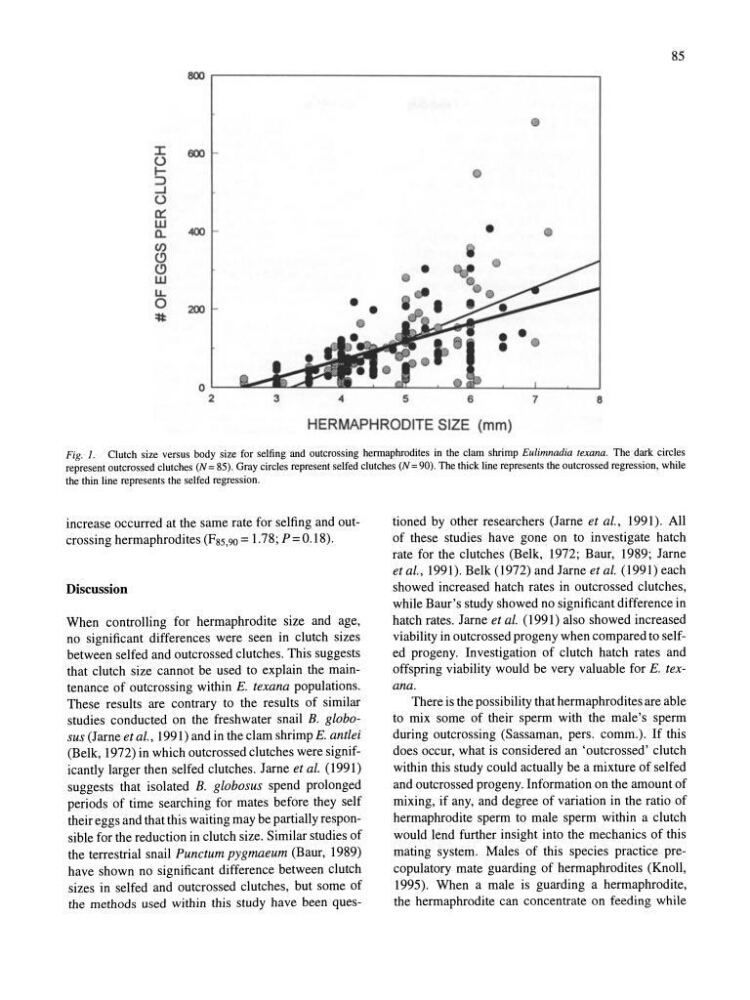
Fig. 1. Clutch size versus body size for selling and outcrossing hermaphrodites in the clam shrimp Eulimnadia texana. The dark circles
represent outcrossed clutches (N = 85). Gray circles represent selfed clutches (N = 90). The thick line represents the outcrossed regression, while
the thin line represents the selfed regression.
increase occurred at the same rate for selfing and outcrossing hermaphrodites (FS5 ,90 = 1.78; P = 0.18).
Discussion
When controlling for hermaphrodite size and age,
no significant differences were seen in clutch sizes
between selfed and outcrossed clutches. This suggests
that clutch size cannot be used to explain the maintenance of outcrossing within E. texana populations.
These results are contrary to the results of similar
studies conducted on the freshwater snail B. globosus (Jarne et aI. , 1991) and in the clam shrimp E. antlei
(Belk, 1972) in which outcrossed clutches were significantly larger then selfed clutches. Jarne et al. (1991)
suggests that isolated B. globosus spend prolonged
periods of time searching for mates before they self
their eggs and that this waiting may be partially responsible for the reduction in clutch size. Similar studies of
the terrestrial snail Punctum pygmaeum (Baur, 1989)
have shown no significant difference between clutch
sizes in selfed and outcrossed clutches, but some of
the methods used within this study have been questioned by other researchers (Jame et aI., 1991). All
of these studies have gone on to investigate hatch
rate for the clutches (Belk, 1972; Baur, 1989; Jarne
et aI., 1991). Belk (1972) and Jarne et al. (1991) each
showed increased hatch rates in outcrossed clutches,
while Baur's study showed no significant difference in
hatch rates. Jame et al. (1991) also showed increased
viability in outcrossed progeny when compared to selfed progeny. Investigation of clutch hatch rates and
offspring viability would be very valuable for E. texana.
There is the possibility that hermaphrodites are able
to mix some of their sperm with the male's sperm
during outcrossing (Sassaman, pers. comm.). If this
does occur, what is considered an 'outcrossed' clutch
within this study could actually be a mixture of selfed
and outcrossed progeny. Information on the amount of
mixing, if any, and degree of variation in the ratio of
hermaphrodite sperm to male sperm within a clutch
would lend further insight into the mechanics of this
mating system. Males of this species practice precopulatory mate guarding of hermaphrodites (Knoll,
1995). When a male is guarding a hermaphrodite,
the hermaphrodite can concentrate on feeding while
800
•
I
600
0
.....
~
...J
0
0:::
UJ
•
a.. <100
C/)
(!)
(!)
UJ
u..
0
200
=It
HERMAPHRODITE SIZE (mm)
Fig. 1. Clutch size versus body size for selling and outcrossing hermaphrodites in the clam shrimp Eulimnadia texana. The dark circles
represent outcrossed clutches (N = 85). Gray circles represent selfed clutches (N = 90). The thick line represents the outcrossed regression, while
the thin line represents the selfed regression.
increase occurred at the same rate for selfing and outcrossing hermaphrodites (FS5 ,90 = 1.78; P = 0.18).
Discussion
When controlling for hermaphrodite size and age,
no significant differences were seen in clutch sizes
between selfed and outcrossed clutches. This suggests
that clutch size cannot be used to explain the maintenance of outcrossing within E. texana populations.
These results are contrary to the results of similar
studies conducted on the freshwater snail B. globosus (Jarne et aI. , 1991) and in the clam shrimp E. antlei
(Belk, 1972) in which outcrossed clutches were significantly larger then selfed clutches. Jarne et al. (1991)
suggests that isolated B. globosus spend prolonged
periods of time searching for mates before they self
their eggs and that this waiting may be partially responsible for the reduction in clutch size. Similar studies of
the terrestrial snail Punctum pygmaeum (Baur, 1989)
have shown no significant difference between clutch
sizes in selfed and outcrossed clutches, but some of
the methods used within this study have been questioned by other researchers (Jame et aI., 1991). All
of these studies have gone on to investigate hatch
rate for the clutches (Belk, 1972; Baur, 1989; Jarne
et aI., 1991). Belk (1972) and Jarne et al. (1991) each
showed increased hatch rates in outcrossed clutches,
while Baur's study showed no significant difference in
hatch rates. Jame et al. (1991) also showed increased
viability in outcrossed progeny when compared to selfed progeny. Investigation of clutch hatch rates and
offspring viability would be very valuable for E. texana.
There is the possibility that hermaphrodites are able
to mix some of their sperm with the male's sperm
during outcrossing (Sassaman, pers. comm.). If this
does occur, what is considered an 'outcrossed' clutch
within this study could actually be a mixture of selfed
and outcrossed progeny. Information on the amount of
mixing, if any, and degree of variation in the ratio of
hermaphrodite sperm to male sperm within a clutch
would lend further insight into the mechanics of this
mating system. Males of this species practice precopulatory mate guarding of hermaphrodites (Knoll,
1995). When a male is guarding a hermaphrodite,
the hermaphrodite can concentrate on feeding while