

84
males (~40%) (Sassaman, 1989; Knoll, 1995). The
factors which allow these percentages of males to be
maintained despite low male viability and the cost
of outcrossing are currently unknown. Studies using
the freshwater hermaphroditic snail Bulinus giobosus
(larneetai., 1991) and the clam shrimpE. antiei (Belk,
1972) have shown that outcrossed clutches are significantly larger than selfed clutches. In the case of B. giobosus, individuals are all simultaneous hermaphrodites
(larne et ai., 1991), while E. antiei, once thought to be
parthenogenetic, is now known to exhibit a mating system similar to that of E. texana (Sassaman, 1988). The
present study seeks to look for similar differences in
clutch size in E. texana. If outcrossed clutches are larger than selfed clutches, it could potentially account for
the maintenance of outcrossing within populations.
Methods
Soil samples were taken from the LTER Playa population approximately 40 km NNE of Las Cruces, Dona
Ana County, New Mexico (for a detailed description of
the site see MacKay et ai., 1990). Laboratory populations were reared using the methods outlined in Knoll
(1994). Statistics were calculated using the computer
statistical package, Systat v5.03 (Systat Inc., Evanston,
Illinois). An a level of <0.05 is considered significant.
Selfed clutches were obtained by isolating a
haphazardly chosen, sexually mature, non-gravid
hermaphrodite in a plastic 'dixie' cup with 125 ml
of aged tap water. Eggs were usually evident within
the dorsal brood chamber of the hermaphrodite within a few hours of isolation and clutches were dropped
from the hermaphrodite in less than 24 hours (pers.
obs.). Therefore, any eggs in the cup 24 hours after
isolation were presumed to be selfed progeny from a
single clutch and were collected and counted. Since the
hermaphrodite molts just prior to each clutch production (Knoll, 1995), it is unlikely that sperm are stored
from previous outcrossings.
For outcrossed clutches, a haphazardly chosen, sexually mature, non-gravid hermaphrodite was isolated
with a sexually mature male in a plastic 'dixie' cup
with 125 ml of aged tap water. The pair was constantly
monitored until outcrossing occurred. For a detailed
description of outcrossing behavior see Knoll (1995).
The male was removed immediately after outcrossing;
the hermaphrodite was left undisturbed in the cup for
24 hours. At the end of the isolation period, the eggs in
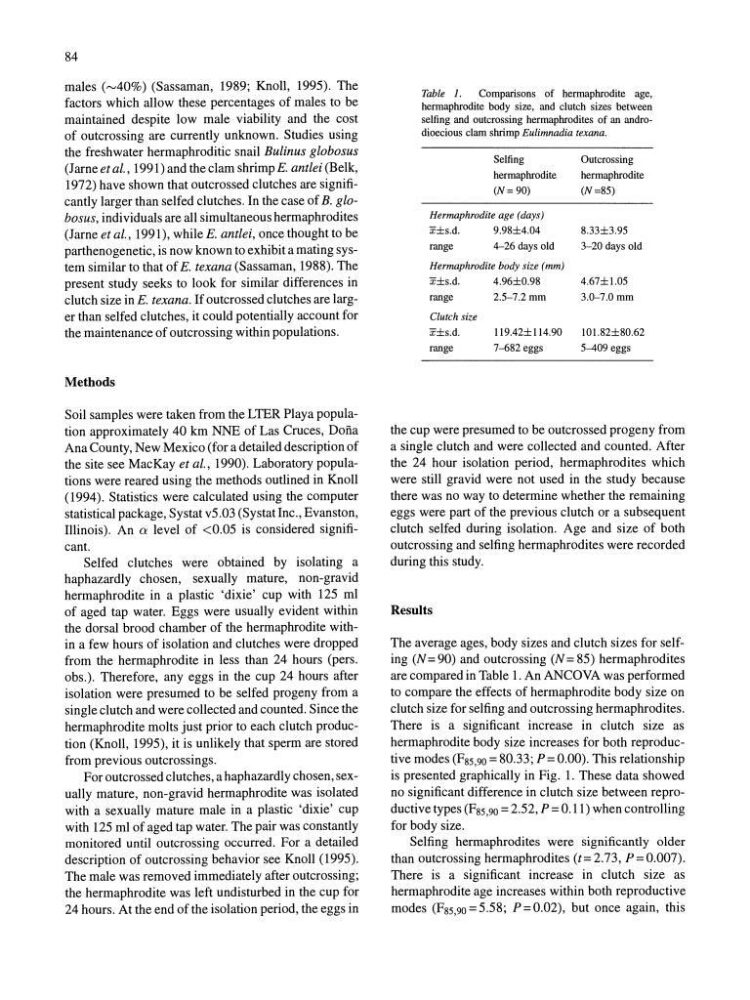
Table 1.
Comparisons of hermaphrodite age,
hermaphrodite body size, and clutch sizes between
selling and outcrossing hermaphrodites of an androdioecious clam shrimp Eulimnadia texana.
Selling
Outcrossing
hermaphrodite
hermaphrodite
(N= 90)
(N =85)
Hermaphrodite age (days)
x±s.d.
9.98±4.04
8.33±3.95
range
4-26 days old
3-20 days old
Hermaphrodite body size (mm)
x±s.d.
4.96±0.98
4.67±1.05
range
2.5-7.2mm
3.0-7.0mm
Clutch size
x±s.d.
119.42±1l4.90
101.82±80.62
range
7-682 eggs
5-409 eggs
the cup were presumed to be outcrossed progeny from
a single clutch and were collected and counted. After
the 24 hour isolation period, hermaphrodites which
were still gravid were not used in the study because
there was no way to determine whether the remaining
eggs were part of the previous clutch or a subsequent
clutch selfed during isolation. Age and size of both
outcrossing and selfing hermaphrodites were recorded
during this study.
Results
The average ages, body sizes and clutch sizes for selfing (N = 90) and outcrossing (N = 85) hermaphrodites
are compared in Table 1. An ANCOVA was performed
to compare the effects of hermaphrodite body size on
clutch size for selfing and outcrossing hermaphrodites.
There is a significant increase in clutch size as
hermaphrodite body size increases for both reproductive modes (F85,9o = 80.33; P = 0.00). This relationship
is presented graphically in Fig. 1. These data showed
no significant difference in clutch size between reproductive types (F85 ,9o = 2.52, P = 0.11) when controlling
for body size.
Selfing hermaphrodites were significantly older
than outcrossing hermaphrodites U=2.73, P=0.007).
There is a significant increase in clutch size as
hermaphrodite age increases within both reproductive
modes (F85,90=5.58; P=0.02), but once again, this
males (~40%) (Sassaman, 1989; Knoll, 1995). The
factors which allow these percentages of males to be
maintained despite low male viability and the cost
of outcrossing are currently unknown. Studies using
the freshwater hermaphroditic snail Bulinus giobosus
(larneetai., 1991) and the clam shrimpE. antiei (Belk,
1972) have shown that outcrossed clutches are significantly larger than selfed clutches. In the case of B. giobosus, individuals are all simultaneous hermaphrodites
(larne et ai., 1991), while E. antiei, once thought to be
parthenogenetic, is now known to exhibit a mating system similar to that of E. texana (Sassaman, 1988). The
present study seeks to look for similar differences in
clutch size in E. texana. If outcrossed clutches are larger than selfed clutches, it could potentially account for
the maintenance of outcrossing within populations.
Methods
Soil samples were taken from the LTER Playa population approximately 40 km NNE of Las Cruces, Dona
Ana County, New Mexico (for a detailed description of
the site see MacKay et ai., 1990). Laboratory populations were reared using the methods outlined in Knoll
(1994). Statistics were calculated using the computer
statistical package, Systat v5.03 (Systat Inc., Evanston,
Illinois). An a level of <0.05 is considered significant.
Selfed clutches were obtained by isolating a
haphazardly chosen, sexually mature, non-gravid
hermaphrodite in a plastic 'dixie' cup with 125 ml
of aged tap water. Eggs were usually evident within
the dorsal brood chamber of the hermaphrodite within a few hours of isolation and clutches were dropped
from the hermaphrodite in less than 24 hours (pers.
obs.). Therefore, any eggs in the cup 24 hours after
isolation were presumed to be selfed progeny from a
single clutch and were collected and counted. Since the
hermaphrodite molts just prior to each clutch production (Knoll, 1995), it is unlikely that sperm are stored
from previous outcrossings.
For outcrossed clutches, a haphazardly chosen, sexually mature, non-gravid hermaphrodite was isolated
with a sexually mature male in a plastic 'dixie' cup
with 125 ml of aged tap water. The pair was constantly
monitored until outcrossing occurred. For a detailed
description of outcrossing behavior see Knoll (1995).
The male was removed immediately after outcrossing;
the hermaphrodite was left undisturbed in the cup for
24 hours. At the end of the isolation period, the eggs in
Table 1.
Comparisons of hermaphrodite age,
hermaphrodite body size, and clutch sizes between
selling and outcrossing hermaphrodites of an androdioecious clam shrimp Eulimnadia texana.
Selling
Outcrossing
hermaphrodite
hermaphrodite
(N= 90)
(N =85)
Hermaphrodite age (days)
x±s.d.
9.98±4.04
8.33±3.95
range
4-26 days old
3-20 days old
Hermaphrodite body size (mm)
x±s.d.
4.96±0.98
4.67±1.05
range
2.5-7.2mm
3.0-7.0mm
Clutch size
x±s.d.
119.42±1l4.90
101.82±80.62
range
7-682 eggs
5-409 eggs
the cup were presumed to be outcrossed progeny from
a single clutch and were collected and counted. After
the 24 hour isolation period, hermaphrodites which
were still gravid were not used in the study because
there was no way to determine whether the remaining
eggs were part of the previous clutch or a subsequent
clutch selfed during isolation. Age and size of both
outcrossing and selfing hermaphrodites were recorded
during this study.
Results
The average ages, body sizes and clutch sizes for selfing (N = 90) and outcrossing (N = 85) hermaphrodites
are compared in Table 1. An ANCOVA was performed
to compare the effects of hermaphrodite body size on
clutch size for selfing and outcrossing hermaphrodites.
There is a significant increase in clutch size as
hermaphrodite body size increases for both reproductive modes (F85,9o = 80.33; P = 0.00). This relationship
is presented graphically in Fig. 1. These data showed
no significant difference in clutch size between reproductive types (F85 ,9o = 2.52, P = 0.11) when controlling
for body size.
Selfing hermaphrodites were significantly older
than outcrossing hermaphrodites U=2.73, P=0.007).
There is a significant increase in clutch size as
hermaphrodite age increases within both reproductive
modes (F85,90=5.58; P=0.02), but once again, this