

ization occurred or the interaction ended. Sperm transfer and fertilization were assumed to have occurred
when the clasping male began to thrust his body up
into the hermaphrodite's carapace and the eggs moved
from the ovary up into the brood chamber. Selfing
was assumed to have occurred when the hermaphrodite
remained motionless on the bottom of the cup and the
eggs moved into the brood chamber with no intervention from either of the males. For detailed descriptions
of both outcrossing and selfing see Knoll (1994).
A test for male intersexual selection and
hermaphrodite intrasexual selection
Two sexually mature non-gravid hermaphrodites with
carapace diameters of at least a 0.5 mm difference were
placed with a sexually mature male of a random size.
The trio was measured, isolated and observed in the
same manner outlined above. Once again, observations
lasted for two hours or until fertilization occurred in
one of the two hermaphrodites. The methods for determining outcrossing and selfing were also the same.
Analysis
For statistical procedures, an a level <0.05 is considered significant throughout this study.
Results
Hermaphrodite intersexual selection and male
intrasexual selection
In the study population, hermaphrodite carapace length
ranged from 3.0 mm to 7.0 mm and males from 3.0 mm
to 6.5 mm. The average size difference between the
pairs of males in this study was 1.45 mm. In 29
observations (58%), no fertilization occurred and it
is assumed that the hermaphrodite was not receptive
for the duration of the observation period. The results
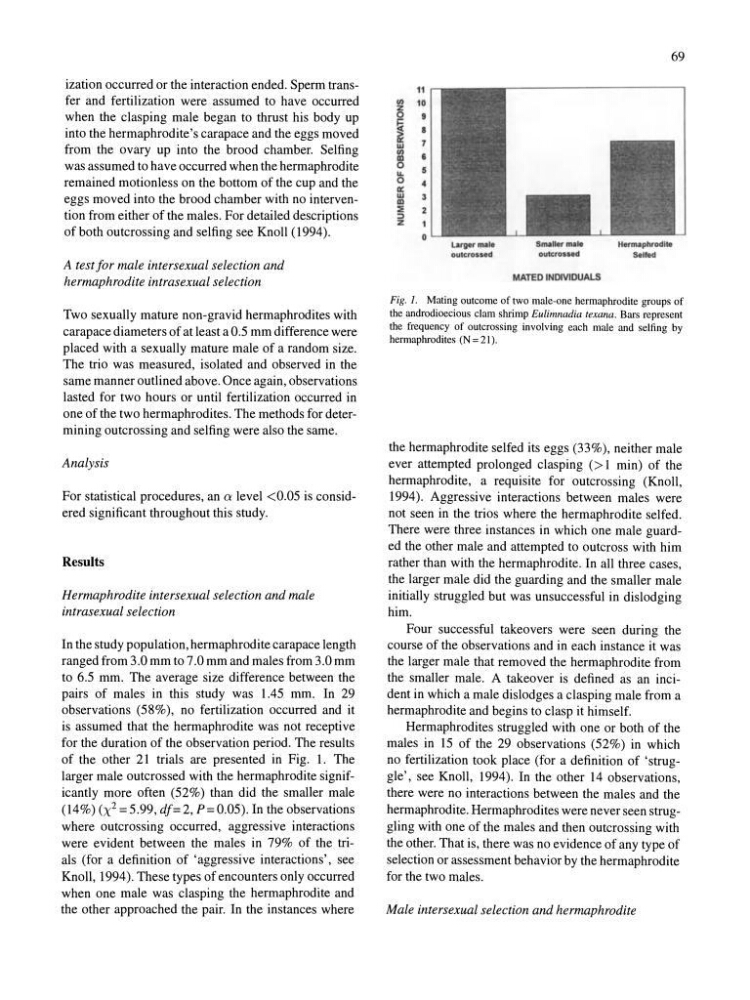
of the other 21 trials are presented in Fig. 1. The
larger male outcrossed with the hermaphrodite significantly more often (52%) than did the smaller male
(14%) (X 2 = 5.99, df= 2, P= 0.05). In the observations
where outcrossing occurred, aggressive interactions
were evident between the males in 79% of the trials (for a definition of 'aggressive interactions', see
Knoll, 1994). These types of encounters only occurred
when one male was clasping the hermaphrodite and
the other approached the pair. In the instances where
69
11
III
10
Z
0
9
Ii 8
~
7
w
l3 6
0
5
... 0 4
II:
w
3
III
:;:
:::l
2
Z
1
0
Larger ml'"
Smilier mile
Hormoph,odlle
oul' cro •• ed
oulcrOlled
Sollod
MATED INDIVIDUALS
Fig. 1. Mating outcome of two male-one hermaphrodite groups of
the androdioecious clam shrimp Eulimnadia texana. Bars represent
the frequency of outcrossing involving each male and selfing by
hermaphrodites (N = 21).
the hermaphrodite selfed its eggs (33%), neither male
ever attempted prolonged clasping (> 1 min) of the
hermaphrodite, a requisite for outcrossing (Knoll,
1994). Aggressive interactions between males were
not seen in the trios where the hermaphrodite selfed.
There were three instances in which one male guarded the other male and attempted to outcross with him
rather than with the hermaphrodite. In all three cases,
the larger male did the guarding and the smaller male
initially struggled but was unsuccessful in dislodging
him.
Four successful takeovers were seen during the
course of the observations and in each instance it was
the larger male that removed the hermaphrodite from
the smaller male. A takeover is defined as an incident in which a male dislodges a clasping male from a
hermaphrodite and begins to clasp it himself.
Hermaphrodites struggled with one or both of the
males in 15 of the 29 observations (52%) in which
no fertilization took place (for a definition of 'struggle', see Knoll, 1994). In the other 14 observations,
there were no interactions between the males and the
hermaphrodite. Hermaphrodites were never seen struggling with one of the males and then outcrossing with
the other. That is, there was no evidence of any type of
selection or assessment behavior by the hermaphrodite
for the two males.
Male intersexual selection and hermaphrodite
when the clasping male began to thrust his body up
into the hermaphrodite's carapace and the eggs moved
from the ovary up into the brood chamber. Selfing
was assumed to have occurred when the hermaphrodite
remained motionless on the bottom of the cup and the
eggs moved into the brood chamber with no intervention from either of the males. For detailed descriptions
of both outcrossing and selfing see Knoll (1994).
A test for male intersexual selection and
hermaphrodite intrasexual selection
Two sexually mature non-gravid hermaphrodites with
carapace diameters of at least a 0.5 mm difference were
placed with a sexually mature male of a random size.
The trio was measured, isolated and observed in the
same manner outlined above. Once again, observations
lasted for two hours or until fertilization occurred in
one of the two hermaphrodites. The methods for determining outcrossing and selfing were also the same.
Analysis
For statistical procedures, an a level <0.05 is considered significant throughout this study.
Results
Hermaphrodite intersexual selection and male
intrasexual selection
In the study population, hermaphrodite carapace length
ranged from 3.0 mm to 7.0 mm and males from 3.0 mm
to 6.5 mm. The average size difference between the
pairs of males in this study was 1.45 mm. In 29
observations (58%), no fertilization occurred and it
is assumed that the hermaphrodite was not receptive
for the duration of the observation period. The results
of the other 21 trials are presented in Fig. 1. The
larger male outcrossed with the hermaphrodite significantly more often (52%) than did the smaller male
(14%) (X 2 = 5.99, df= 2, P= 0.05). In the observations
where outcrossing occurred, aggressive interactions
were evident between the males in 79% of the trials (for a definition of 'aggressive interactions', see
Knoll, 1994). These types of encounters only occurred
when one male was clasping the hermaphrodite and
the other approached the pair. In the instances where
69
11
III
10
Z
0
9
Ii 8
~
7
w
l3 6
0
5
... 0 4
II:
w
3
III
:;:
:::l
2
Z
1
0
Larger ml'"
Smilier mile
Hormoph,odlle
oul' cro •• ed
oulcrOlled
Sollod
MATED INDIVIDUALS
Fig. 1. Mating outcome of two male-one hermaphrodite groups of
the androdioecious clam shrimp Eulimnadia texana. Bars represent
the frequency of outcrossing involving each male and selfing by
hermaphrodites (N = 21).
the hermaphrodite selfed its eggs (33%), neither male
ever attempted prolonged clasping (> 1 min) of the
hermaphrodite, a requisite for outcrossing (Knoll,
1994). Aggressive interactions between males were
not seen in the trios where the hermaphrodite selfed.
There were three instances in which one male guarded the other male and attempted to outcross with him
rather than with the hermaphrodite. In all three cases,
the larger male did the guarding and the smaller male
initially struggled but was unsuccessful in dislodging
him.
Four successful takeovers were seen during the
course of the observations and in each instance it was
the larger male that removed the hermaphrodite from
the smaller male. A takeover is defined as an incident in which a male dislodges a clasping male from a
hermaphrodite and begins to clasp it himself.
Hermaphrodites struggled with one or both of the
males in 15 of the 29 observations (52%) in which
no fertilization took place (for a definition of 'struggle', see Knoll, 1994). In the other 14 observations,
there were no interactions between the males and the
hermaphrodite. Hermaphrodites were never seen struggling with one of the males and then outcrossing with
the other. That is, there was no evidence of any type of
selection or assessment behavior by the hermaphrodite
for the two males.
Male intersexual selection and hermaphrodite