

311
D~
F ~
2mm
A Be
1 mm
DEFGH
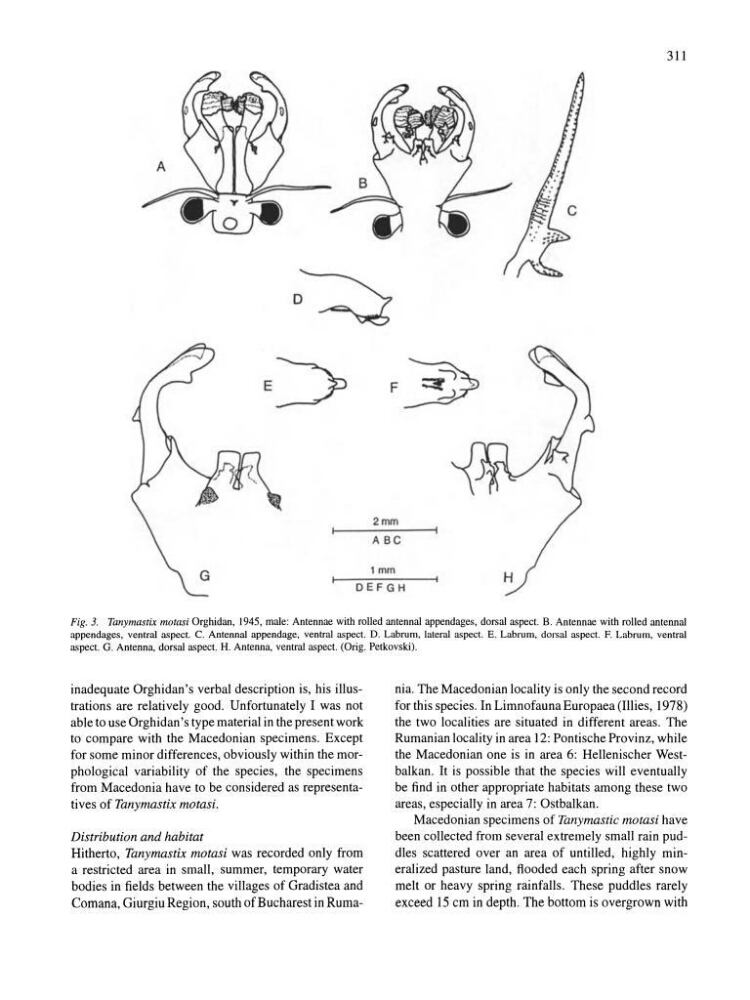
Fig. 3. Tanymastix motasi Orghidan, 1945, male: Antennae with rolled antennal appendages, dorsal aspect. B. Antennae with rolled antenna!
appendages, ventra! aspect. C. Antennal appendage, ventral aspect. D. Labrum, lateral aspect. E. Labrum, dorsal aspect. F. Labrum, ventral
aspect. G. Antenna, dorsal aspect. H. Antenna, ventral aspect. (Orig. Petkovski).
inadequate Orghidan's verbal description is, his illustrations are relatively good. Unfortunately I was not
able to use Orghidan's type material in the present work
to compare with the Macedonian specimens. Except
for some minor differences, obviously within the morphological variability of the species, the specimens
from Macedonia have to be considered as representatives of Tanymastix motasi.
Distribution and habitat
Hitherto, Tanymastix motasi was recorded only from
a restricted area in small, summer, temporary water
bodies in fields between the villages of Gradistea and
Comana, Giurgiu Region, south of Bucharest in Rumania. The Macedonian locality is only the second record
for this species. In Limnofauna Europaea (Illies, 1978)
the two localities are situated in different areas. The
Rumanian locality in area 12: Pontische Provinz, while
the Macedonian one is in area 6: Hellenischer Westbalkan. It is possible that the species will eventually
be find in other appropriate habitats among these two
areas, especially in area 7: Ostbalkan.
Macedonian specimens of Tanymastic motasi have
been collected from several extremely small rain puddles scattered over an area of untilled, highly mineralized pasture land, flooded each spring after snow
melt or heavy spring rainfalls. These puddles rarely
exceed 15 cm in depth . The bottom is overgrown with
D~
F ~
2mm
A Be
1 mm
DEFGH
Fig. 3. Tanymastix motasi Orghidan, 1945, male: Antennae with rolled antennal appendages, dorsal aspect. B. Antennae with rolled antenna!
appendages, ventra! aspect. C. Antennal appendage, ventral aspect. D. Labrum, lateral aspect. E. Labrum, dorsal aspect. F. Labrum, ventral
aspect. G. Antenna, dorsal aspect. H. Antenna, ventral aspect. (Orig. Petkovski).
inadequate Orghidan's verbal description is, his illustrations are relatively good. Unfortunately I was not
able to use Orghidan's type material in the present work
to compare with the Macedonian specimens. Except
for some minor differences, obviously within the morphological variability of the species, the specimens
from Macedonia have to be considered as representatives of Tanymastix motasi.
Distribution and habitat
Hitherto, Tanymastix motasi was recorded only from
a restricted area in small, summer, temporary water
bodies in fields between the villages of Gradistea and
Comana, Giurgiu Region, south of Bucharest in Rumania. The Macedonian locality is only the second record
for this species. In Limnofauna Europaea (Illies, 1978)
the two localities are situated in different areas. The
Rumanian locality in area 12: Pontische Provinz, while
the Macedonian one is in area 6: Hellenischer Westbalkan. It is possible that the species will eventually
be find in other appropriate habitats among these two
areas, especially in area 7: Ostbalkan.
Macedonian specimens of Tanymastic motasi have
been collected from several extremely small rain puddles scattered over an area of untilled, highly mineralized pasture land, flooded each spring after snow
melt or heavy spring rainfalls. These puddles rarely
exceed 15 cm in depth . The bottom is overgrown with