

276
S P I N I C A U D A T A
LIMNADIIDAE
IMNADIA : 0 YEYETTA
LIMNADIA : .
LENTICULARIS
L A E V I C A U D A T A
LYNCEIDAE
LYNCEUS : • ANDRONACHENSIS
• BRACHWRUS
•
.'
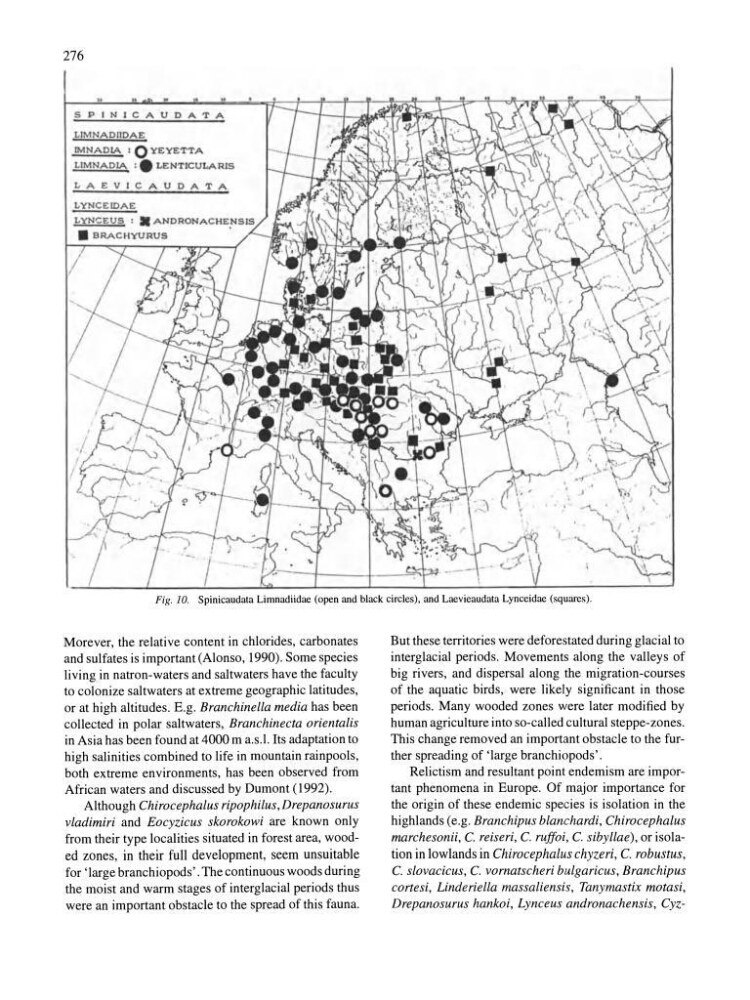
Fig. 10. Spinicaudata Limnadiidae (open and black circles), and Laevieaudata Lynceidae (squares).
Morever, the relative content in chlorides, carbonates
and sulfates is important (Alonso, 1990). Some species
living in natron-waters and saltwaters have the faculty
to colonize saltwaters at extreme geographic latitudes,
or at high altitudes. E.g. Branchinella media has been
collected in polar saltwaters, Branchinecta orientalis
in Asia has been found at 4000 m a.s.1. Its adaptation to
high salinities combined to life in mountain rainpools,
both extreme environments, has been observed from
African waters and discussed by Dumont (1992).
Although Chirocephalus ripophilus, Drepanosurus
vladimiri and Eocyzicus skorokowi are known only
from their type localities situated in forest area, wooded zones, in their full development, seem unsuitable
for' large branchiopods' . The continuous woods during
the moist and warm stages of interglacial periods thus
were an important obstacle to the spread of this fauna.
But these territories were deforestated during glacial to
interglacial periods. Movements along the valleys of
big rivers, and dispersal along the migration-courses
of the aquatic birds, were likely significant in those
periods. Many wooded zones were later modified by
human agriculture into so-called cultural steppe-zones.
This change removed an important obstacle to the further spreading of 'large branchiopods'.
Relictism and resultant point endemism are important phenomena in Europe. Of major importance for
the origin of these endemic species is isolation in the
highlands (e.g. Branchipus blanchardi, Chirocephalus
marchesonii, C. reiseri, C. ruffoi, C. sibyllae), or isolation in lowlands in Chirocephalus chyzeri, C. robustus,
C. slovacicus, C. vornatscheri bulgaricus, Branchipus
cortesi, Linderiella massaliensis, Tanymastix motasi,
Drepanosurus hankoi, Lynceus andronachensis, Cyz-
S P I N I C A U D A T A
LIMNADIIDAE
IMNADIA : 0 YEYETTA
LIMNADIA : .
LENTICULARIS
L A E V I C A U D A T A
LYNCEIDAE
LYNCEUS : • ANDRONACHENSIS
• BRACHWRUS
•
.'
Fig. 10. Spinicaudata Limnadiidae (open and black circles), and Laevieaudata Lynceidae (squares).
Morever, the relative content in chlorides, carbonates
and sulfates is important (Alonso, 1990). Some species
living in natron-waters and saltwaters have the faculty
to colonize saltwaters at extreme geographic latitudes,
or at high altitudes. E.g. Branchinella media has been
collected in polar saltwaters, Branchinecta orientalis
in Asia has been found at 4000 m a.s.1. Its adaptation to
high salinities combined to life in mountain rainpools,
both extreme environments, has been observed from
African waters and discussed by Dumont (1992).
Although Chirocephalus ripophilus, Drepanosurus
vladimiri and Eocyzicus skorokowi are known only
from their type localities situated in forest area, wooded zones, in their full development, seem unsuitable
for' large branchiopods' . The continuous woods during
the moist and warm stages of interglacial periods thus
were an important obstacle to the spread of this fauna.
But these territories were deforestated during glacial to
interglacial periods. Movements along the valleys of
big rivers, and dispersal along the migration-courses
of the aquatic birds, were likely significant in those
periods. Many wooded zones were later modified by
human agriculture into so-called cultural steppe-zones.
This change removed an important obstacle to the further spreading of 'large branchiopods'.
Relictism and resultant point endemism are important phenomena in Europe. Of major importance for
the origin of these endemic species is isolation in the
highlands (e.g. Branchipus blanchardi, Chirocephalus
marchesonii, C. reiseri, C. ruffoi, C. sibyllae), or isolation in lowlands in Chirocephalus chyzeri, C. robustus,
C. slovacicus, C. vornatscheri bulgaricus, Branchipus
cortesi, Linderiella massaliensis, Tanymastix motasi,
Drepanosurus hankoi, Lynceus andronachensis, Cyz-