

267
,.
• .-c."
ANOSTRACA
BRANCHIN£CTIDAE
: A F"EROX
,
I
I
\.
......... ~
\
'''--",- '
\
~
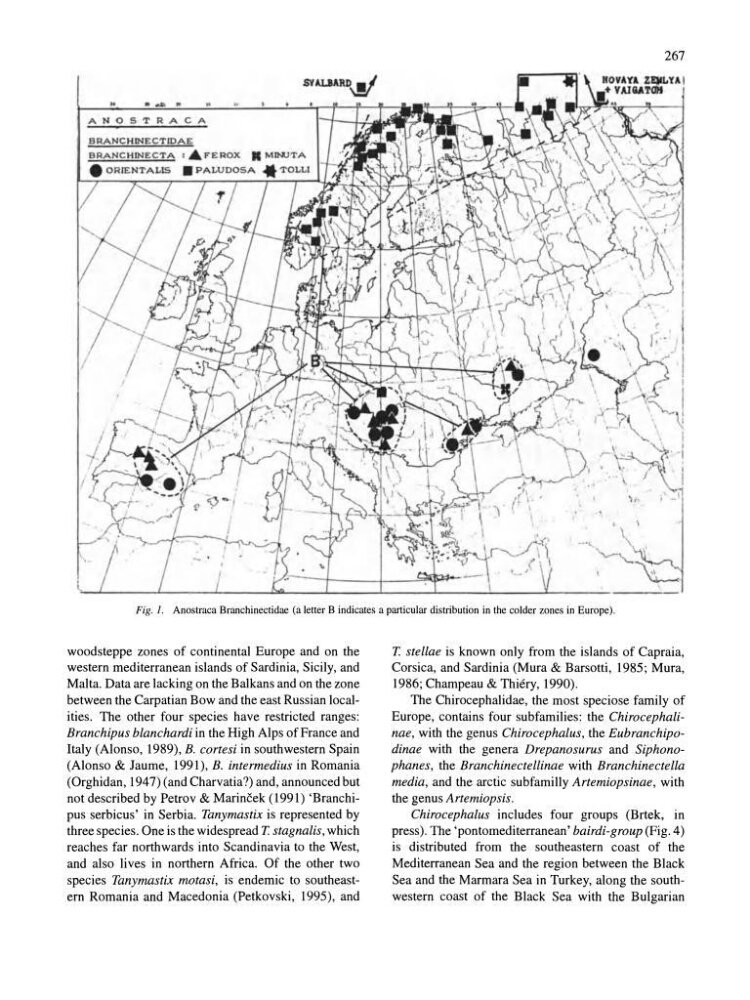
Fig. 1. Anostraca Branchinectidae (a letter B indicates a particular distribution in the colder zones in Europe).
woodsteppe zones of continental Europe and on the
western mediterranean islands of Sardinia, Sicily, and
Malta. Data are lacking on the Balkans and on the zone
between the Carpatian Bow and the east Russian localities. The other four species have restricted ranges:
Branchipus blanchardi in the High Alps of France and
Italy (Alonso, 1989), B. cortesi in southwestern Spain
(Alonso & Jaume, 1991), B. intermedius in Romania
(Orghidan, 1947) (and Charvatia?) and, announced but
not described by Petrov & Marincek (1991) ' Branchipus serbicus' in Serbia. Tanymastix is represented by
three species. One is the widespread T stagnalis, which
reaches far northwards into Scandinavia to the West,
and also lives in northern Africa. Of the other two
species Tanymastix motasi, is endemic to southeastern Romania and Macedonia (Petkovski, 1995), and
T stellae is known only from the islands of Capraia,
Corsica, and Sardinia (Mura & Barsotti, 1985; Mura,
1986; Champeau & Thiery, 1990).
The Chirocephalidae, the most speciose family of
Europe, contains four subfamilies: the Chirocephalinae, with the genus Chirocephalus, the Eubranchipodinae with the genera Drepanosurus and Siphonophanes, the Branchinectellinae with Branchinectella
media, and the arctic subfamilly Artemiopsinae, with
the genus Artemiopsis.
Chirocephalus includes four groups (Brtek, in
press). The 'pontomediterranean' bairdi-group (Fig. 4)
is distributed from the southeastern coast of the
Mediterranean Sea and the region between the Black
Sea and the Marmara Sea in Turkey, along the southwestern coast of the Black Sea with the Bulgarian
,.
• .-c."
ANOSTRACA
BRANCHIN£CTIDAE
: A F"EROX
,
I
I
\.
......... ~
\
'''--",- '
\
~
Fig. 1. Anostraca Branchinectidae (a letter B indicates a particular distribution in the colder zones in Europe).
woodsteppe zones of continental Europe and on the
western mediterranean islands of Sardinia, Sicily, and
Malta. Data are lacking on the Balkans and on the zone
between the Carpatian Bow and the east Russian localities. The other four species have restricted ranges:
Branchipus blanchardi in the High Alps of France and
Italy (Alonso, 1989), B. cortesi in southwestern Spain
(Alonso & Jaume, 1991), B. intermedius in Romania
(Orghidan, 1947) (and Charvatia?) and, announced but
not described by Petrov & Marincek (1991) ' Branchipus serbicus' in Serbia. Tanymastix is represented by
three species. One is the widespread T stagnalis, which
reaches far northwards into Scandinavia to the West,
and also lives in northern Africa. Of the other two
species Tanymastix motasi, is endemic to southeastern Romania and Macedonia (Petkovski, 1995), and
T stellae is known only from the islands of Capraia,
Corsica, and Sardinia (Mura & Barsotti, 1985; Mura,
1986; Champeau & Thiery, 1990).
The Chirocephalidae, the most speciose family of
Europe, contains four subfamilies: the Chirocephalinae, with the genus Chirocephalus, the Eubranchipodinae with the genera Drepanosurus and Siphonophanes, the Branchinectellinae with Branchinectella
media, and the arctic subfamilly Artemiopsinae, with
the genus Artemiopsis.
Chirocephalus includes four groups (Brtek, in
press). The 'pontomediterranean' bairdi-group (Fig. 4)
is distributed from the southeastern coast of the
Mediterranean Sea and the region between the Black
Sea and the Marmara Sea in Turkey, along the southwestern coast of the Black Sea with the Bulgarian