

different species compared with the large specimens
thriving sometimes in the contiguous surroundings, but
in more shadowed, larger and cooler ponds.
Family Metalimnadiidae (Paraimnadiidae)
Now some notes about Metalimnadia serratura, a
species that was first described by Mattox (1952) from
Venezuela from the banks of the Orinoco. I found this
species in the northeast corner of Colombia, inhabiting a special type of rock pool in the western extension of the Guiana Shield and described it in 1991 as
Paraimnadia guayanensis, (Roessler, 1991), as I was
not aware of Mattox's earlier description.
This species constitutes a special type of conchostracan with a series of morphological and physiological
features, which together, from my viewpoint, required
the establishment of a new taxonomic unit at the family level. This was also mentioned by Mattox (1952).
Since Straskraba (1965) already created the subfamily Metalimnadiidae, the proper name for the family I originally proposed (Roessler, 1991) is Metalimnadiidae. The distinctive features involve the valve
structure, the head morphology and some anatomical and reproductive details (comp. Mattox, 1952 and
Roessler, 1991).
Metalimnadia nevertheless is a form that seems
to be more related to the Limnadiidae and Imnadiidae than to other families. It shares with them general
characteristics of the head shape and telson. The head
is generally rounded in the three families, but only
the Limnadiidae possess the typical 'Scheitelorgan'
(nuchal organ). On the other hand, only the Imnadiidae show the occipital process as it is found in other
families and absent in Metalimnadiidae and Limnadiidae.
Additional features that distinguish Metalimnadiidae from other conchostracan families concern the
structure and the mode of growth of the carapace
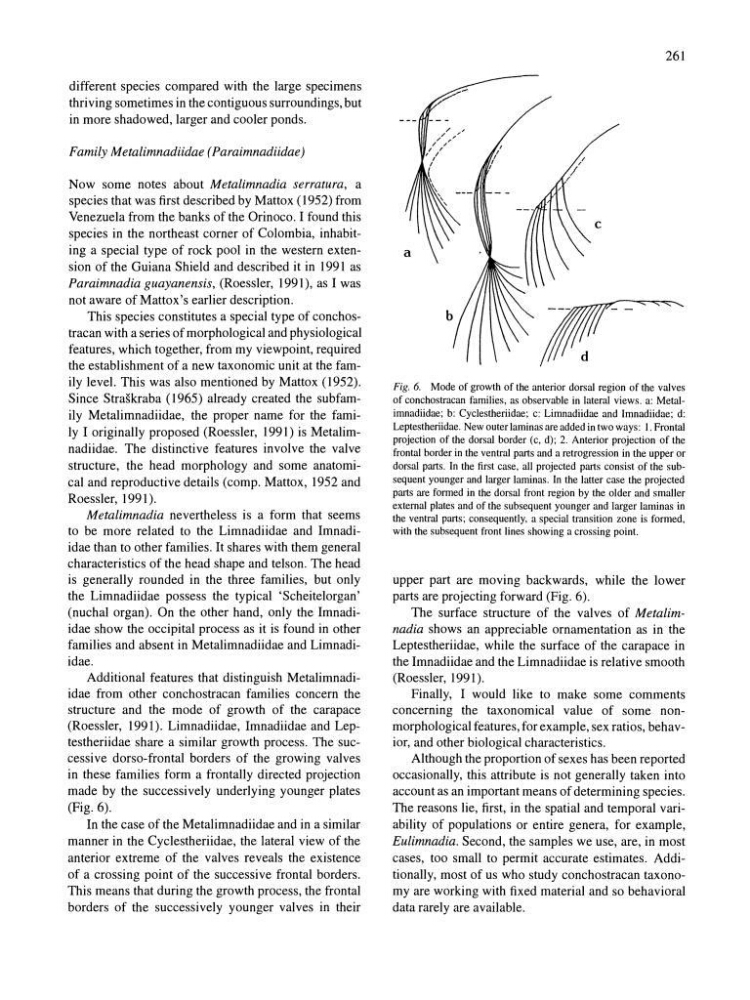
(Roessler, 1991). Limnadiidae, Imnadiidae and Leptestheriidae share a similar growth process. The successive dorso-frontal borders of the growing valves
in these families form a frontally directed projection
made by the successively underlying younger plates
(Fig. 6).
In the case of the Metalimnadiidae and in a similar
manner in the Cyclestheriidae, the lateral view of the
anterior extreme of the valves reveals the existence
of a crossing point of the successive frontal borders.
This means that during the growth process, the frontal
borders of the successively younger valves in their
261
Fig. 6. Mode of growth of the anterior dorsal region of the valves
of conchostracan families, as observable in lateral views. a: Metalimnadiidae; b: Cyclestheriidae; c: Limnadiidae and Imnadiidae; d:
Leptestheriidae. New outer laminas are added in two ways: I. Frontal
projection of the dorsal border (c. d); 2. Anterior projection of the
frontal border in the ventral parts and a retrogression in the upper or
dorsal parts. In the first case, all projected parts consist of the subsequent younger and larger laminas. In the latter case the projected
parts are formed in the dorsal front region by the older and smaller
external plates and of the subsequent younger and larger laminas in
the ventral parts; consequently, a special transition zone is formed,
with the subsequent front lines showing a crossing point.
upper part are moving backwards, while the lower
parts are projecting forward (Fig. 6).
The surface structure of the valves of Metalimnadia shows an appreciable ornamentation as in the
Leptestheriidae, while the surface of the carapace in
the Imnadiidae and the Limnadiidae is relative smooth
(Roessler, 1991).
Finally, I would like to make some comments
concerning the taxonomical value of some nonmorphological features, for example, sex ratios, behavior, and other biological characteristics.
Although the proportion of sexes has been reported
occasionally, this attribute is not generally taken into
account as an important means of determining species.
The reasons lie, first, in the spatial and temporal variability of populations or entire genera, for example,
Eulimnadia. Second, the samples we use, are, in most
cases, too small to permit accurate estimates. Additionally, most of us who study conchostracan taxonomy are working with fixed material and so behavioral
data rarely are available.
thriving sometimes in the contiguous surroundings, but
in more shadowed, larger and cooler ponds.
Family Metalimnadiidae (Paraimnadiidae)
Now some notes about Metalimnadia serratura, a
species that was first described by Mattox (1952) from
Venezuela from the banks of the Orinoco. I found this
species in the northeast corner of Colombia, inhabiting a special type of rock pool in the western extension of the Guiana Shield and described it in 1991 as
Paraimnadia guayanensis, (Roessler, 1991), as I was
not aware of Mattox's earlier description.
This species constitutes a special type of conchostracan with a series of morphological and physiological
features, which together, from my viewpoint, required
the establishment of a new taxonomic unit at the family level. This was also mentioned by Mattox (1952).
Since Straskraba (1965) already created the subfamily Metalimnadiidae, the proper name for the family I originally proposed (Roessler, 1991) is Metalimnadiidae. The distinctive features involve the valve
structure, the head morphology and some anatomical and reproductive details (comp. Mattox, 1952 and
Roessler, 1991).
Metalimnadia nevertheless is a form that seems
to be more related to the Limnadiidae and Imnadiidae than to other families. It shares with them general
characteristics of the head shape and telson. The head
is generally rounded in the three families, but only
the Limnadiidae possess the typical 'Scheitelorgan'
(nuchal organ). On the other hand, only the Imnadiidae show the occipital process as it is found in other
families and absent in Metalimnadiidae and Limnadiidae.
Additional features that distinguish Metalimnadiidae from other conchostracan families concern the
structure and the mode of growth of the carapace
(Roessler, 1991). Limnadiidae, Imnadiidae and Leptestheriidae share a similar growth process. The successive dorso-frontal borders of the growing valves
in these families form a frontally directed projection
made by the successively underlying younger plates
(Fig. 6).
In the case of the Metalimnadiidae and in a similar
manner in the Cyclestheriidae, the lateral view of the
anterior extreme of the valves reveals the existence
of a crossing point of the successive frontal borders.
This means that during the growth process, the frontal
borders of the successively younger valves in their
261
Fig. 6. Mode of growth of the anterior dorsal region of the valves
of conchostracan families, as observable in lateral views. a: Metalimnadiidae; b: Cyclestheriidae; c: Limnadiidae and Imnadiidae; d:
Leptestheriidae. New outer laminas are added in two ways: I. Frontal
projection of the dorsal border (c. d); 2. Anterior projection of the
frontal border in the ventral parts and a retrogression in the upper or
dorsal parts. In the first case, all projected parts consist of the subsequent younger and larger laminas. In the latter case the projected
parts are formed in the dorsal front region by the older and smaller
external plates and of the subsequent younger and larger laminas in
the ventral parts; consequently, a special transition zone is formed,
with the subsequent front lines showing a crossing point.
upper part are moving backwards, while the lower
parts are projecting forward (Fig. 6).
The surface structure of the valves of Metalimnadia shows an appreciable ornamentation as in the
Leptestheriidae, while the surface of the carapace in
the Imnadiidae and the Limnadiidae is relative smooth
(Roessler, 1991).
Finally, I would like to make some comments
concerning the taxonomical value of some nonmorphological features, for example, sex ratios, behavior, and other biological characteristics.
Although the proportion of sexes has been reported
occasionally, this attribute is not generally taken into
account as an important means of determining species.
The reasons lie, first, in the spatial and temporal variability of populations or entire genera, for example,
Eulimnadia. Second, the samples we use, are, in most
cases, too small to permit accurate estimates. Additionally, most of us who study conchostracan taxonomy are working with fixed material and so behavioral
data rarely are available.