

251
adu It
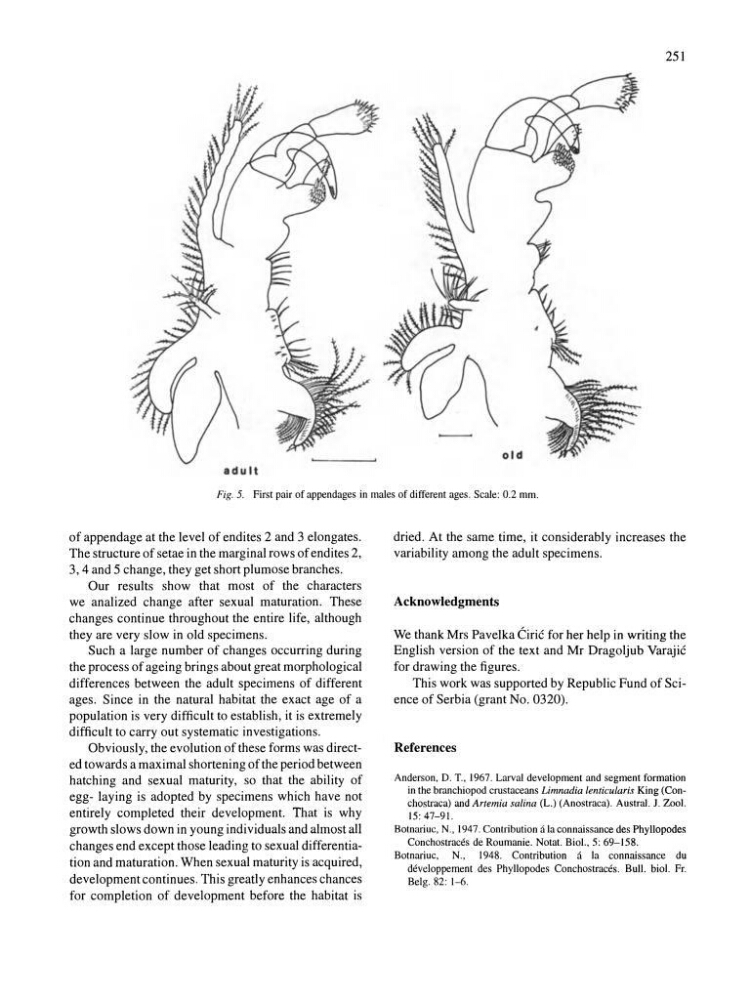
Fig. 5. First pair of appendages in males of different ages. Scale: 0.2 mm.
of appendage at the level of endites 2 and 3 elongates.
The structure of setae in the marginal rows of endites 2,
3,4 and 5 change, they get short plumose branches.
Our results show that most of the characters
we analized change after sexual maturation. These
changes continue throughout the entire life, although
they are very slow in old specimens.
Such a large number of changes occurring during
the process of ageing brings about great morphological
differences between the adult specimens of different
ages. Since in the natural habitat the exact age of a
population is very difficult to establish, it is extremely
difficult to carry out systematic investigations.
Obviously, the evolution of these forms was directed towards a maximal shortening of the period between
hatching and sexual maturity, so that the ability of
egg- laying is adopted by specimens which have not
entirely completed their development. That is why
growth slows down in young individuals and almost all
changes end except those leading to sexual differentiation and maturation. When sexual maturity is acquired,
development continues. This greatly enhances chances
for completion of development before the habitat is
dried. At the same time, it considerably increases the
variability among the adult specimens.
Acknowledgments
We thank Mrs Pavelka Ciric for her help in writing the
English version of the text and Mr Dragoljub Varajic
for drawing the figures.
This work was supported by Republic Fund of Science of Serbia (grant No. 0320).
References
Anderson, D. T., 1967. Larval development and segment formation
in the branchiopod crustaceans Limnadia lenticularis King (Conchostraca) and Artemia salina (L.) (Anostraca). Austral. J. Zoo!.
IS: 47-9J.
Botnariuc, N., 1947. Contribution ala connaissance des Phyllopodes
Conchostraces de Roumanie. Notal. BioI., 5: 69-158.
Botnariuc, N., 1948. Contribution a la connaissance du
developpement des Phyllopodes Conchostraces. Bull. bioI. Fr.
Belg. 82: 1-6.
adu It
Fig. 5. First pair of appendages in males of different ages. Scale: 0.2 mm.
of appendage at the level of endites 2 and 3 elongates.
The structure of setae in the marginal rows of endites 2,
3,4 and 5 change, they get short plumose branches.
Our results show that most of the characters
we analized change after sexual maturation. These
changes continue throughout the entire life, although
they are very slow in old specimens.
Such a large number of changes occurring during
the process of ageing brings about great morphological
differences between the adult specimens of different
ages. Since in the natural habitat the exact age of a
population is very difficult to establish, it is extremely
difficult to carry out systematic investigations.
Obviously, the evolution of these forms was directed towards a maximal shortening of the period between
hatching and sexual maturity, so that the ability of
egg- laying is adopted by specimens which have not
entirely completed their development. That is why
growth slows down in young individuals and almost all
changes end except those leading to sexual differentiation and maturation. When sexual maturity is acquired,
development continues. This greatly enhances chances
for completion of development before the habitat is
dried. At the same time, it considerably increases the
variability among the adult specimens.
Acknowledgments
We thank Mrs Pavelka Ciric for her help in writing the
English version of the text and Mr Dragoljub Varajic
for drawing the figures.
This work was supported by Republic Fund of Science of Serbia (grant No. 0320).
References
Anderson, D. T., 1967. Larval development and segment formation
in the branchiopod crustaceans Limnadia lenticularis King (Conchostraca) and Artemia salina (L.) (Anostraca). Austral. J. Zoo!.
IS: 47-9J.
Botnariuc, N., 1947. Contribution ala connaissance des Phyllopodes
Conchostraces de Roumanie. Notal. BioI., 5: 69-158.
Botnariuc, N., 1948. Contribution a la connaissance du
developpement des Phyllopodes Conchostraces. Bull. bioI. Fr.
Belg. 82: 1-6.