

242
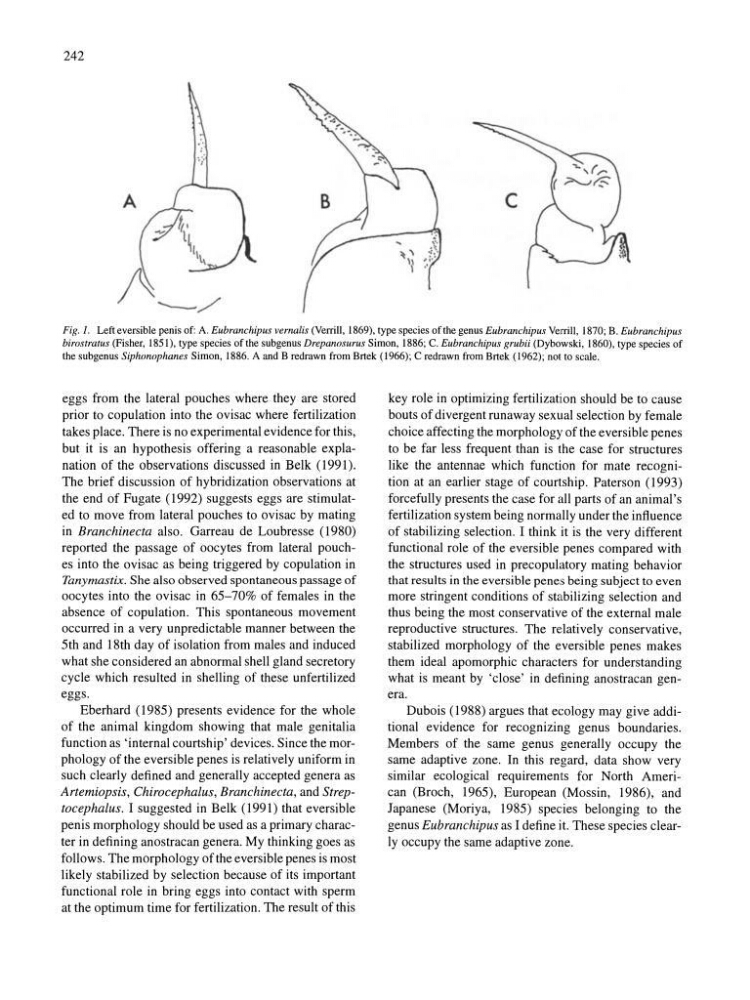
Fig. 1. Left eversible penis of: A. Eubranchipus vernalis (Verrill, 1869), type species ofthe genus Eubranchipus Verrill, 1870; B. Eubranchipus
birostratus (Fisher, 1851), type species of the subgenus Drepanosurus Simon, 1886; C. Eubranchipus grubii (Dybowski, 1860), type species of
the subgenus Siphonophanes Simon, 1886. A and B redrawn from Brtek (1966); C redrawn from Brtek (1962); not to scale.
eggs from the lateral pouches where they are stored
prior to copulation into the ovisac where fertilization
takes place. There is no experimental evidence for this,
but it is an hypothesis offering a reasonable explanation of the observations discussed in Belk (1991),
The brief discussion of hybridization observations at
the end of Fugate (1992) suggests eggs are stimulated to move from lateral pouches to ovisac by mating
in Branchinecta also. Garreau de Loubresse (1980)
reported the passage of oocytes from lateral pouches into the ovisac as being triggered by copulation in
Tanymastix. She also observed spontaneous passage of
oocytes into the ovisac in 65-70% of females in the
absence of copulation. This spontaneous movement
occurred in a very unpredictable manner between the
5th and 18th day of isolation from males and induced
what she considered an abnormal shell gland secretory
cycle which resulted in shelling of these unfertilized
eggs.
Eberhard (1985) presents evidence for the whole
of the animal kingdom showing that male genitalia
function as 'internal courtship' devices. Since the morphology of the eversible penes is relatively uniform in
such clearly defined and generally accepted genera as
Artemiopsis, Chirocephalus, Branchinecta, and Streptocephalus. I suggested in Belk (1991) that eversible
penis morphology should be used as a primary character in defining anostracan genera. My thinking goes as
follows. The morphology of the eversible penes is most
likely stabilized by selection because of its important
functional role in bring eggs into contact with sperm
at the optimum time for fertilization. The result of this
key role in optimizing fertilization should be to cause
bouts of divergent runaway sexual selection by female
choice affecting the morphology of the eversible penes
to be far less frequent than is the case for structures
like the antennae which function for mate recognition at an earlier stage of courtship. Paterson (1993)
forcefully presents the case for all parts of an animal's
fertilization system being normally under the influence
of stabilizing selection. I think it is the very different
functional role of the eversible penes compared with
the structures used in precopulatory mating behavior
that results in the eversible penes being subject to even
more stringent conditions of stabilizing selection and
thus being the most conservative of the external male
reproductive structures. The relatively conservative,
stabilized morphology of the eversible penes makes
them ideal apomorphic characters for understanding
what is meant by 'close' in defining anostracan genera.
Dubois (1988) argues that ecology may give additional evidence for recognizing genus boundaries.
Members of the same genus generally occupy the
same adaptive zone. In this regard, data show very
similar ecological requirements for North American (Broch, 1965), European (Mossin, 1986), and
Japanese (Moriya, 1985) species belonging to the
genus Eubranchipus as I define it. These species clearly occupy the same adaptive zone.
Fig. 1. Left eversible penis of: A. Eubranchipus vernalis (Verrill, 1869), type species ofthe genus Eubranchipus Verrill, 1870; B. Eubranchipus
birostratus (Fisher, 1851), type species of the subgenus Drepanosurus Simon, 1886; C. Eubranchipus grubii (Dybowski, 1860), type species of
the subgenus Siphonophanes Simon, 1886. A and B redrawn from Brtek (1966); C redrawn from Brtek (1962); not to scale.
eggs from the lateral pouches where they are stored
prior to copulation into the ovisac where fertilization
takes place. There is no experimental evidence for this,
but it is an hypothesis offering a reasonable explanation of the observations discussed in Belk (1991),
The brief discussion of hybridization observations at
the end of Fugate (1992) suggests eggs are stimulated to move from lateral pouches to ovisac by mating
in Branchinecta also. Garreau de Loubresse (1980)
reported the passage of oocytes from lateral pouches into the ovisac as being triggered by copulation in
Tanymastix. She also observed spontaneous passage of
oocytes into the ovisac in 65-70% of females in the
absence of copulation. This spontaneous movement
occurred in a very unpredictable manner between the
5th and 18th day of isolation from males and induced
what she considered an abnormal shell gland secretory
cycle which resulted in shelling of these unfertilized
eggs.
Eberhard (1985) presents evidence for the whole
of the animal kingdom showing that male genitalia
function as 'internal courtship' devices. Since the morphology of the eversible penes is relatively uniform in
such clearly defined and generally accepted genera as
Artemiopsis, Chirocephalus, Branchinecta, and Streptocephalus. I suggested in Belk (1991) that eversible
penis morphology should be used as a primary character in defining anostracan genera. My thinking goes as
follows. The morphology of the eversible penes is most
likely stabilized by selection because of its important
functional role in bring eggs into contact with sperm
at the optimum time for fertilization. The result of this
key role in optimizing fertilization should be to cause
bouts of divergent runaway sexual selection by female
choice affecting the morphology of the eversible penes
to be far less frequent than is the case for structures
like the antennae which function for mate recognition at an earlier stage of courtship. Paterson (1993)
forcefully presents the case for all parts of an animal's
fertilization system being normally under the influence
of stabilizing selection. I think it is the very different
functional role of the eversible penes compared with
the structures used in precopulatory mating behavior
that results in the eversible penes being subject to even
more stringent conditions of stabilizing selection and
thus being the most conservative of the external male
reproductive structures. The relatively conservative,
stabilized morphology of the eversible penes makes
them ideal apomorphic characters for understanding
what is meant by 'close' in defining anostracan genera.
Dubois (1988) argues that ecology may give additional evidence for recognizing genus boundaries.
Members of the same genus generally occupy the
same adaptive zone. In this regard, data show very
similar ecological requirements for North American (Broch, 1965), European (Mossin, 1986), and
Japanese (Moriya, 1985) species belonging to the
genus Eubranchipus as I define it. These species clearly occupy the same adaptive zone.