

8
g)
c)
a)
ex
proximal endite I coxa
basipod
endopod
exopod
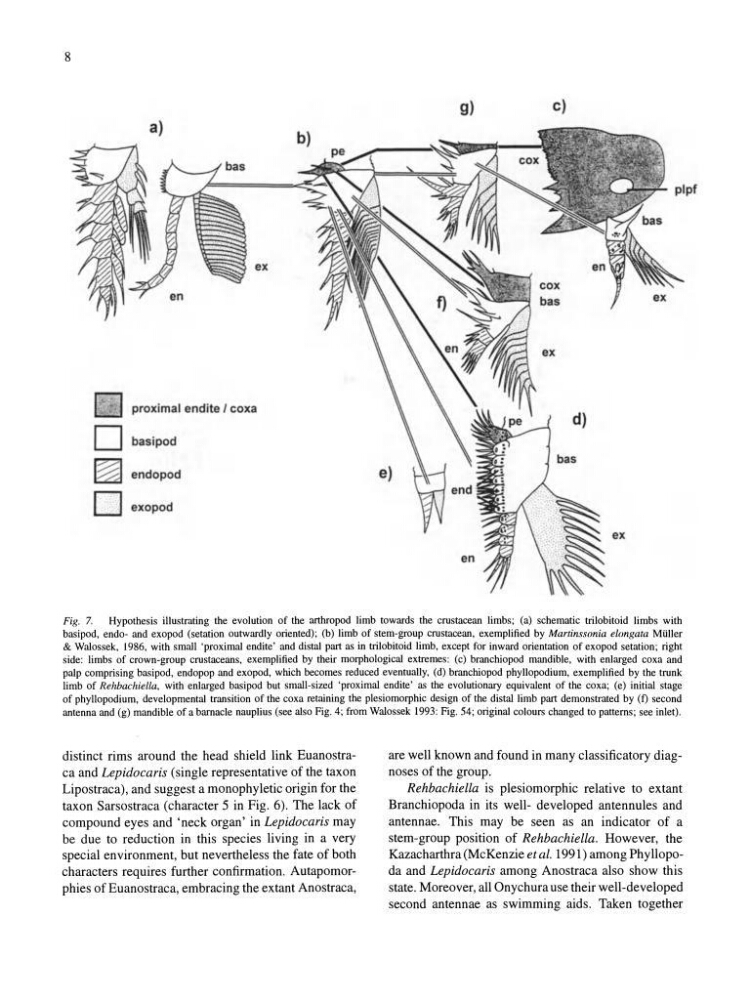
Fig. 7.
Hypothesis illustrating the evolution of the arthropod limb towatds the crustacean limbs; (a) schematic trilobitoid limbs with
basipod, en do- and exopod (setation outwatdly oriented); (b) limb of stem-group crustacean, exemplified by Martinssonia eiongata Miiller
& Walossek, 1986, with small 'proximal endite' and distal part as in trilobitoid limb, except for inwatd orientation of exopod setation; right
side: limbs of crown-group crustaceans, exemplified by their morphological extremes: (c) branchiopod mandible, with enlatged coxa and
palp comprising basipod, endopop and exopod, which becomes reduced eventually, (d) branchiopod phyllopodium, exemplified by the trunk
limb of Rehbachiella, with enlatged basipod but small-sized 'proximal endite' as the evolutionaty equivalent of the coxa; (e) initial stage
of phyllopodium, developmental transition of the coxa retaining the plesiomorphic design of the distal limb part demonstrated by (f) second
antenna and (g) mandible of a batnacle nauplius (see also Fig. 4; from Walossek 1993: Fig. 54; original colours changed to patterns; see inlet).
distinct rims around the head shield link Euanostraca and Lepidocaris (single representative of the taxon
Lipostraca), and suggest a monophyletic origin for the
taxon Sarsostraca (character 5 in Fig. 6). The lack of
compound eyes and 'neck organ' in Lepidocaris may
be due to reduction in this species living in a very
special environment, but nevertheless the fate of both
characters requires further confirmation. Autapomorphies of Euanostraca, embracing the extant Anostraca,
are well known and found in many classificatory diagnoses of the group.
Rehbachiella is plesiomorphic relative to extant
Branchiopoda in its well- developed antennules and
antennae. This may be seen as an indicator of a
stem-group position of Rehbachiella. However, the
Kazacharthra (McKenzie et al. 1991) among Phy llopoda and Lepidocaris among Anostraca also show this
state. Moreover, all Onychura use their well-developed
second antennae as swimming aids. Taken together
g)
c)
a)
ex
proximal endite I coxa
basipod
endopod
exopod
Fig. 7.
Hypothesis illustrating the evolution of the arthropod limb towatds the crustacean limbs; (a) schematic trilobitoid limbs with
basipod, en do- and exopod (setation outwatdly oriented); (b) limb of stem-group crustacean, exemplified by Martinssonia eiongata Miiller
& Walossek, 1986, with small 'proximal endite' and distal part as in trilobitoid limb, except for inwatd orientation of exopod setation; right
side: limbs of crown-group crustaceans, exemplified by their morphological extremes: (c) branchiopod mandible, with enlatged coxa and
palp comprising basipod, endopop and exopod, which becomes reduced eventually, (d) branchiopod phyllopodium, exemplified by the trunk
limb of Rehbachiella, with enlatged basipod but small-sized 'proximal endite' as the evolutionaty equivalent of the coxa; (e) initial stage
of phyllopodium, developmental transition of the coxa retaining the plesiomorphic design of the distal limb part demonstrated by (f) second
antenna and (g) mandible of a batnacle nauplius (see also Fig. 4; from Walossek 1993: Fig. 54; original colours changed to patterns; see inlet).
distinct rims around the head shield link Euanostraca and Lepidocaris (single representative of the taxon
Lipostraca), and suggest a monophyletic origin for the
taxon Sarsostraca (character 5 in Fig. 6). The lack of
compound eyes and 'neck organ' in Lepidocaris may
be due to reduction in this species living in a very
special environment, but nevertheless the fate of both
characters requires further confirmation. Autapomorphies of Euanostraca, embracing the extant Anostraca,
are well known and found in many classificatory diagnoses of the group.
Rehbachiella is plesiomorphic relative to extant
Branchiopoda in its well- developed antennules and
antennae. This may be seen as an indicator of a
stem-group position of Rehbachiella. However, the
Kazacharthra (McKenzie et al. 1991) among Phy llopoda and Lepidocaris among Anostraca also show this
state. Moreover, all Onychura use their well-developed
second antennae as swimming aids. Taken together