

7
Branchiopoda
EUlnosltJc •
• i ,
nee upper JUrlssk
Nalasl •• c •
• I
nce CI r'bOnlr,r' our.
Kazacharthr.
Trillnk: J Juranic.
Spinlcauda.a
l i"(II Siluriln
l •• vic.udal. a
since?? ?
Conchoslraca
L-_"T'"_..JI __ - -
Calmanostraca
Maxillapada
Anostraca
Phyllopoda
since Upper cambrian
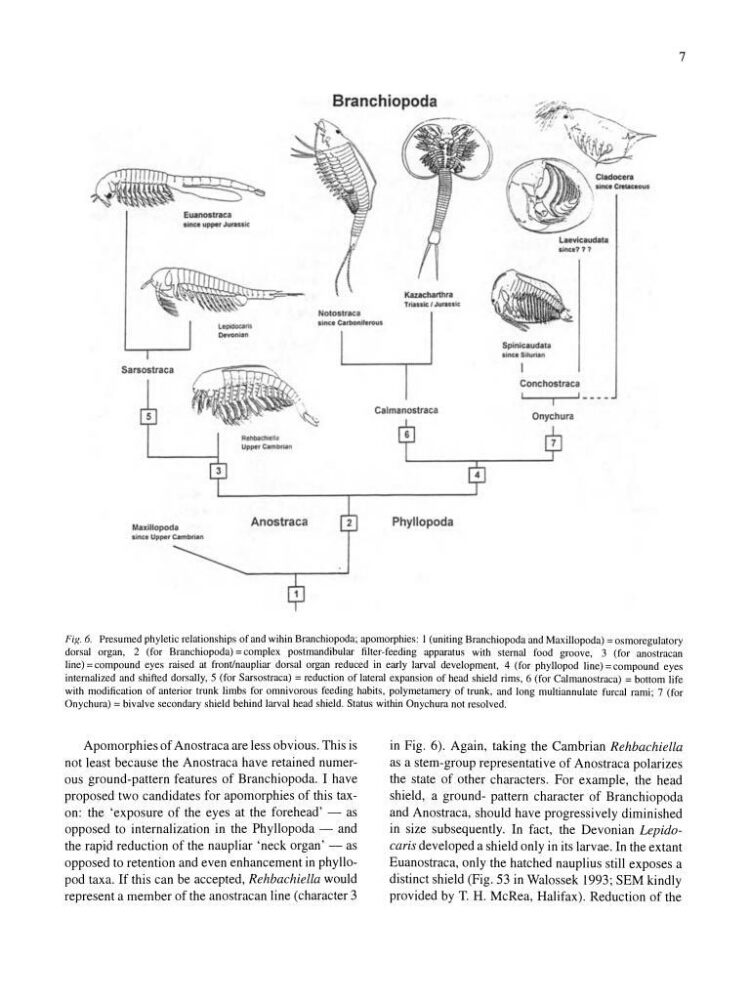
FiR. 6. Presumed phyletic relationships of and wihin Branchiopoda; apomorphies: I (uniting Branchiopoda and Maxillopoda) = osmoregulatory
dorsal organ, 2 (for Branchiopoda) = complex postmandibular filter-feeding apparatus with sternal food groove, 3 (for anostracan
line) = compound eyes raised at frontlnaupliar dorsal organ reduced in early larval development, 4 (for phyllopod line) = compound eyes
internalized and shifted dorsally, 5 (for Sarsostraca) = reduction of lateral expansion of head shield rims, 6 (for Calmanostraca) = bottom life
with modification of anterior trunk limbs for omnivorous feeding habits, polymetamery of trunk, and long multiannulate furcal rami; 7 (for
Onychura) = bivalve secondary shield behind larval head shield. Status within Onychura not resolved.
Apomorphies of Anostraca are less obvious. This is
not least because the Anostraca have retained numerous ground-pattern features of Branchiopoda. I have
proposed two candidates for apomorphies of this taxon: the 'exposure of the eyes at the forehead' - as
opposed to internalization in the Phyllopoda - and
the rapid reduction of the naupliar 'neck organ' - as
opposed to retention and even enhancement in phyllopod taxa. If this can be accepted, Rehbachiella would
represent a member of the anostracan line (character 3
in Fig. 6). Again, taking the Cambrian Rehbachiella
as a stem-group representative of Anostraca polarizes
the state of other characters. For example, the head
shield, a ground- pattern character of Branchiopoda
and Anostraca, should have progressively diminished
in size subsequently. In fact, the Devonian Lepidocaris developed a shield only in its larvae. In the extant
Euanostraca, only the hatched nauplius still exposes a
distinct shield (Fig. 53 in Walossek 1993; SEM kindly
provided by T. H. McRea, Halifax). Reduction of the
Branchiopoda
EUlnosltJc •
• i ,
nee upper JUrlssk
Nalasl •• c •
• I
nce CI r'bOnlr,r' our.
Kazacharthr.
Trillnk: J Juranic.
Spinlcauda.a
l i"(II Siluriln
l •• vic.udal. a
since?? ?
Conchoslraca
L-_"T'"_..JI __ - -
Calmanostraca
Maxillapada
Anostraca
Phyllopoda
since Upper cambrian
FiR. 6. Presumed phyletic relationships of and wihin Branchiopoda; apomorphies: I (uniting Branchiopoda and Maxillopoda) = osmoregulatory
dorsal organ, 2 (for Branchiopoda) = complex postmandibular filter-feeding apparatus with sternal food groove, 3 (for anostracan
line) = compound eyes raised at frontlnaupliar dorsal organ reduced in early larval development, 4 (for phyllopod line) = compound eyes
internalized and shifted dorsally, 5 (for Sarsostraca) = reduction of lateral expansion of head shield rims, 6 (for Calmanostraca) = bottom life
with modification of anterior trunk limbs for omnivorous feeding habits, polymetamery of trunk, and long multiannulate furcal rami; 7 (for
Onychura) = bivalve secondary shield behind larval head shield. Status within Onychura not resolved.
Apomorphies of Anostraca are less obvious. This is
not least because the Anostraca have retained numerous ground-pattern features of Branchiopoda. I have
proposed two candidates for apomorphies of this taxon: the 'exposure of the eyes at the forehead' - as
opposed to internalization in the Phyllopoda - and
the rapid reduction of the naupliar 'neck organ' - as
opposed to retention and even enhancement in phyllopod taxa. If this can be accepted, Rehbachiella would
represent a member of the anostracan line (character 3
in Fig. 6). Again, taking the Cambrian Rehbachiella
as a stem-group representative of Anostraca polarizes
the state of other characters. For example, the head
shield, a ground- pattern character of Branchiopoda
and Anostraca, should have progressively diminished
in size subsequently. In fact, the Devonian Lepidocaris developed a shield only in its larvae. In the extant
Euanostraca, only the hatched nauplius still exposes a
distinct shield (Fig. 53 in Walossek 1993; SEM kindly
provided by T. H. McRea, Halifax). Reduction of the