

B
6
4
2
o
D 4 days
~ 7 days
163
60
105135
260
375
675
2010
Conductivity of medium (uS cm- 1 )
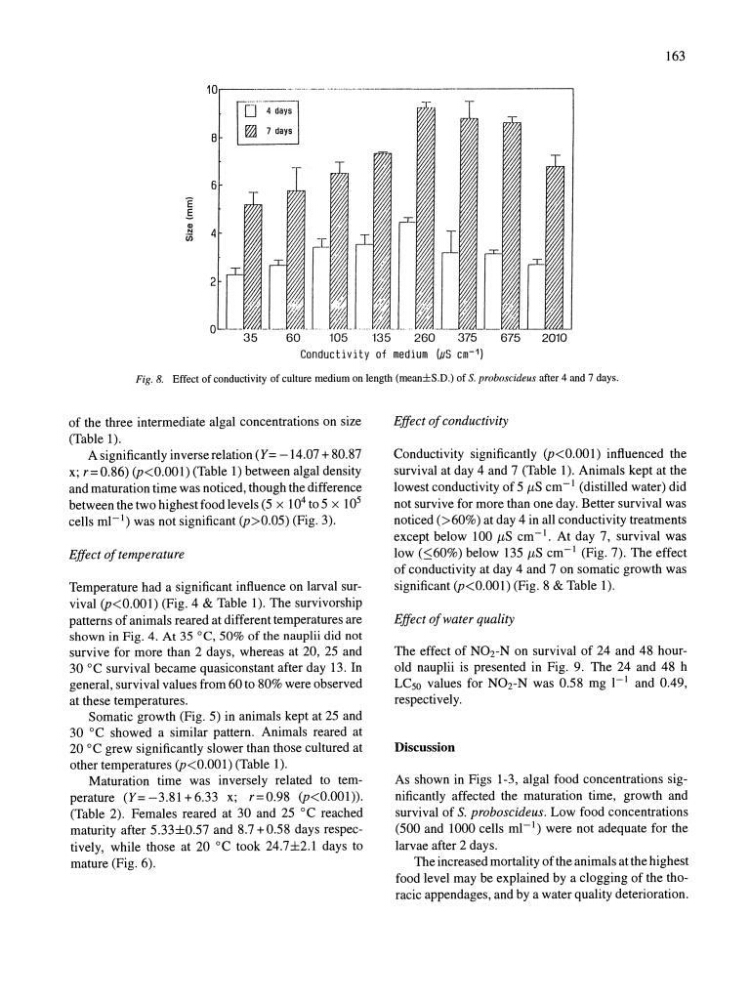
Fig. 8. Effect of conductivity of culture medium on length (mean±S.D.) of S. proboscideus after 4 and 7 days.
of the three intermediate algal concentrations on size
(Table 1).
A significantly inverse relation (Y= -14.07 + 80.87
x; r=0.86) (p<0.001) (Table 1) between algal density
and maturation time was noticed, though the difference
between the two highest food levels (5 x 10 4 to 5 X 10 5
cells ml- I ) was not significant (p>0.05) (Fig. 3).
Effect of temperature
Temperature had a significant influence on larval survival (p<0.001) (Fig. 4 & Table 1). The survivorship
patterns of animals reared at different temperatures are
shown in Fig. 4. At 35°C, 50% of the nauplii did not
survive for more than 2 days, whereas at 20, 25 and
30°C survival became quasiconstant after day 13. In
general, survival values from 60 to 80% were observed
at these temperatures.
Somatic growth (Fig. 5) in animals kept at 25 and
30°C showed a similar pattern. Animals reared at
20 °C grew significantly slower than those cultured at
other temperatures (p<0.00l) (Table 1).
Maturation time was inversely related to temperature (Y= -3.81 + 6.33 x; r=0.98 (p<0.001)).
(Table 2). Females reared at 30 and 25°C reached
maturity after 5.33±0.57 and 8.7 +0.58 days respectively, while those at 20°C took 24.7±2.l days to
mature (Fig. 6).
Effect of conductivity
Conductivity significantly (p<0.001) influenced the
survival at day 4 and 7 (Table 1). Animals kept at the
lowest conductivity of 5 j.tS cm- I (distilled water) did
not survive for more than one day. Better survival was
noticed (>60%) at day 4 in all conductivity treatments
except below 100 j.tS cm- I . At day 7, survival was
low (::;60%) below 135 j.tS cm- I (Fig. 7). The effect
of conductivity at day 4 and 7 on somatic growth was
significant (p<0.001) (Fig. 8 & Table 1).
Effect of water quality
The effect of N02-N on survival of 24 and 48 hourold nauplii is presented in Fig. 9. The 24 and 48 h
LC50 values for N02-N was 0.58 mg I-I and 0.49,
respectively.
Discussion
As shown in Figs 1-3, algal food concentrations significantly affected the maturation time, growth and
survival of S. proboscideus. Low food concentrations
(500 and 1000 cells ml- I ) were not adequate for the
larvae after 2 days.
The increased mortality of the animals at the highest
food level may be explained by a clogging of the thoracic appendages, and by a water quality deterioration.
6
4
2
o
D 4 days
~ 7 days
163
60
105135
260
375
675
2010
Conductivity of medium (uS cm- 1 )
Fig. 8. Effect of conductivity of culture medium on length (mean±S.D.) of S. proboscideus after 4 and 7 days.
of the three intermediate algal concentrations on size
(Table 1).
A significantly inverse relation (Y= -14.07 + 80.87
x; r=0.86) (p<0.001) (Table 1) between algal density
and maturation time was noticed, though the difference
between the two highest food levels (5 x 10 4 to 5 X 10 5
cells ml- I ) was not significant (p>0.05) (Fig. 3).
Effect of temperature
Temperature had a significant influence on larval survival (p<0.001) (Fig. 4 & Table 1). The survivorship
patterns of animals reared at different temperatures are
shown in Fig. 4. At 35°C, 50% of the nauplii did not
survive for more than 2 days, whereas at 20, 25 and
30°C survival became quasiconstant after day 13. In
general, survival values from 60 to 80% were observed
at these temperatures.
Somatic growth (Fig. 5) in animals kept at 25 and
30°C showed a similar pattern. Animals reared at
20 °C grew significantly slower than those cultured at
other temperatures (p<0.00l) (Table 1).
Maturation time was inversely related to temperature (Y= -3.81 + 6.33 x; r=0.98 (p<0.001)).
(Table 2). Females reared at 30 and 25°C reached
maturity after 5.33±0.57 and 8.7 +0.58 days respectively, while those at 20°C took 24.7±2.l days to
mature (Fig. 6).
Effect of conductivity
Conductivity significantly (p<0.001) influenced the
survival at day 4 and 7 (Table 1). Animals kept at the
lowest conductivity of 5 j.tS cm- I (distilled water) did
not survive for more than one day. Better survival was
noticed (>60%) at day 4 in all conductivity treatments
except below 100 j.tS cm- I . At day 7, survival was
low (::;60%) below 135 j.tS cm- I (Fig. 7). The effect
of conductivity at day 4 and 7 on somatic growth was
significant (p<0.001) (Fig. 8 & Table 1).
Effect of water quality
The effect of N02-N on survival of 24 and 48 hourold nauplii is presented in Fig. 9. The 24 and 48 h
LC50 values for N02-N was 0.58 mg I-I and 0.49,
respectively.
Discussion
As shown in Figs 1-3, algal food concentrations significantly affected the maturation time, growth and
survival of S. proboscideus. Low food concentrations
(500 and 1000 cells ml- I ) were not adequate for the
larvae after 2 days.
The increased mortality of the animals at the highest
food level may be explained by a clogging of the thoracic appendages, and by a water quality deterioration.