

143
~
\ J
,/'
,
Ii
e \~
'1
~
f
.
........ .
•
, .
... . .). :
.
~
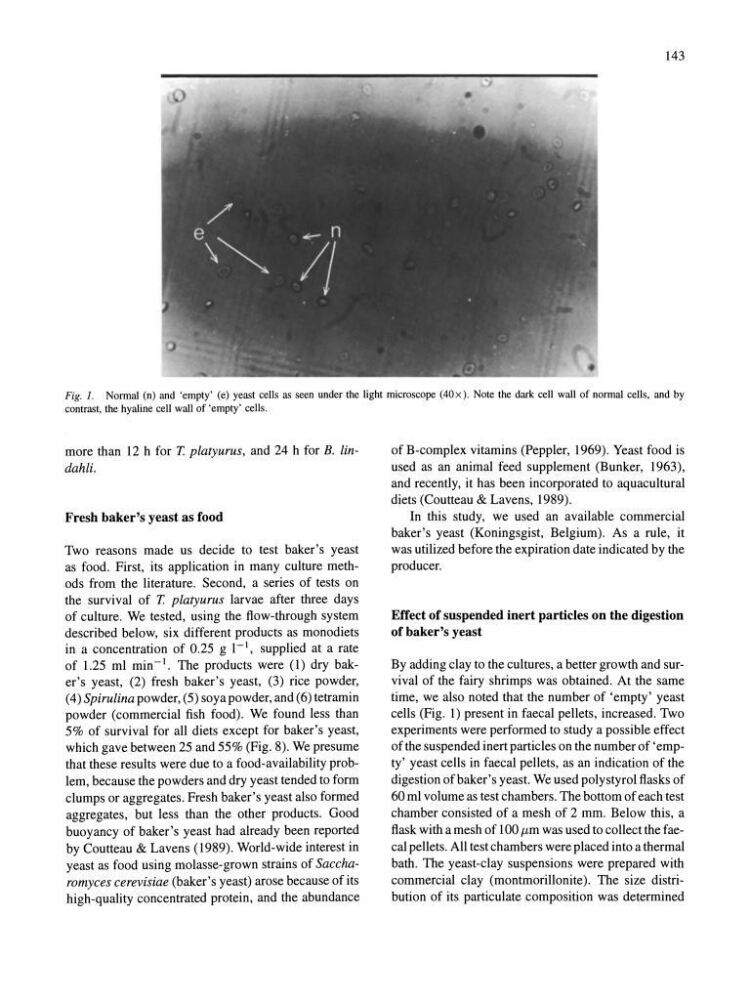
Fig. 1. Normal (n) and 'empty' (e) yeast cells as seen under the light microscope (40x). Note the dark cell wall of normal cells, and by
contrast, the hyaline cell wall of 'empty' cells.
more than 12 h for T. platyurus, and 24 h for B. lindahli.
Fresh baker's yeast as food
Two reasons made us decide to test baker's yeast
as food. First, its application in many culture methods from the literature. Second, a series of tests on
the survival of T. platyurus larvae after three days
of culture. We tested, using the flow-through system
described below, six different products as monodiets
in a concentration of 0.25 g I-I, supplied at a rate
of 1.25 ml min-I. The products were (1) dry baker's yeast, (2) fresh baker's yeast, (3) rice powder,
(4) Spirulina powder, (5) soya powder, and (6) tetramin
powder (commercial fish food). We found less than
5% of survival for all diets except for baker's yeast,
which gave between 25 and 55% (Fig. 8). We presume
that these results were due to a food-availability problem, because the powders and dry yeast tended to form
clumps or aggregates. Fresh baker's yeast also formed
aggregates, but less than the other products. Good
buoyancy of baker's yeast had already been reported
by Coutteau & Lavens (1989). World-wide interest in
yeast as food using molasse-grown strains of Saccharomyces cerevisiae (baker's yeast) arose because of its
high-quality concentrated protein, and the abundance
of B-complex vitamins (Peppler, 1969). Yeast food is
used as an animal feed supplement (Bunker, 1963),
and recently, it has been incorporated to aquacultural
diets (Coutteau & Lavens, 1989).
In this study, we used an available commercial
baker's yeast (Koningsgist, Belgium). As a rule, it
was utilized before the expiration date indicated by the
producer.
Effect of suspended inert particles on the digestion
of baker's yeast
By adding clay to the cultures, a better growth and survival of the fairy shrimps was obtained. At the same
time, we also noted that the number of 'empty' yeast
cells (Fig. 1) present in faecal pellets, increased. Two
experiments were performed to study a possible effect
of the suspended inert particles on the number of 'empty' yeast cells in faecal pellets, as an indication of the
digestion of baker's yeast. We used polystyrol flasks of
60 ml volume as test chambers. The bottom of each test
chamber consisted of a mesh of 2 mm. Below this, a
flask with a mesh of 100 /Lm was used to collect the faecal pellets. All test chambers were placed into a thermal
bath. The yeast-clay suspensions were prepared with
commercial clay (montmorillonite). The size distribution of its particulate composition was determined
~
\ J
,/'
,
Ii
e \~
'1
~
f
.
........ .
•
, .
... . .). :
.
~
Fig. 1. Normal (n) and 'empty' (e) yeast cells as seen under the light microscope (40x). Note the dark cell wall of normal cells, and by
contrast, the hyaline cell wall of 'empty' cells.
more than 12 h for T. platyurus, and 24 h for B. lindahli.
Fresh baker's yeast as food
Two reasons made us decide to test baker's yeast
as food. First, its application in many culture methods from the literature. Second, a series of tests on
the survival of T. platyurus larvae after three days
of culture. We tested, using the flow-through system
described below, six different products as monodiets
in a concentration of 0.25 g I-I, supplied at a rate
of 1.25 ml min-I. The products were (1) dry baker's yeast, (2) fresh baker's yeast, (3) rice powder,
(4) Spirulina powder, (5) soya powder, and (6) tetramin
powder (commercial fish food). We found less than
5% of survival for all diets except for baker's yeast,
which gave between 25 and 55% (Fig. 8). We presume
that these results were due to a food-availability problem, because the powders and dry yeast tended to form
clumps or aggregates. Fresh baker's yeast also formed
aggregates, but less than the other products. Good
buoyancy of baker's yeast had already been reported
by Coutteau & Lavens (1989). World-wide interest in
yeast as food using molasse-grown strains of Saccharomyces cerevisiae (baker's yeast) arose because of its
high-quality concentrated protein, and the abundance
of B-complex vitamins (Peppler, 1969). Yeast food is
used as an animal feed supplement (Bunker, 1963),
and recently, it has been incorporated to aquacultural
diets (Coutteau & Lavens, 1989).
In this study, we used an available commercial
baker's yeast (Koningsgist, Belgium). As a rule, it
was utilized before the expiration date indicated by the
producer.
Effect of suspended inert particles on the digestion
of baker's yeast
By adding clay to the cultures, a better growth and survival of the fairy shrimps was obtained. At the same
time, we also noted that the number of 'empty' yeast
cells (Fig. 1) present in faecal pellets, increased. Two
experiments were performed to study a possible effect
of the suspended inert particles on the number of 'empty' yeast cells in faecal pellets, as an indication of the
digestion of baker's yeast. We used polystyrol flasks of
60 ml volume as test chambers. The bottom of each test
chamber consisted of a mesh of 2 mm. Below this, a
flask with a mesh of 100 /Lm was used to collect the faecal pellets. All test chambers were placed into a thermal
bath. The yeast-clay suspensions were prepared with
commercial clay (montmorillonite). The size distribution of its particulate composition was determined