

Table 2. Growth of Thamnocephalus platyurus reared
at 2S.5±1.0 °C in a flow-through system under
treatments 1 (baker's yeast, com oil, and synthetic
trans-/3-carotene) and 2 (baker's yeast, and com oil)
of four replicates each. The experiment started with
24 h-01d larvae.
Day
N measured Standard
Growth rate
from each length (mm) mm day-l
replicate
mean±SD
Treatment 1
10
0.92±0.08
3
10
4.63±0.S3 1.85
6
pooled
9.71±0.50 1.69
500
9.94±0.6S 1.77
S~
9.48±0.S9 1.61
9
pooled
12.36±0.27 0.88
500
11.81±0.84 0.62
S~
12.92±0.59 1.14
11
pooled
lS.21±0.S9 0.95
300
lS.04±2.77 1.07
2~
IS.30±1.93 0.79
Treatment 2
1
10
0.89±0.09
3
10
4.S7±0.Sl 1.84
6
pooled
9.79±0.62 1.74
sod'
9.59±0.74 1.67
S
9
pooled
11.39±0.72 0.53
500
11.43±0.69 0.61
S
11
pooled
14.82±0.97 1.14
300
14.S4±1.47 1.03
2~
lS.23±1.76 1.29
were carried out with an eye-piece micrometer on a
stereo-microscope Wild M3 to the nearest 0.18 mm.
The experiment was carried out at 25.5±1.0 °C, pH of
6.7-7.2, conductivity 580-630 J,LS cm- 1 , and a light
regime of 16L18D.
The diet for treatment 1 was prepared as follows: 0.05 g of synthetic (crystalline) trans-,B-carotene
(Sigma-C9750) was diluted in 6 ml of corn oil
(Nonkels, Belgium) at room temperature and kept at
2 °C until used. To each 20 g of baker's yeast (Koningsgist, Belgium) to be used according to the feeding
schedule (see Maeda-Martinez et ai., 1995; this volume), 1.8 ml of corn oil with diluted synthetic trans-,Bcarotene was added. The diet of treatment 2 consisted
of baker's yeast and corn oil without synthetic trans-,B135
carotene. Using absolute ethanol as a solvent, pigment
extractions were analyzed under a UV-visible recording spectrophotometer (UV-160A Shimadzu). Measurements between wavelengths 300 to 600 nm gave
a maximum peak of absorption at 447 nm for both the
extractions from (1) synthetic trans-,B-carotene, and
from (2) baker's yeast with corn oil and synthetic trans,B-carotene, and at 499 nm for the extractions from
(3) baker's yeast with corn oil. The absorption maximum of ,B-carotene in ethanol has been reported to be
at 453 nm by Isler et at. (1956, in Goodwing, 1980),
and at 449 and 475 nm by Katayama et al. (1972, in
Davis, 1976).
Pooled data for survival, and both pooled, and sexseparated data for growth at days 3, 6, 9 & 11 were analyzed by one-way ANOVA (Tukey) (SYSTAT, Wilkinson, 1990).
Results
Survival & growth
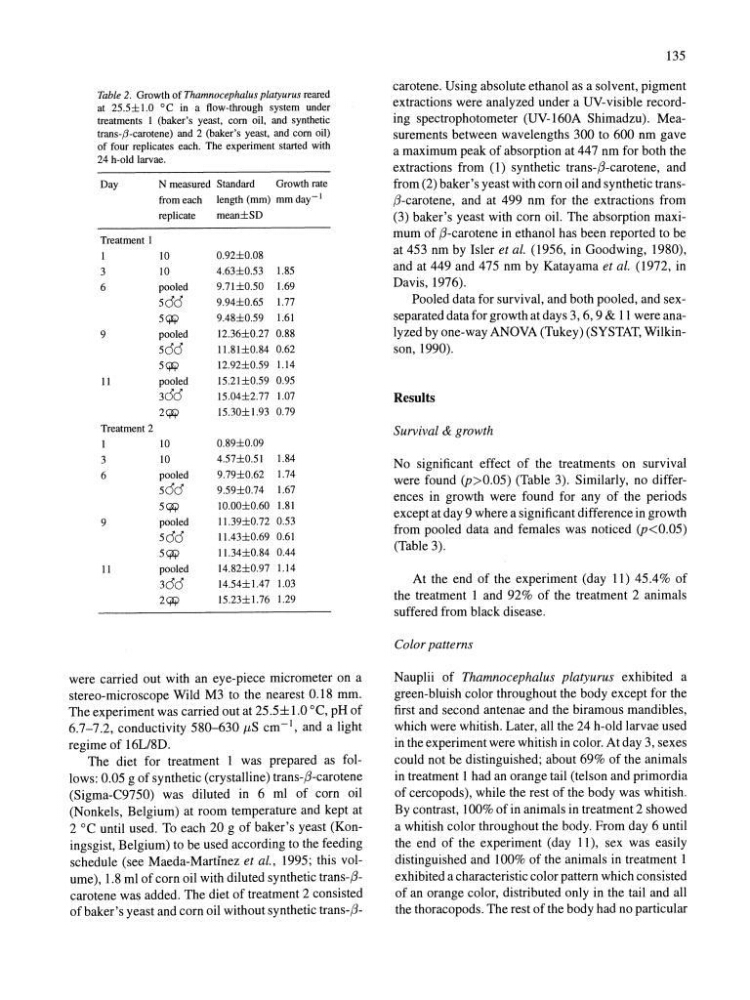
No significant effect of the treatments on survival
were found (p>0.05) (Table 3). Similarly, no differences in growth were found for any of the periods
except at day 9 where a significant difference in growth
from pooled data and females was noticed (p<0.05)
(Table 3).
At the end of the experiment (day 11) 45.4% of
the treatment 1 and 92% of the treatment 2 animals
suffered from black disease.
Color patterns
Nauplii of Thamnocephalus platyurus exhibited a
green-bluish color throughout the body except for the
first and second antenae and the biramous mandibles,
which were whitish. Later, all the 24 h-old larvae used
in the experiment were whitish in color. At day 3, sexes
could not be distinguished; about 69% of the animals
in treatment 1 had an orange tail (telson and primordia
of cercopods), while the rest of the body was whitish.
By contrast, 100% of in animals in treatment 2 showed
a whitish color throughout the body. From day 6 until
the end of the experiment (day 11), sex was easily
distinguished and 100% of the animals in treatment 1
exhibited a characteristic color pattern which consisted
of an orange color, distributed only in the tail and all
the thoracopods. The rest of the body had no particular
at 2S.5±1.0 °C in a flow-through system under
treatments 1 (baker's yeast, com oil, and synthetic
trans-/3-carotene) and 2 (baker's yeast, and com oil)
of four replicates each. The experiment started with
24 h-01d larvae.
Day
N measured Standard
Growth rate
from each length (mm) mm day-l
replicate
mean±SD
Treatment 1
10
0.92±0.08
3
10
4.63±0.S3 1.85
6
pooled
9.71±0.50 1.69
500
9.94±0.6S 1.77
S~
9.48±0.S9 1.61
9
pooled
12.36±0.27 0.88
500
11.81±0.84 0.62
S~
12.92±0.59 1.14
11
pooled
lS.21±0.S9 0.95
300
lS.04±2.77 1.07
2~
IS.30±1.93 0.79
Treatment 2
1
10
0.89±0.09
3
10
4.S7±0.Sl 1.84
6
pooled
9.79±0.62 1.74
sod'
9.59±0.74 1.67
S
9
pooled
11.39±0.72 0.53
500
11.43±0.69 0.61
S
11
pooled
14.82±0.97 1.14
300
14.S4±1.47 1.03
2~
lS.23±1.76 1.29
were carried out with an eye-piece micrometer on a
stereo-microscope Wild M3 to the nearest 0.18 mm.
The experiment was carried out at 25.5±1.0 °C, pH of
6.7-7.2, conductivity 580-630 J,LS cm- 1 , and a light
regime of 16L18D.
The diet for treatment 1 was prepared as follows: 0.05 g of synthetic (crystalline) trans-,B-carotene
(Sigma-C9750) was diluted in 6 ml of corn oil
(Nonkels, Belgium) at room temperature and kept at
2 °C until used. To each 20 g of baker's yeast (Koningsgist, Belgium) to be used according to the feeding
schedule (see Maeda-Martinez et ai., 1995; this volume), 1.8 ml of corn oil with diluted synthetic trans-,Bcarotene was added. The diet of treatment 2 consisted
of baker's yeast and corn oil without synthetic trans-,B135
carotene. Using absolute ethanol as a solvent, pigment
extractions were analyzed under a UV-visible recording spectrophotometer (UV-160A Shimadzu). Measurements between wavelengths 300 to 600 nm gave
a maximum peak of absorption at 447 nm for both the
extractions from (1) synthetic trans-,B-carotene, and
from (2) baker's yeast with corn oil and synthetic trans,B-carotene, and at 499 nm for the extractions from
(3) baker's yeast with corn oil. The absorption maximum of ,B-carotene in ethanol has been reported to be
at 453 nm by Isler et at. (1956, in Goodwing, 1980),
and at 449 and 475 nm by Katayama et al. (1972, in
Davis, 1976).
Pooled data for survival, and both pooled, and sexseparated data for growth at days 3, 6, 9 & 11 were analyzed by one-way ANOVA (Tukey) (SYSTAT, Wilkinson, 1990).
Results
Survival & growth
No significant effect of the treatments on survival
were found (p>0.05) (Table 3). Similarly, no differences in growth were found for any of the periods
except at day 9 where a significant difference in growth
from pooled data and females was noticed (p<0.05)
(Table 3).
At the end of the experiment (day 11) 45.4% of
the treatment 1 and 92% of the treatment 2 animals
suffered from black disease.
Color patterns
Nauplii of Thamnocephalus platyurus exhibited a
green-bluish color throughout the body except for the
first and second antenae and the biramous mandibles,
which were whitish. Later, all the 24 h-old larvae used
in the experiment were whitish in color. At day 3, sexes
could not be distinguished; about 69% of the animals
in treatment 1 had an orange tail (telson and primordia
of cercopods), while the rest of the body was whitish.
By contrast, 100% of in animals in treatment 2 showed
a whitish color throughout the body. From day 6 until
the end of the experiment (day 11), sex was easily
distinguished and 100% of the animals in treatment 1
exhibited a characteristic color pattern which consisted
of an orange color, distributed only in the tail and all
the thoracopods. The rest of the body had no particular