

122
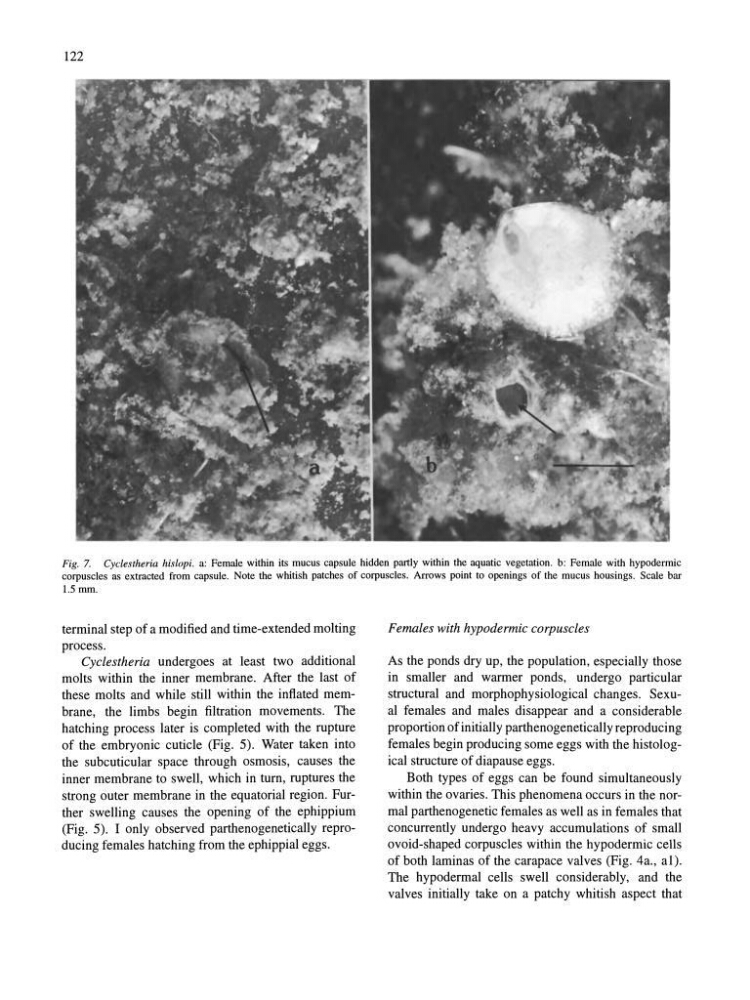
Fig. 7. Cyclestheria hisiopi. a: Female within its mucus capsule hidden partly within the aquatic vegetation. b: Female with hypodermic
corpuscles as extracted from capsule. Note the whitish patches of corpuscles. Arrows point to openings of the mucus housings. Scale bar
1.5 mm.
terminal step of a modified and time-extended molting
process.
Cyclestheria undergoes at least two additional
molts within the inner membrane. After the last of
these molts and while still within the inflated membrane, the limbs begin filtration movements. The
hatching process later is completed with the rupture
of the embryonic cuticle (Fig. 5). Water taken into
the subcuticular space through osmosis, causes the
inner membrane to swell, which in turn, ruptures the
strong outer membrane in the equatorial region. Further swelling causes the opening of the ephippium
(Fig. 5). I only observed parthenogenetically reproducing females hatching from the ephippial eggs.
Females with hypodermic corpuscles
As the ponds dry up, the population, especially those
in smaller and warmer ponds, undergo particular
structural and morphophysiological changes. Sexual females and males disappear and a considerable
proportion of initially parthenogenetically reproducing
females begin producing some eggs with the histological structure of diapause eggs.
Both types of eggs can be found simultaneously
within the ovaries. This phenomena occurs in the normal parthenogenetic females as well as in females that
concurrently undergo heavy accumulations of small
ovoid-shaped corpuscles within the hypodermic cells
of both laminas of the carapace valves (Fig. 4a., al).
The hypodermal cells swell considerably, and the
valves initially take on a patchy whitish aspect that
Fig. 7. Cyclestheria hisiopi. a: Female within its mucus capsule hidden partly within the aquatic vegetation. b: Female with hypodermic
corpuscles as extracted from capsule. Note the whitish patches of corpuscles. Arrows point to openings of the mucus housings. Scale bar
1.5 mm.
terminal step of a modified and time-extended molting
process.
Cyclestheria undergoes at least two additional
molts within the inner membrane. After the last of
these molts and while still within the inflated membrane, the limbs begin filtration movements. The
hatching process later is completed with the rupture
of the embryonic cuticle (Fig. 5). Water taken into
the subcuticular space through osmosis, causes the
inner membrane to swell, which in turn, ruptures the
strong outer membrane in the equatorial region. Further swelling causes the opening of the ephippium
(Fig. 5). I only observed parthenogenetically reproducing females hatching from the ephippial eggs.
Females with hypodermic corpuscles
As the ponds dry up, the population, especially those
in smaller and warmer ponds, undergo particular
structural and morphophysiological changes. Sexual females and males disappear and a considerable
proportion of initially parthenogenetically reproducing
females begin producing some eggs with the histological structure of diapause eggs.
Both types of eggs can be found simultaneously
within the ovaries. This phenomena occurs in the normal parthenogenetic females as well as in females that
concurrently undergo heavy accumulations of small
ovoid-shaped corpuscles within the hypodermic cells
of both laminas of the carapace valves (Fig. 4a., al).
The hypodermal cells swell considerably, and the
valves initially take on a patchy whitish aspect that