

52
Consumption
~
91461
c
o
~
'I:t
~ ......
'0. 0
(/) CO
Q)
0:::
Production
25795
Activity Patterns
Excretion
59650
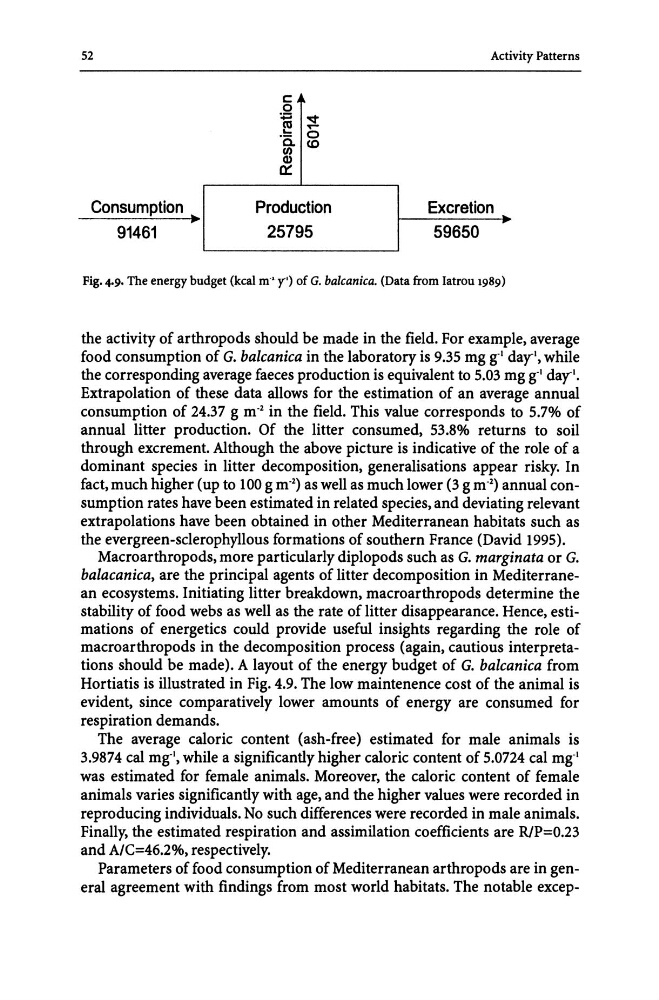
Fig. 4.9. The energy budget (kcal mo' 1') of G. balcanica. (Data from Iatrou 1989)
the activity of arthropods should be made in the field. For example, average
food consumption of G. balcanica in the laboratory is 9.35 mg g-I dayl, while
the corresponding average faeces production is equivalent to 5.03 mg g-I dayl.
Extrapolation of these data allows for the estimation of an average annual
consumption of 24.37 g m- z in the field. This value corresponds to 5.7% of
annual litter production. Of the litter consumed, 53.8% returns to soil
through excrement. Although the above picture is indicative of the role of a
dominant species in litter decomposition, generalisations appear risky. In
fact, much higher (up to 100 g m- Z ) as well as much lower (3 gm- Z ) annual consumption rates have been estimated in related species, and deviating relevant
extrapolations have been obtained in other Mediterranean habitats such as
the evergreen-sclerophyllous formations of southern France (David 1995).
Macroarthropods, more particularly diplopods such as G. marginata or G.
balacanica, are the principal agents of litter decomposition in Mediterranean ecosystems. Initiating litter breakdown, macroarthropods determine the
stability of food webs as well as the rate of litter disappearance. Hence, estimations of energetics could provide useful insights regarding the role of
macroarthropods in the decomposition process (again, cautious interpretations should be made). A layout of the energy budget of G. balcanica from
Hortiatis is illustrated in Fig. 4.9. The low maintenence cost of the animal is
evident, since comparatively lower amounts of energy are consumed for
respiration demands.
The average caloric content (ash-free) estimated for male animals is
3.9874 cal mg- I , while a significantly higher caloric content of 5.0724 cal mg- I
was estimated for female animals. Moreover, the caloric content of female
animals varies significantly with age, and the higher values were recorded in
reproducing individuals. No such differences were recorded in male animals.
Finally, the estimated respiration and assimilation coefficients are R/P=0.23
and AlC=46.2%, respectively.
Parameters of food consumption of Mediterranean arthropods are in general agreement with findings from most world habitats. The notable excep-
Consumption
~
91461
c
o
~
'I:t
~ ......
'0. 0
(/) CO
Q)
0:::
Production
25795
Activity Patterns
Excretion
59650
Fig. 4.9. The energy budget (kcal mo' 1') of G. balcanica. (Data from Iatrou 1989)
the activity of arthropods should be made in the field. For example, average
food consumption of G. balcanica in the laboratory is 9.35 mg g-I dayl, while
the corresponding average faeces production is equivalent to 5.03 mg g-I dayl.
Extrapolation of these data allows for the estimation of an average annual
consumption of 24.37 g m- z in the field. This value corresponds to 5.7% of
annual litter production. Of the litter consumed, 53.8% returns to soil
through excrement. Although the above picture is indicative of the role of a
dominant species in litter decomposition, generalisations appear risky. In
fact, much higher (up to 100 g m- Z ) as well as much lower (3 gm- Z ) annual consumption rates have been estimated in related species, and deviating relevant
extrapolations have been obtained in other Mediterranean habitats such as
the evergreen-sclerophyllous formations of southern France (David 1995).
Macroarthropods, more particularly diplopods such as G. marginata or G.
balacanica, are the principal agents of litter decomposition in Mediterranean ecosystems. Initiating litter breakdown, macroarthropods determine the
stability of food webs as well as the rate of litter disappearance. Hence, estimations of energetics could provide useful insights regarding the role of
macroarthropods in the decomposition process (again, cautious interpretations should be made). A layout of the energy budget of G. balcanica from
Hortiatis is illustrated in Fig. 4.9. The low maintenence cost of the animal is
evident, since comparatively lower amounts of energy are consumed for
respiration demands.
The average caloric content (ash-free) estimated for male animals is
3.9874 cal mg- I , while a significantly higher caloric content of 5.0724 cal mg- I
was estimated for female animals. Moreover, the caloric content of female
animals varies significantly with age, and the higher values were recorded in
reproducing individuals. No such differences were recorded in male animals.
Finally, the estimated respiration and assimilation coefficients are R/P=0.23
and AlC=46.2%, respectively.
Parameters of food consumption of Mediterranean arthropods are in general agreement with findings from most world habitats. The notable excep-