

The Joint Effect of Temperature and Humidity on Feeding Activity and Demography
51
100
'" 80
~
"0 60
~
~
"P 40
"
-<:
~ 20
o~~~~----~~~--------~ o
5
10
15
20
25
30
Temperature ·C
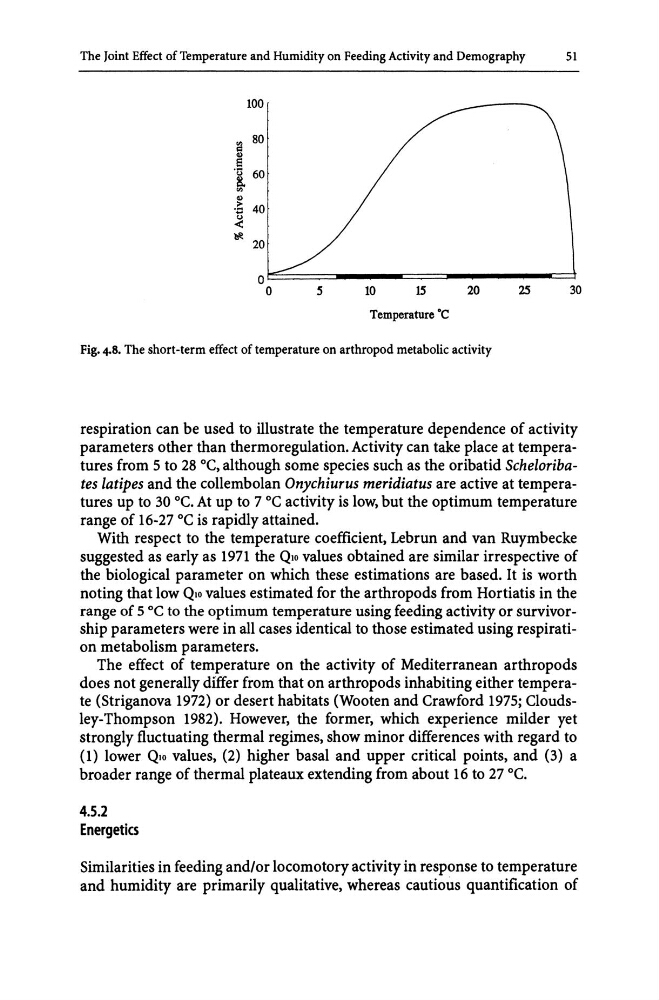
Fig. 4-8. The short-term effect of temperature on arthropod metabolic activity
respiration can be used to illustrate the temperature dependence of activity
parameters other than thermoregulation. Activity can take place at temperatures from 5 to 28°C, although some species such as the oribatid Scheloribates latipes and the collembolan Onychiurus meridiatus are active at temperatures up to 30°C. At up to 7 °C activity is low, but the optimum temperature
range of 16-27 °C is rapidly attained.
With respect to the temperature coefficient, Lebrun and van Ruymbecke
suggested as early as 1971 the QIO values obtained are similar irrespective of
the biological parameter on which these estimations are based. It is worth
noting that low QIO values estimated for the arthropods from Hortiatis in the
range of 5 °C to the optimum temperature using feeding activity or survivorship parameters were in all cases identical to those estimated using respiration metabolism parameters.
The effect of temperature on the activity of Mediterranean arthropods
does not generally differ from that on arthropods inhabiting either temperate (Striganova 1972) or desert habitats (Wooten and Crawford 1975; Cloudsley-Thompson 1982). However, the former, which experience milder yet
strongly fluctuating thermal regimes, show minor differences with regard to
(1) lower QIO values, (2) higher basal and upper critical points, and (3) a
broader range of thermal plateaux extending from about 16 to 27°c'
4.5.2
Energetics
Similarities in feeding and/or locomotory activity in response to temperature
and humidity are primarily qualitative, whereas cautious quantification of
51
100
'" 80
~
"0 60
~
~
"P 40
"
-<:
~ 20
o~~~~----~~~--------~ o
5
10
15
20
25
30
Temperature ·C
Fig. 4-8. The short-term effect of temperature on arthropod metabolic activity
respiration can be used to illustrate the temperature dependence of activity
parameters other than thermoregulation. Activity can take place at temperatures from 5 to 28°C, although some species such as the oribatid Scheloribates latipes and the collembolan Onychiurus meridiatus are active at temperatures up to 30°C. At up to 7 °C activity is low, but the optimum temperature
range of 16-27 °C is rapidly attained.
With respect to the temperature coefficient, Lebrun and van Ruymbecke
suggested as early as 1971 the QIO values obtained are similar irrespective of
the biological parameter on which these estimations are based. It is worth
noting that low QIO values estimated for the arthropods from Hortiatis in the
range of 5 °C to the optimum temperature using feeding activity or survivorship parameters were in all cases identical to those estimated using respiration metabolism parameters.
The effect of temperature on the activity of Mediterranean arthropods
does not generally differ from that on arthropods inhabiting either temperate (Striganova 1972) or desert habitats (Wooten and Crawford 1975; Cloudsley-Thompson 1982). However, the former, which experience milder yet
strongly fluctuating thermal regimes, show minor differences with regard to
(1) lower QIO values, (2) higher basal and upper critical points, and (3) a
broader range of thermal plateaux extending from about 16 to 27°c'
4.5.2
Energetics
Similarities in feeding and/or locomotory activity in response to temperature
and humidity are primarily qualitative, whereas cautious quantification of