

The Joint Effect of Temperature and Humidity on Feeding Activity and Demography
49
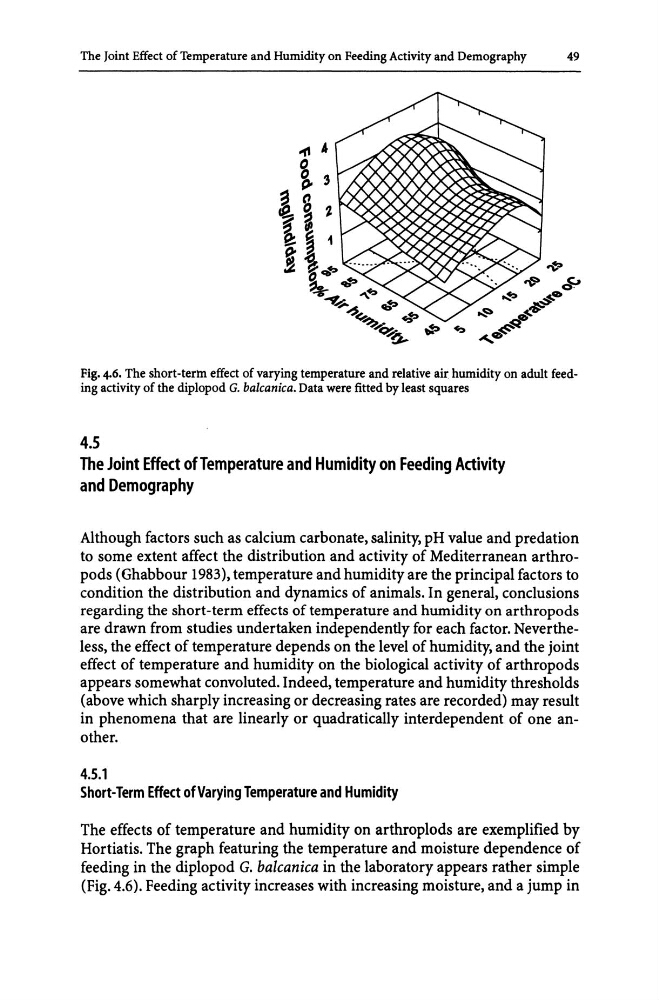
Fig. 4.6. The short-term effect of varying temperature and relative air humidity on adult feeding activity of the diplopod G. balcanica. Data were fitted by least squares
4.5
The Joint Effect ofTemperature and Humidity on Feeding Activity
and Demography
Although factors such as calcium carbonate, salinity, pH value and predation
to some extent affect the distribution and activity of Mediterranean arthropods (Ghabbour 1983), temperature and humidity are the principal factors to
condition the distribution and dynamics of animals. In general, conclusions
regarding the short-term effects of temperature and humidity on arthropods
are drawn from studies undertaken independently for each factor. Nevertheless, the effect of temperature depends on the level of humidity, and the joint
effect of temperature and humidity on the biological activity of arthropods
appears somewhat convoluted. Indeed, temperature and humidity thresholds
(above which sharply increasing or decreasing rates are recorded) may result
in phenomena that are linearly or quadratically interdependent of one another.
4.5.1
Short-Term Effect of Varying Temperature and Humidity
The effects of temperature and humidity on arthroplods are exemplified by
Hortiatis. The graph featuring the temperature and moisture dependence of
feeding in the diplopod G. balcanica in the laboratory appears rather simple
(Fig. 4.6). Feeding activity increases with increasing moisture, and a jump in
49
Fig. 4.6. The short-term effect of varying temperature and relative air humidity on adult feeding activity of the diplopod G. balcanica. Data were fitted by least squares
4.5
The Joint Effect ofTemperature and Humidity on Feeding Activity
and Demography
Although factors such as calcium carbonate, salinity, pH value and predation
to some extent affect the distribution and activity of Mediterranean arthropods (Ghabbour 1983), temperature and humidity are the principal factors to
condition the distribution and dynamics of animals. In general, conclusions
regarding the short-term effects of temperature and humidity on arthropods
are drawn from studies undertaken independently for each factor. Nevertheless, the effect of temperature depends on the level of humidity, and the joint
effect of temperature and humidity on the biological activity of arthropods
appears somewhat convoluted. Indeed, temperature and humidity thresholds
(above which sharply increasing or decreasing rates are recorded) may result
in phenomena that are linearly or quadratically interdependent of one another.
4.5.1
Short-Term Effect of Varying Temperature and Humidity
The effects of temperature and humidity on arthroplods are exemplified by
Hortiatis. The graph featuring the temperature and moisture dependence of
feeding in the diplopod G. balcanica in the laboratory appears rather simple
(Fig. 4.6). Feeding activity increases with increasing moisture, and a jump in