

34
Respiratory Metabolism
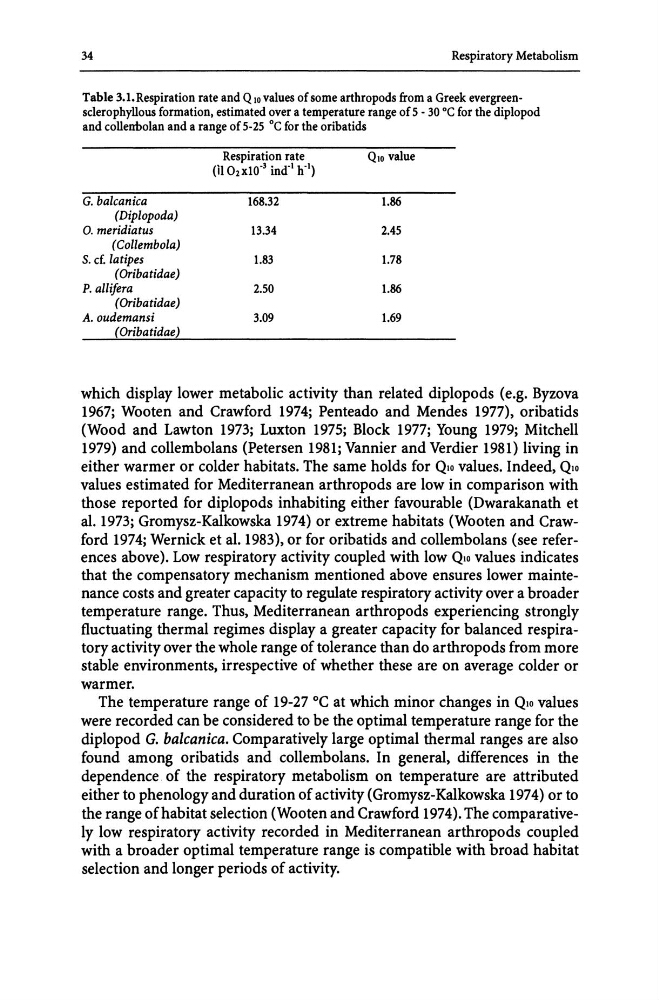
Table 3.1.Respiration rate and Q 10 values of some arthropods from a Greek evergreensc1erophyllous formation, estimated over a temperature range of 5 - 30 ·c for the diplopod
and collenbolan and a range of 5-25°C for the oribatids
Respiration rate
(ll 02xlO- 3 ind- I h-I)
QIO value
G_ balcanica
168.32
1.86
(Diplopoda)
0_ meridiatus
13_34
2.45
(Collembola)
S. cf. latipes
1.83
1.78
(Oribatidae)
P. alli/era
2.50
1.86
(Oriba tidae)
A. oudemansi
3.09
1.69
(Oribatidae)
which display lower metabolic activity than related diplopods (e.g. Byzova
1967; Wooten and Crawford 1974; Penteado and Mendes 1977), oribatids
(Wood and Lawton 1973; Luxton 1975; Block 1977; Young 1979; Mitchell
1979) and collembolans (Petersen 1981; Vannier and Verdier 1981) living in
either warmer or colder habitats. The same holds for QIO values. Indeed, QIO
values estimated for Mediterranean arthropods are low in comparison with
those reported for diplopods inhabiting either favourable (Dwarakanath et
al. 1973; Gromysz-Kalkowska 1974) or extreme habitats (Wooten and Crawford 1974; Wernick et al. 1983), or for oribatids and collembolans (see references above). Low respiratory activity coupled with low QIO values indicates
that the compensatory mechanism mentioned above ensures lower maintenance costs and greater capacity to regulate respiratory activity over a broader
temperature range. Thus, Mediterranean arthropods experiencing strongly
fluctuating thermal regimes display a greater capacity for balanced respiratory activity over the whole range of tolerance than do arthropods from more
stable environments, irrespective of whether these are on average colder or
warmer.
The temperature range of 19-27 °C at which minor changes in QIO values
were recorded can be considered to be the optimal temperature range for the
diplopod G. balcanica. Comparatively large optimal thermal ranges are also
found among oribatids and collembolans. In general, differences in the
dependence of the respiratory metabolism on temperature are attributed
either to phenology and duration of activity (Gromysz-Kalkowska 1974) or to
the range of habitat selection (Wooten and Crawford 1974). The comparatively low respiratory activity recorded in Mediterranean arthropods coupled
with a broader optimal temperature range is compatible with broad habitat
selection and longer periods of activity.
Respiratory Metabolism
Table 3.1.Respiration rate and Q 10 values of some arthropods from a Greek evergreensc1erophyllous formation, estimated over a temperature range of 5 - 30 ·c for the diplopod
and collenbolan and a range of 5-25°C for the oribatids
Respiration rate
(ll 02xlO- 3 ind- I h-I)
QIO value
G_ balcanica
168.32
1.86
(Diplopoda)
0_ meridiatus
13_34
2.45
(Collembola)
S. cf. latipes
1.83
1.78
(Oribatidae)
P. alli/era
2.50
1.86
(Oriba tidae)
A. oudemansi
3.09
1.69
(Oribatidae)
which display lower metabolic activity than related diplopods (e.g. Byzova
1967; Wooten and Crawford 1974; Penteado and Mendes 1977), oribatids
(Wood and Lawton 1973; Luxton 1975; Block 1977; Young 1979; Mitchell
1979) and collembolans (Petersen 1981; Vannier and Verdier 1981) living in
either warmer or colder habitats. The same holds for QIO values. Indeed, QIO
values estimated for Mediterranean arthropods are low in comparison with
those reported for diplopods inhabiting either favourable (Dwarakanath et
al. 1973; Gromysz-Kalkowska 1974) or extreme habitats (Wooten and Crawford 1974; Wernick et al. 1983), or for oribatids and collembolans (see references above). Low respiratory activity coupled with low QIO values indicates
that the compensatory mechanism mentioned above ensures lower maintenance costs and greater capacity to regulate respiratory activity over a broader
temperature range. Thus, Mediterranean arthropods experiencing strongly
fluctuating thermal regimes display a greater capacity for balanced respiratory activity over the whole range of tolerance than do arthropods from more
stable environments, irrespective of whether these are on average colder or
warmer.
The temperature range of 19-27 °C at which minor changes in QIO values
were recorded can be considered to be the optimal temperature range for the
diplopod G. balcanica. Comparatively large optimal thermal ranges are also
found among oribatids and collembolans. In general, differences in the
dependence of the respiratory metabolism on temperature are attributed
either to phenology and duration of activity (Gromysz-Kalkowska 1974) or to
the range of habitat selection (Wooten and Crawford 1974). The comparatively low respiratory activity recorded in Mediterranean arthropods coupled
with a broader optimal temperature range is compatible with broad habitat
selection and longer periods of activity.