

108
.:a
Community Structure
1,2.--------------------------------------------------,
0,9
Q. coccifera OIter)
Sphaeridia pumilis
Parisotoma natabilis
Pseudosinella albida
~ 0,6 Isolomurus palustris
Gi:lI&t:lI
I.oxycedrus
Orchesella irregularilineata
Ceralophysella engandinensis
0,3
Lidu:m
Mossbank
Onychiurus meridialus
Xenyllasp.
CryploPYgus bipunclatus
Melaphorura biparlita Q. coccifera (humus)
o
Axis I
2
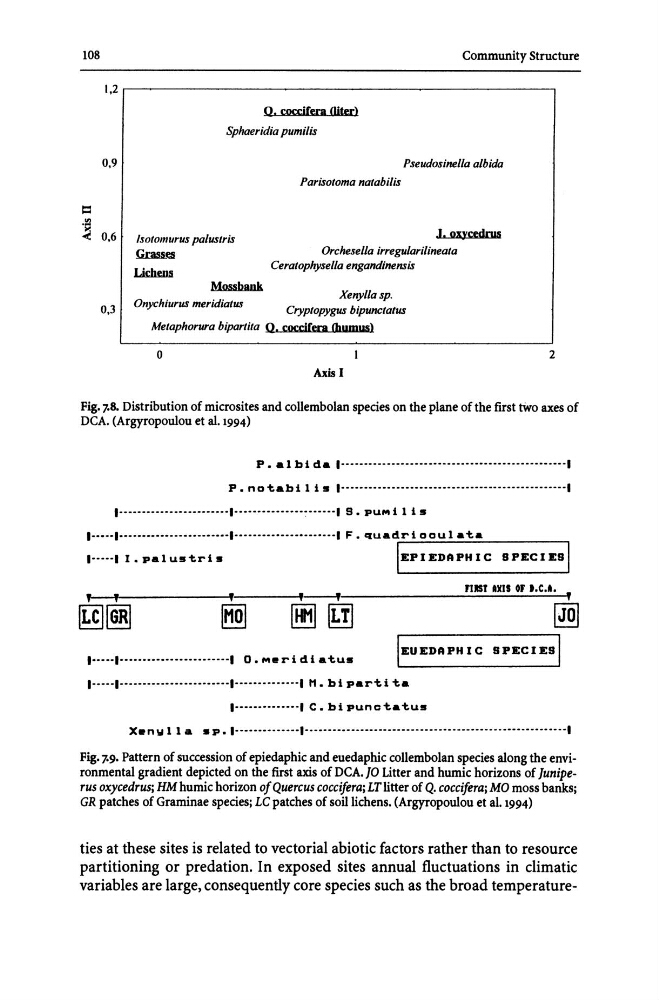
Fig. 7.8. Distribution of microsites and collembolan species on the plane of the first two axes of
DCA. (Argyropoulou et al.1994)
P. a1 bi da 1---------------------------------------·---------1
P. no tab i 1 i s 1-------------------------------------------------1
1------------------------1---------------7------1 S. PUM i 1 i s
1.--.. 1----··--···------.. ··---1-·----.. ------·----.. ·1 F. quadr i 00 u 1 a ta
1"'--1 I. pal ustri s
\EPI EDAPH I C SPECI ES I
flllSI AXIS or D.C... ,
~, ..... ~,~ .......... --. ......... ~, ............... ~,~,--............... --.......... ~~~~~--~
~~
~
[Hffi ~
@Q]
1 .. --·1----·--------·----·-----1 O. Meri di atu.
IEUEDAPHIC SPECIESI
1----·1----------------·------·1--------------1 M. b i part ita
1--------------1 C. b i pun c ta tus
XI! n y 1 1 a • p. 1------·-------1---------------------------------------------------------1
Fig. 7.9. Pattern of succession of epiedaphic and euedaphic collembolan species along the environmental gradient depicted on the first axis of DCA. JO Litter and humic horizons of Junipe·
rus oxycedrus; HM humic horizon of Quercus coccifera; LT litter of Q. coccifera; MO moss banks;
GR patches of Graminae species; LC patches of soil lichens. (Argyropoulou et al. 1994)
ties at these sites is related to vectorial abiotic factors rather than to resource
partitioning or predation. In exposed sites annual fluctuations in climatic
variables are large, consequently core species such as the broad temperature-
.:a
Community Structure
1,2.--------------------------------------------------,
0,9
Q. coccifera OIter)
Sphaeridia pumilis
Parisotoma natabilis
Pseudosinella albida
~ 0,6 Isolomurus palustris
Gi:lI&t:lI
I.oxycedrus
Orchesella irregularilineata
Ceralophysella engandinensis
0,3
Lidu:m
Mossbank
Onychiurus meridialus
Xenyllasp.
CryploPYgus bipunclatus
Melaphorura biparlita Q. coccifera (humus)
o
Axis I
2
Fig. 7.8. Distribution of microsites and collembolan species on the plane of the first two axes of
DCA. (Argyropoulou et al.1994)
P. a1 bi da 1---------------------------------------·---------1
P. no tab i 1 i s 1-------------------------------------------------1
1------------------------1---------------7------1 S. PUM i 1 i s
1.--.. 1----··--···------.. ··---1-·----.. ------·----.. ·1 F. quadr i 00 u 1 a ta
1"'--1 I. pal ustri s
\EPI EDAPH I C SPECI ES I
flllSI AXIS or D.C... ,
~, ..... ~,~ .......... --. ......... ~, ............... ~,~,--............... --.......... ~~~~~--~
~~
~
[Hffi ~
@Q]
1 .. --·1----·--------·----·-----1 O. Meri di atu.
IEUEDAPHIC SPECIESI
1----·1----------------·------·1--------------1 M. b i part ita
1--------------1 C. b i pun c ta tus
XI! n y 1 1 a • p. 1------·-------1---------------------------------------------------------1
Fig. 7.9. Pattern of succession of epiedaphic and euedaphic collembolan species along the environmental gradient depicted on the first axis of DCA. JO Litter and humic horizons of Junipe·
rus oxycedrus; HM humic horizon of Quercus coccifera; LT litter of Q. coccifera; MO moss banks;
GR patches of Graminae species; LC patches of soil lichens. (Argyropoulou et al. 1994)
ties at these sites is related to vectorial abiotic factors rather than to resource
partitioning or predation. In exposed sites annual fluctuations in climatic
variables are large, consequently core species such as the broad temperature-