

Community Structures Induced by Human Practices
107
1,2 r - - - - - - - - - - - - - - - - - - - - - - - - - - - - - ,
Ceratophysella engandinensis
.Ianua.n
D-«emb.er
0,9
Marj;h
==
.!!3
.:i! 0,6
Onychiurus meridiatus
November
Pseudosinella albida .Iwu:
&bJ:.u.o.n
Parisotoma natabilis
Ot.tllb.er
0,3 Cryptopygus bipunctatus
Aprl) Sphaeridia pumilis
o
Axis I
Xenyllasp.
Orchesella irregularilineata
September
2
~
August
3
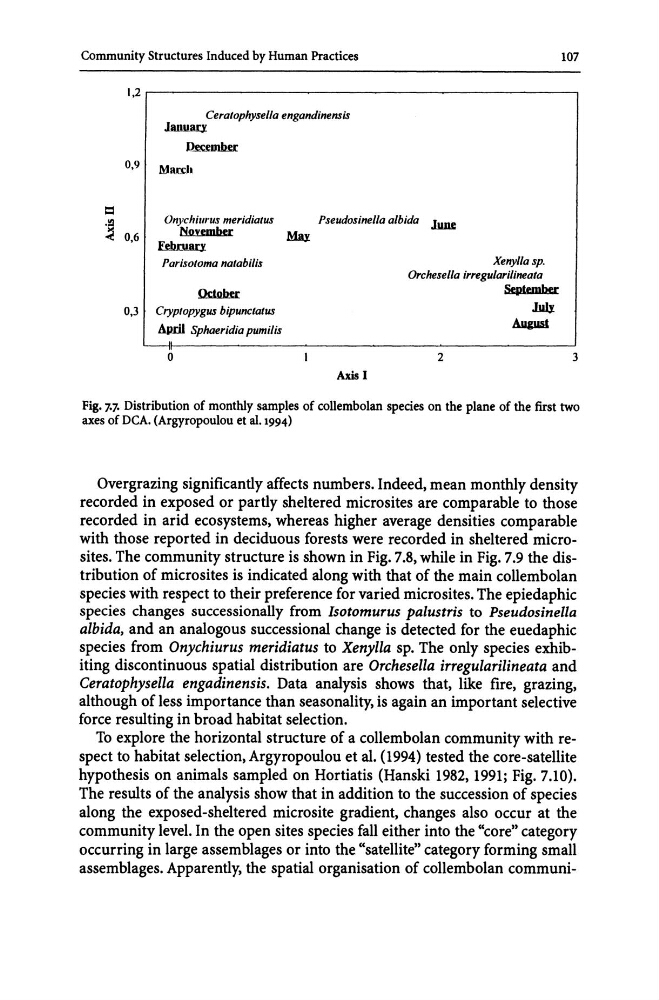
Fig. 7-7. Distribution of monthly samples of collembolan species on the plane of the first two
axes of DCA. (Argyropoulou et at. 1994)
Overgrazing significantly affects numbers. Indeed, mean monthly density
recorded in exposed or partly sheltered micro sites are comparable to those
recorded in arid ecosystems, whereas higher average densities comparable
with those reported in deciduous forests were recorded in sheltered microsites. The community structure is shown in Fig. 7.8, while in Fig. 7.9 the distribution of microsites is indicated along with that of the main collembolan
species with respect to their preference for varied microsites. The epiedaphic
species changes successionally from Isotomurus palustris to Pseudosinella
alb ida, and an analogous successional change is detected for the euedaphic
species from Onychiurus meridiatus to Xenylla sp. The only species exhibiting discontinuous spatial distribution are Orchesella irregularilineata and
Ceratophysella engadinensis. Data analysis shows that, like fire, grazing,
although of less importance than seasonality, is again an important selective
force resulting in broad habitat selection.
To explore the horizontal structure of a collembolan community with respect to habitat selection, Argyropoulou et al. (1994) tested the core-satellite
hypothesis on animals sampled on Hortiatis (Hanski 1982, 1991; Fig. 7.10).
The results of the analysis show that in addition to the succession of species
along the exposed-sheltered microsite gradient, changes also occur at the
community level. In the open sites species fall either into the "core" category
occurring in large assemblages or into the "satellite" category forming small
assemblages. Apparently, the spatial organisation of collembolan communi-
107
1,2 r - - - - - - - - - - - - - - - - - - - - - - - - - - - - - ,
Ceratophysella engandinensis
.Ianua.n
D-«emb.er
0,9
Marj;h
==
.!!3
.:i! 0,6
Onychiurus meridiatus
November
Pseudosinella albida .Iwu:
&bJ:.u.o.n
Parisotoma natabilis
Ot.tllb.er
0,3 Cryptopygus bipunctatus
Aprl) Sphaeridia pumilis
o
Axis I
Xenyllasp.
Orchesella irregularilineata
September
2
~
August
3
Fig. 7-7. Distribution of monthly samples of collembolan species on the plane of the first two
axes of DCA. (Argyropoulou et at. 1994)
Overgrazing significantly affects numbers. Indeed, mean monthly density
recorded in exposed or partly sheltered micro sites are comparable to those
recorded in arid ecosystems, whereas higher average densities comparable
with those reported in deciduous forests were recorded in sheltered microsites. The community structure is shown in Fig. 7.8, while in Fig. 7.9 the distribution of microsites is indicated along with that of the main collembolan
species with respect to their preference for varied microsites. The epiedaphic
species changes successionally from Isotomurus palustris to Pseudosinella
alb ida, and an analogous successional change is detected for the euedaphic
species from Onychiurus meridiatus to Xenylla sp. The only species exhibiting discontinuous spatial distribution are Orchesella irregularilineata and
Ceratophysella engadinensis. Data analysis shows that, like fire, grazing,
although of less importance than seasonality, is again an important selective
force resulting in broad habitat selection.
To explore the horizontal structure of a collembolan community with respect to habitat selection, Argyropoulou et al. (1994) tested the core-satellite
hypothesis on animals sampled on Hortiatis (Hanski 1982, 1991; Fig. 7.10).
The results of the analysis show that in addition to the succession of species
along the exposed-sheltered microsite gradient, changes also occur at the
community level. In the open sites species fall either into the "core" category
occurring in large assemblages or into the "satellite" category forming small
assemblages. Apparently, the spatial organisation of collembolan communi-