

3 Storage and Detoxification of Bivalve Molluscs as a Tool in a Marketing Strategy
35
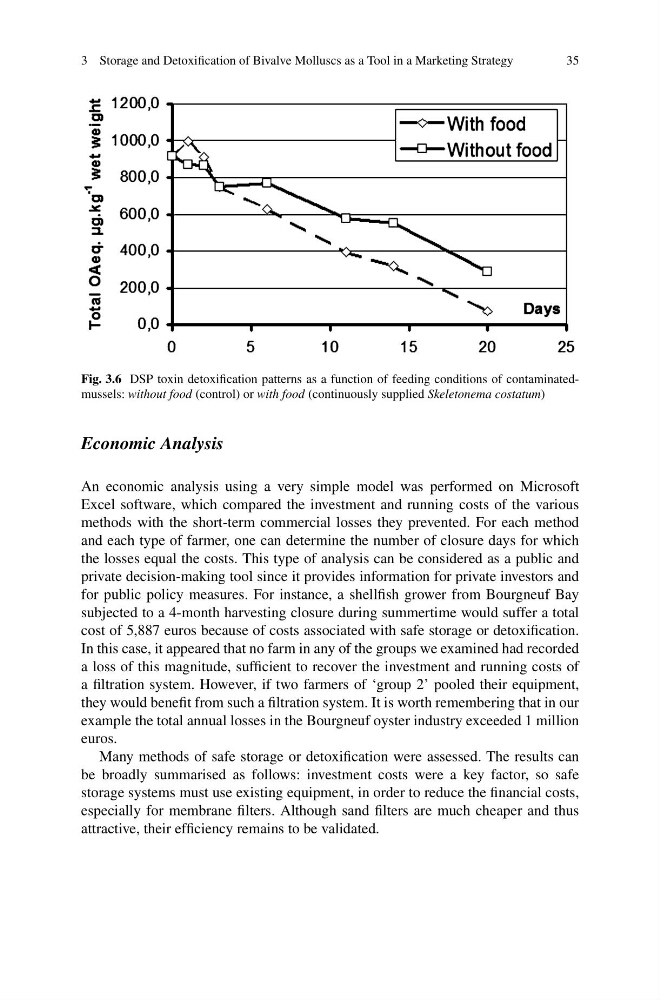
Fig. 3.6 DSP toxin detoxification patterns as a function of feeding conditions of contaminatedmussels: without food (control) or with food (continuously supplied Skeletonema costatum)
Economic Analysis
An economic analysis using a very simple model was performed on Microsoft
Excel software, which compared the investment and running costs of the various
methods with the short-term commercial losses they prevented. For each method
and each type of farmer, one can determine the number of closure days for which
the losses equal the costs. This type of analysis can be considered as a public and
private decision-making tool since it provides information for private investors and
for public policy measures. For instance, a shellfish grower from Bourgneuf Bay
subjected to a 4-month harvesting closure during summertime would suffer a total
cost of 5,887 euros because of costs associated with safe storage or detoxification.
In this case, it appeared that no farm in any of the groups we examined had recorded
a loss of this magnitude, sufficient to recover the investment and running costs of
a filtration system. However, if two farmers of ‘group 2’ pooled their equipment,
they would benefit from such a filtration system. It is worth remembering that in our
example the total annual losses in the Bourgneuf oyster industry exceeded 1 million
euros.
Many methods of safe storage or detoxification were assessed. The results can
be broadly summarised as follows: investment costs were a key factor, so safe
storage systems must use existing equipment, in order to reduce the financial costs,
especially for membrane filters. Although sand filters are much cheaper and thus
attractive, their efficiency remains to be validated.
35
Fig. 3.6 DSP toxin detoxification patterns as a function of feeding conditions of contaminatedmussels: without food (control) or with food (continuously supplied Skeletonema costatum)
Economic Analysis
An economic analysis using a very simple model was performed on Microsoft
Excel software, which compared the investment and running costs of the various
methods with the short-term commercial losses they prevented. For each method
and each type of farmer, one can determine the number of closure days for which
the losses equal the costs. This type of analysis can be considered as a public and
private decision-making tool since it provides information for private investors and
for public policy measures. For instance, a shellfish grower from Bourgneuf Bay
subjected to a 4-month harvesting closure during summertime would suffer a total
cost of 5,887 euros because of costs associated with safe storage or detoxification.
In this case, it appeared that no farm in any of the groups we examined had recorded
a loss of this magnitude, sufficient to recover the investment and running costs of
a filtration system. However, if two farmers of ‘group 2’ pooled their equipment,
they would benefit from such a filtration system. It is worth remembering that in our
example the total annual losses in the Bourgneuf oyster industry exceeded 1 million
euros.
Many methods of safe storage or detoxification were assessed. The results can
be broadly summarised as follows: investment costs were a key factor, so safe
storage systems must use existing equipment, in order to reduce the financial costs,
especially for membrane filters. Although sand filters are much cheaper and thus
attractive, their efficiency remains to be validated.