

34
J. Haure et al.
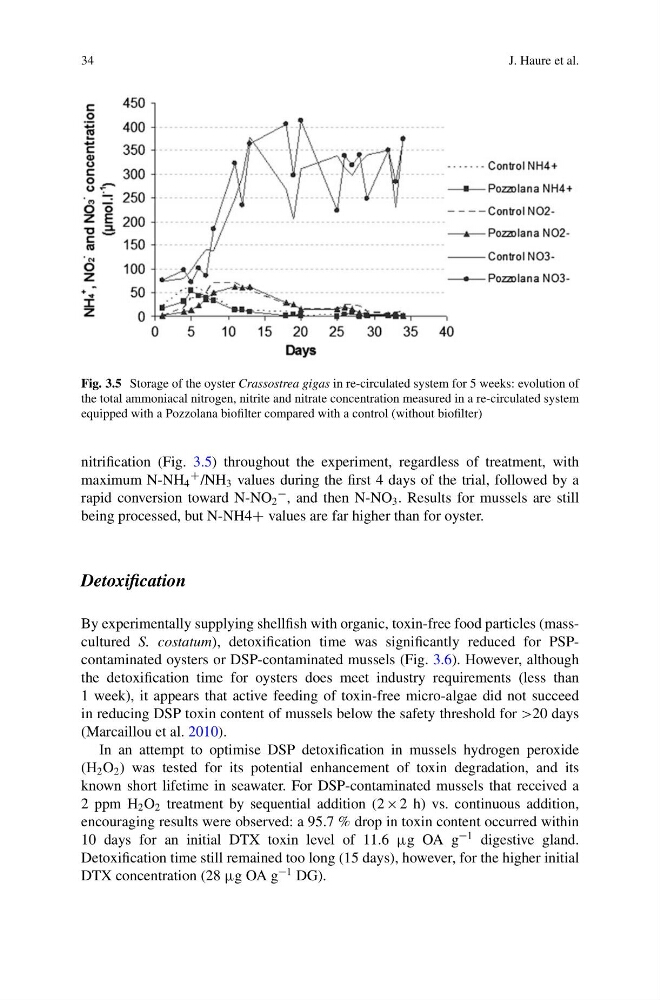
Fig. 3.5 Storage of the oyster Crassostrea gigas in re-circulated system for 5 weeks: evolution of
the total ammoniacal nitrogen, nitrite and nitrate concentration measured in a re-circulated system
equipped with a Pozzolana biofilter compared with a control (without biofilter)
nitrification (Fig. 3.5) throughout the experiment, regardless of treatment, with
maximum N-NH 4
C /NH 3 values during the first 4 days of the trial, followed by a
rapid conversion toward N-NO 2
, and then N-NO 3 . Results for mussels are still
being processed, but N-NH4C values are far higher than for oyster.
Detoxification
By experimentally supplying shellfish with organic, toxin-free food particles (masscultured S. costatum), detoxification time was significantly reduced for PSPcontaminated oysters or DSP-contaminated mussels (Fig. 3.6). However, although
the detoxification time for oysters does meet industry requirements (less than
1 week), it appears that active feeding of toxin-free micro-algae did not succeed
in reducing DSP toxin content of mussels below the safety threshold for >20 days
(Marcaillou et al. 2010).
In an attempt to optimise DSP detoxification in mussels hydrogen peroxide
(H 2 O 2 ) was tested for its potential enhancement of toxin degradation, and its
known short lifetime in seawater. For DSP-contaminated mussels that received a
2 ppm H 2 O 2 treatment by sequential addition (2 2 h) vs. continuous addition,
encouraging results were observed: a 95.7 % drop in toxin content occurred within
10 days for an initial DTX toxin level of 11.6 g OA g
digestive gland.
Detoxification time still remained too long (15 days), however, for the higher initial
DTX concentration (28 g OA g
1 DG).
J. Haure et al.
Fig. 3.5 Storage of the oyster Crassostrea gigas in re-circulated system for 5 weeks: evolution of
the total ammoniacal nitrogen, nitrite and nitrate concentration measured in a re-circulated system
equipped with a Pozzolana biofilter compared with a control (without biofilter)
nitrification (Fig. 3.5) throughout the experiment, regardless of treatment, with
maximum N-NH 4
C /NH 3 values during the first 4 days of the trial, followed by a
rapid conversion toward N-NO 2
, and then N-NO 3 . Results for mussels are still
being processed, but N-NH4C values are far higher than for oyster.
Detoxification
By experimentally supplying shellfish with organic, toxin-free food particles (masscultured S. costatum), detoxification time was significantly reduced for PSPcontaminated oysters or DSP-contaminated mussels (Fig. 3.6). However, although
the detoxification time for oysters does meet industry requirements (less than
1 week), it appears that active feeding of toxin-free micro-algae did not succeed
in reducing DSP toxin content of mussels below the safety threshold for >20 days
(Marcaillou et al. 2010).
In an attempt to optimise DSP detoxification in mussels hydrogen peroxide
(H 2 O 2 ) was tested for its potential enhancement of toxin degradation, and its
known short lifetime in seawater. For DSP-contaminated mussels that received a
2 ppm H 2 O 2 treatment by sequential addition (2 2 h) vs. continuous addition,
encouraging results were observed: a 95.7 % drop in toxin content occurred within
10 days for an initial DTX toxin level of 11.6 g OA g
digestive gland.
Detoxification time still remained too long (15 days), however, for the higher initial
DTX concentration (28 g OA g
1 DG).