

1 Recent International Efforts to Improve Bivalve Molluscan Shellfish Safety
3
Clams, cockles,
ark shells
17%
Mussels
48%
Oysters
11%
Scallops,
pectens
24%
Export-Quantity (tonnes)
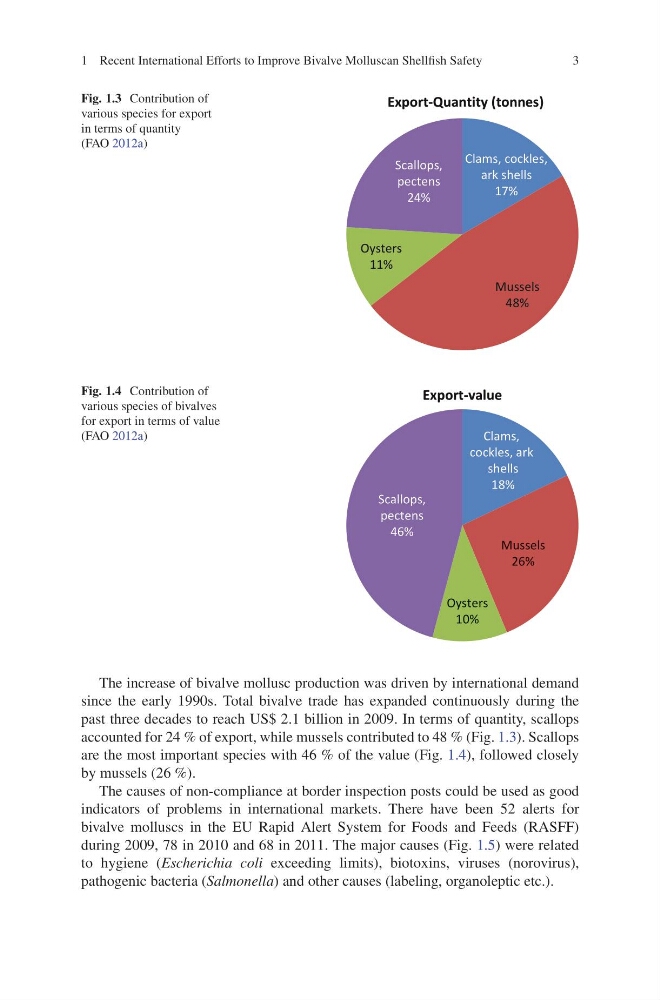
Fig. 1.3 Contribution of
various species for export
in terms of quantity
(FAO 2012a)
Clams,
cockles, ark
shells
18%
Mussels
26%
Oysters
10%
Scallops,
pectens
46%
Export-value
Fig. 1.4 Contribution of
various species of bivalves
for export in terms of value
(FAO 2012a)
The increase of bivalve mollusc production was driven by international demand
since the early 1990s. Total bivalve trade has expanded continuously during the
past three decades to reach US$ 2.1 billion in 2009. In terms of quantity, scallops
accounted for 24 % of export, while mussels contributed to 48 % (Fig. 1.3). Scallops
are the most important species with 46 % of the value (Fig. 1.4), followed closely
by mussels (26 %).
The causes of non-compliance at border inspection posts could be used as good
indicators of problems in international markets. There have been 52 alerts for
bivalve molluscs in the EU Rapid Alert System for Foods and Feeds (RASFF)
during 2009, 78 in 2010 and 68 in 2011. The major causes (Fig. 1.5) were related
to hygiene (Escherichia coli exceeding limits), biotoxins, viruses (norovirus),
pathogenic bacteria (Salmonella) and other causes (labeling, organoleptic etc.).
3
Clams, cockles,
ark shells
17%
Mussels
48%
Oysters
11%
Scallops,
pectens
24%
Export-Quantity (tonnes)
Fig. 1.3 Contribution of
various species for export
in terms of quantity
(FAO 2012a)
Clams,
cockles, ark
shells
18%
Mussels
26%
Oysters
10%
Scallops,
pectens
46%
Export-value
Fig. 1.4 Contribution of
various species of bivalves
for export in terms of value
(FAO 2012a)
The increase of bivalve mollusc production was driven by international demand
since the early 1990s. Total bivalve trade has expanded continuously during the
past three decades to reach US$ 2.1 billion in 2009. In terms of quantity, scallops
accounted for 24 % of export, while mussels contributed to 48 % (Fig. 1.3). Scallops
are the most important species with 46 % of the value (Fig. 1.4), followed closely
by mussels (26 %).
The causes of non-compliance at border inspection posts could be used as good
indicators of problems in international markets. There have been 52 alerts for
bivalve molluscs in the EU Rapid Alert System for Foods and Feeds (RASFF)
during 2009, 78 in 2010 and 68 in 2011. The major causes (Fig. 1.5) were related
to hygiene (Escherichia coli exceeding limits), biotoxins, viruses (norovirus),
pathogenic bacteria (Salmonella) and other causes (labeling, organoleptic etc.).