

14 Bioaccumulation and Removal Dynamics of Murine Norovirus in Manila Clams. . .
171
Table 14.2 Depuration trials (designated as 1–5) on clams
contaminated with MNV-1
T r i a l 1
2
3
4
5
A v
a
T P
0.00
0.00
0.00 0.00 0.00
0.00 (˙0)
T 0
6.49
5.54
6.27 6.04 6.57
6.18 (˙0.4)
T 1
8.00
6.83
6.29 6.12 5.80
6.61 (˙0.9)
T 2
7.63
7.24
5.27 5.51 5.77
6.28 (˙1.1)
T 3
6.48
6.84
6.26 5.36 5.98
6.18 (˙0.6)
T 4
6.07
5.81
5.85 5.65 5.70
5.82 (˙0.2)
T 5
6.69
6.91
6.20 5.80 4.91
6.10 (˙0.8)
T 6
6.41
6.94
5.54 5.52 5.03
5.89 (˙0.8)
T 7
6.50
7.13
5.89 5.71 5.89
6.22 (˙0.6)
vr
b
0.01
c
1.59
c
0.38 0.33 0.68 0.04 (˙0.9)
Results are expressed as logRNA copies/g digestive tissues. T P
sampling at shellfish arrival, T 0 sampling at transfer of shellfish from
the bioaccumulation tanks to the depuration system, T 1 –T 7 day 1–7
samplings during purification process
a Average of the five-depuration trials and standard deviation
b Log units of viral removal at the end of the depuration
c Increase in the depuration rate between T 0 and T 7
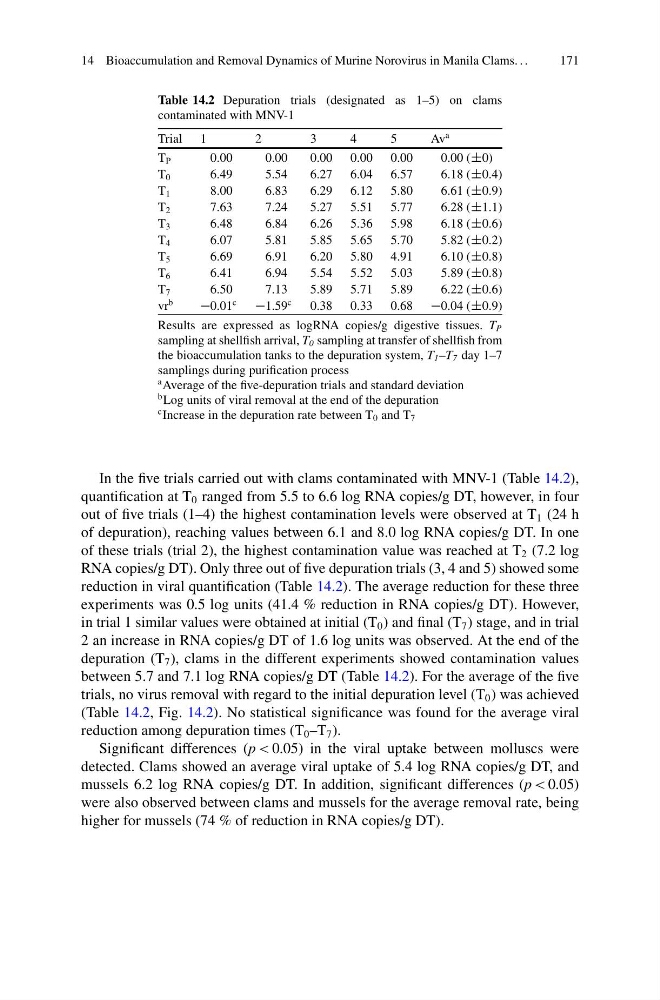
In the five trials carried out with clams contaminated with MNV-1 (Table 14.2),
quantification at T 0 ranged from 5.5 to 6.6 log RNA copies/g DT, however, in four
out of five trials (1–4) the highest contamination levels were observed at T 1 (24 h
of depuration), reaching values between 6.1 and 8.0 log RNA copies/g DT. In one
of these trials (trial 2), the highest contamination value was reached at T 2 (7.2 log
RNA copies/g DT). Only three out of five depuration trials (3, 4 and 5) showed some
reduction in viral quantification (Table 14.2). The average reduction for these three
experiments was 0.5 log units (41.4 % reduction in RNA copies/g DT). However,
in trial 1 similar values were obtained at initial (T 0 ) and final (T 7 ) stage, and in trial
2 an increase in RNA copies/g DT of 1.6 log units was observed. At the end of the
depuration (T 7 ), clams in the different experiments showed contamination values
between 5.7 and 7.1 log RNA copies/g DT (Table 14.2). For the average of the five
trials, no virus removal with regard to the initial depuration level (T 0 ) was achieved
(Table 14.2, Fig. 14.2). No statistical significance was found for the average viral
reduction among depuration times (T 0 –T 7 ).
Significant differences (p < 0.05) in the viral uptake between molluscs were
detected. Clams showed an average viral uptake of 5.4 log RNA copies/g DT, and
mussels 6.2 log RNA copies/g DT. In addition, significant differences (p < 0.05)
were also observed between clams and mussels for the average removal rate, being
higher for mussels (74 % of reduction in RNA copies/g DT).
171
Table 14.2 Depuration trials (designated as 1–5) on clams
contaminated with MNV-1
T r i a l 1
2
3
4
5
A v
a
T P
0.00
0.00
0.00 0.00 0.00
0.00 (˙0)
T 0
6.49
5.54
6.27 6.04 6.57
6.18 (˙0.4)
T 1
8.00
6.83
6.29 6.12 5.80
6.61 (˙0.9)
T 2
7.63
7.24
5.27 5.51 5.77
6.28 (˙1.1)
T 3
6.48
6.84
6.26 5.36 5.98
6.18 (˙0.6)
T 4
6.07
5.81
5.85 5.65 5.70
5.82 (˙0.2)
T 5
6.69
6.91
6.20 5.80 4.91
6.10 (˙0.8)
T 6
6.41
6.94
5.54 5.52 5.03
5.89 (˙0.8)
T 7
6.50
7.13
5.89 5.71 5.89
6.22 (˙0.6)
vr
b
0.01
c
1.59
c
0.38 0.33 0.68 0.04 (˙0.9)
Results are expressed as logRNA copies/g digestive tissues. T P
sampling at shellfish arrival, T 0 sampling at transfer of shellfish from
the bioaccumulation tanks to the depuration system, T 1 –T 7 day 1–7
samplings during purification process
a Average of the five-depuration trials and standard deviation
b Log units of viral removal at the end of the depuration
c Increase in the depuration rate between T 0 and T 7
In the five trials carried out with clams contaminated with MNV-1 (Table 14.2),
quantification at T 0 ranged from 5.5 to 6.6 log RNA copies/g DT, however, in four
out of five trials (1–4) the highest contamination levels were observed at T 1 (24 h
of depuration), reaching values between 6.1 and 8.0 log RNA copies/g DT. In one
of these trials (trial 2), the highest contamination value was reached at T 2 (7.2 log
RNA copies/g DT). Only three out of five depuration trials (3, 4 and 5) showed some
reduction in viral quantification (Table 14.2). The average reduction for these three
experiments was 0.5 log units (41.4 % reduction in RNA copies/g DT). However,
in trial 1 similar values were obtained at initial (T 0 ) and final (T 7 ) stage, and in trial
2 an increase in RNA copies/g DT of 1.6 log units was observed. At the end of the
depuration (T 7 ), clams in the different experiments showed contamination values
between 5.7 and 7.1 log RNA copies/g DT (Table 14.2). For the average of the five
trials, no virus removal with regard to the initial depuration level (T 0 ) was achieved
(Table 14.2, Fig. 14.2). No statistical significance was found for the average viral
reduction among depuration times (T 0 –T 7 ).
Significant differences (p < 0.05) in the viral uptake between molluscs were
detected. Clams showed an average viral uptake of 5.4 log RNA copies/g DT, and
mussels 6.2 log RNA copies/g DT. In addition, significant differences (p < 0.05)
were also observed between clams and mussels for the average removal rate, being
higher for mussels (74 % of reduction in RNA copies/g DT).