

12 Distribution of Cd, Pb, As and Hg in Oyster Tissue, Sediment and Water. . .
143
Results and Discussions
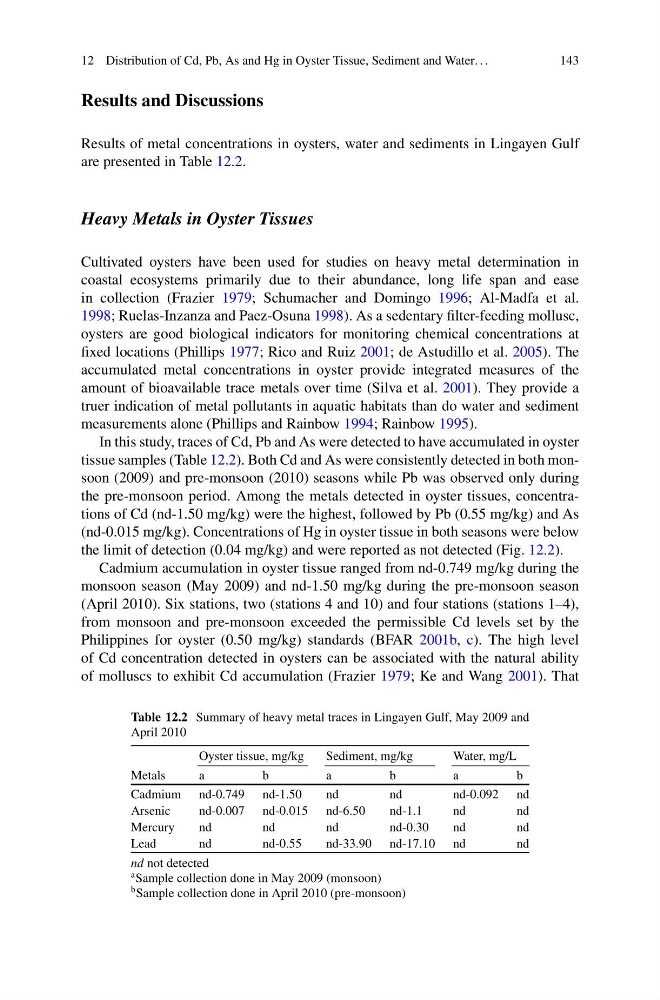
Results of metal concentrations in oysters, water and sediments in Lingayen Gulf
are presented in Table 12.2.
Heavy Metals in Oyster Tissues
Cultivated oysters have been used for studies on heavy metal determination in
coastal ecosystems primarily due to their abundance, long life span and ease
in collection (Frazier 1979; Schumacher and Domingo 1996; Al-Madfa et al.
1998; Ruelas-Inzanza and Paez-Osuna 1998). As a sedentary filter-feeding mollusc,
oysters are good biological indicators for monitoring chemical concentrations at
fixed locations (Phillips 1977; Rico and Ruiz 2001; de Astudillo et al. 2005). The
accumulated metal concentrations in oyster provide integrated measures of the
amount of bioavailable trace metals over time (Silva et al. 2001). They provide a
truer indication of metal pollutants in aquatic habitats than do water and sediment
measurements alone (Phillips and Rainbow 1994; Rainbow 1995).
In this study, traces of Cd, Pb and As were detected to have accumulated in oyster
tissue samples (Table 12.2). Both Cd and As were consistently detected in both monsoon (2009) and pre-monsoon (2010) seasons while Pb was observed only during
the pre-monsoon period. Among the metals detected in oyster tissues, concentrations of Cd (nd-1.50 mg/kg) were the highest, followed by Pb (0.55 mg/kg) and As
(nd-0.015 mg/kg). Concentrations of Hg in oyster tissue in both seasons were below
the limit of detection (0.04 mg/kg) and were reported as not detected (Fig. 12.2).
Cadmium accumulation in oyster tissue ranged from nd-0.749 mg/kg during the
monsoon season (May 2009) and nd-1.50 mg/kg during the pre-monsoon season
(April 2010). Six stations, two (stations 4 and 10) and four stations (stations 1–4),
from monsoon and pre-monsoon exceeded the permissible Cd levels set by the
Philippines for oyster (0.50 mg/kg) standards (BFAR 2001b, c). The high level
of Cd concentration detected in oysters can be associated with the natural ability
of molluscs to exhibit Cd accumulation (Frazier 1979; Ke and Wang 2001). That
Table 12.2 Summary of heavy metal traces in Lingayen Gulf, May 2009 and
April 2010
Oyster tissue, mg/kg
Sediment, mg/kg
Water, mg/L
Metals
a
b
a
b
a
b
Cadmium nd-0.749 nd-1.50
nd
nd
nd-0.092 nd
Arsenic
nd-0.007 nd-0.015 nd-6.50
nd-1.1
nd
nd
Mercury
nd
nd
nd
nd-0.30
nd
nd
Lead
nd
nd-0.55
nd-33.90 nd-17.10 nd
nd
nd not detected
a Sample collection done in May 2009 (monsoon)
b Sample collection done in April 2010 (pre-monsoon)
143
Results and Discussions
Results of metal concentrations in oysters, water and sediments in Lingayen Gulf
are presented in Table 12.2.
Heavy Metals in Oyster Tissues
Cultivated oysters have been used for studies on heavy metal determination in
coastal ecosystems primarily due to their abundance, long life span and ease
in collection (Frazier 1979; Schumacher and Domingo 1996; Al-Madfa et al.
1998; Ruelas-Inzanza and Paez-Osuna 1998). As a sedentary filter-feeding mollusc,
oysters are good biological indicators for monitoring chemical concentrations at
fixed locations (Phillips 1977; Rico and Ruiz 2001; de Astudillo et al. 2005). The
accumulated metal concentrations in oyster provide integrated measures of the
amount of bioavailable trace metals over time (Silva et al. 2001). They provide a
truer indication of metal pollutants in aquatic habitats than do water and sediment
measurements alone (Phillips and Rainbow 1994; Rainbow 1995).
In this study, traces of Cd, Pb and As were detected to have accumulated in oyster
tissue samples (Table 12.2). Both Cd and As were consistently detected in both monsoon (2009) and pre-monsoon (2010) seasons while Pb was observed only during
the pre-monsoon period. Among the metals detected in oyster tissues, concentrations of Cd (nd-1.50 mg/kg) were the highest, followed by Pb (0.55 mg/kg) and As
(nd-0.015 mg/kg). Concentrations of Hg in oyster tissue in both seasons were below
the limit of detection (0.04 mg/kg) and were reported as not detected (Fig. 12.2).
Cadmium accumulation in oyster tissue ranged from nd-0.749 mg/kg during the
monsoon season (May 2009) and nd-1.50 mg/kg during the pre-monsoon season
(April 2010). Six stations, two (stations 4 and 10) and four stations (stations 1–4),
from monsoon and pre-monsoon exceeded the permissible Cd levels set by the
Philippines for oyster (0.50 mg/kg) standards (BFAR 2001b, c). The high level
of Cd concentration detected in oysters can be associated with the natural ability
of molluscs to exhibit Cd accumulation (Frazier 1979; Ke and Wang 2001). That
Table 12.2 Summary of heavy metal traces in Lingayen Gulf, May 2009 and
April 2010
Oyster tissue, mg/kg
Sediment, mg/kg
Water, mg/L
Metals
a
b
a
b
a
b
Cadmium nd-0.749 nd-1.50
nd
nd
nd-0.092 nd
Arsenic
nd-0.007 nd-0.015 nd-6.50
nd-1.1
nd
nd
Mercury
nd
nd
nd
nd-0.30
nd
nd
Lead
nd
nd-0.55
nd-33.90 nd-17.10 nd
nd
nd not detected
a Sample collection done in May 2009 (monsoon)
b Sample collection done in April 2010 (pre-monsoon)