

8 Defining a Sampling Strategy for Okadaic Acid (OA) Toxins in Shellfish. . .
93
1. For population variance: the larger the population variance, the larger the
sampling error.
2. For the number of individuals in each sample: the larger the number of
individuals sampled, the smaller the sampling error. This principle is called the
law of large numbers.
The last factor requires further explanation:
Variability between sub-samples which consists of pools of individuals is the
variability between means. Indeed, we can consider that the OA concentration of a
pool is equal to the mean of the concentrations of the individuals in the pool. The
standard error of the mean is the standard deviation of the sample mean estimate of
a population mean. It is usually estimated by the sample estimate of the population
standard deviation divided by the square root of the sample size (assuming statistical
independence of the values in the sample).
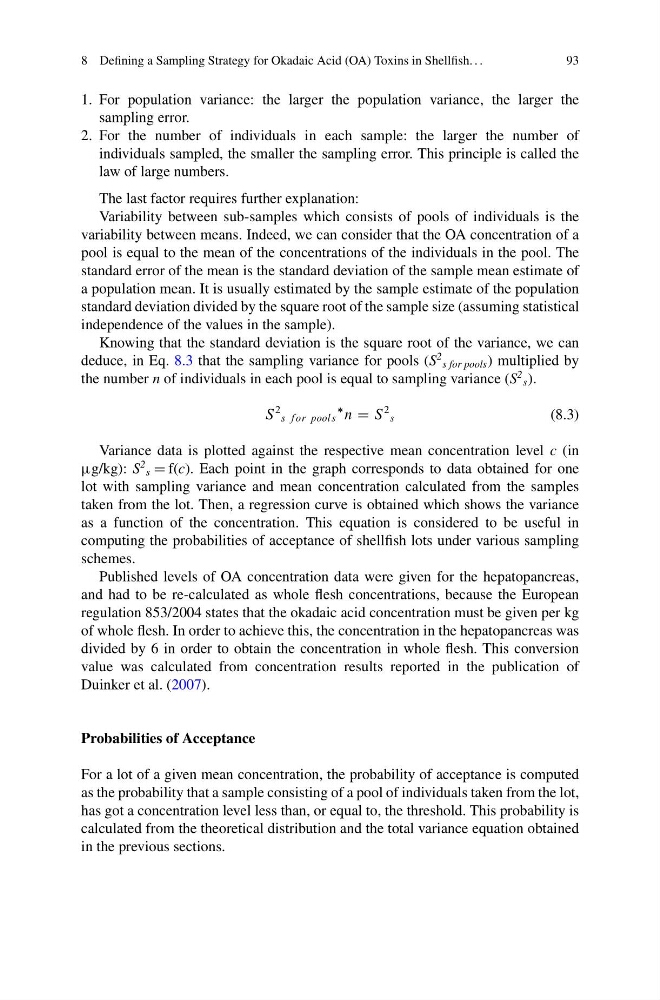
Knowing that the standard deviation is the square root of the variance, we can
deduce, in Eq. 8.3 that the sampling variance for pools (S
2
s for pools ) multiplied by
the number n of individuals in each pool is equal to sampling variance (S
2
s ).
S
2 s f or pools
n D S
2 s
(8.3)
Variance data is plotted against the respective mean concentration level c (in
g/kg): S
2
s D f(c). Each point in the graph corresponds to data obtained for one
lot with sampling variance and mean concentration calculated from the samples
taken from the lot. Then, a regression curve is obtained which shows the variance
as a function of the concentration. This equation is considered to be useful in
computing the probabilities of acceptance of shellfish lots under various sampling
schemes.
Published levels of OA concentration data were given for the hepatopancreas,
and had to be re-calculated as whole flesh concentrations, because the European
regulation 853/2004 states that the okadaic acid concentration must be given per kg
of whole flesh. In order to achieve this, the concentration in the hepatopancreas was
divided by 6 in order to obtain the concentration in whole flesh. This conversion
value was calculated from concentration results reported in the publication of
Duinker et al. (2007).
Probabilities of Acceptance
For a lot of a given mean concentration, the probability of acceptance is computed
as the probability that a sample consisting of a pool of individuals taken from the lot,
has got a concentration level less than, or equal to, the threshold. This probability is
calculated from the theoretical distribution and the total variance equation obtained
in the previous sections.
93
1. For population variance: the larger the population variance, the larger the
sampling error.
2. For the number of individuals in each sample: the larger the number of
individuals sampled, the smaller the sampling error. This principle is called the
law of large numbers.
The last factor requires further explanation:
Variability between sub-samples which consists of pools of individuals is the
variability between means. Indeed, we can consider that the OA concentration of a
pool is equal to the mean of the concentrations of the individuals in the pool. The
standard error of the mean is the standard deviation of the sample mean estimate of
a population mean. It is usually estimated by the sample estimate of the population
standard deviation divided by the square root of the sample size (assuming statistical
independence of the values in the sample).
Knowing that the standard deviation is the square root of the variance, we can
deduce, in Eq. 8.3 that the sampling variance for pools (S
2
s for pools ) multiplied by
the number n of individuals in each pool is equal to sampling variance (S
2
s ).
S
2 s f or pools
n D S
2 s
(8.3)
Variance data is plotted against the respective mean concentration level c (in
g/kg): S
2
s D f(c). Each point in the graph corresponds to data obtained for one
lot with sampling variance and mean concentration calculated from the samples
taken from the lot. Then, a regression curve is obtained which shows the variance
as a function of the concentration. This equation is considered to be useful in
computing the probabilities of acceptance of shellfish lots under various sampling
schemes.
Published levels of OA concentration data were given for the hepatopancreas,
and had to be re-calculated as whole flesh concentrations, because the European
regulation 853/2004 states that the okadaic acid concentration must be given per kg
of whole flesh. In order to achieve this, the concentration in the hepatopancreas was
divided by 6 in order to obtain the concentration in whole flesh. This conversion
value was calculated from concentration results reported in the publication of
Duinker et al. (2007).
Probabilities of Acceptance
For a lot of a given mean concentration, the probability of acceptance is computed
as the probability that a sample consisting of a pool of individuals taken from the lot,
has got a concentration level less than, or equal to, the threshold. This probability is
calculated from the theoretical distribution and the total variance equation obtained
in the previous sections.