

Food Supply Regimes and Individual Growth Histories
85
Table 4.2. Model parameters for body growth in Daphnia pulex
Parameter
Value
B/
Neonate size
1.1
J!gC
B'
Size at ftrst reproductive investment
7.5
J!g C
B'", Extrapolated body size where ingestion is zero
132.0
J!gC
C'
Incipient limiting food concentration
0.17
(mgC) r 1
e
Food carbon assimilation efftciency
0.8
h
Specific molting loss rate
0.045
day" 1
I' /
Maximum specific ingestion rate in neonates
1.05
day"l
R'
Maximum fraction allocated to reproduction
0.8
r
Specific respiration rate
0.25
day"l
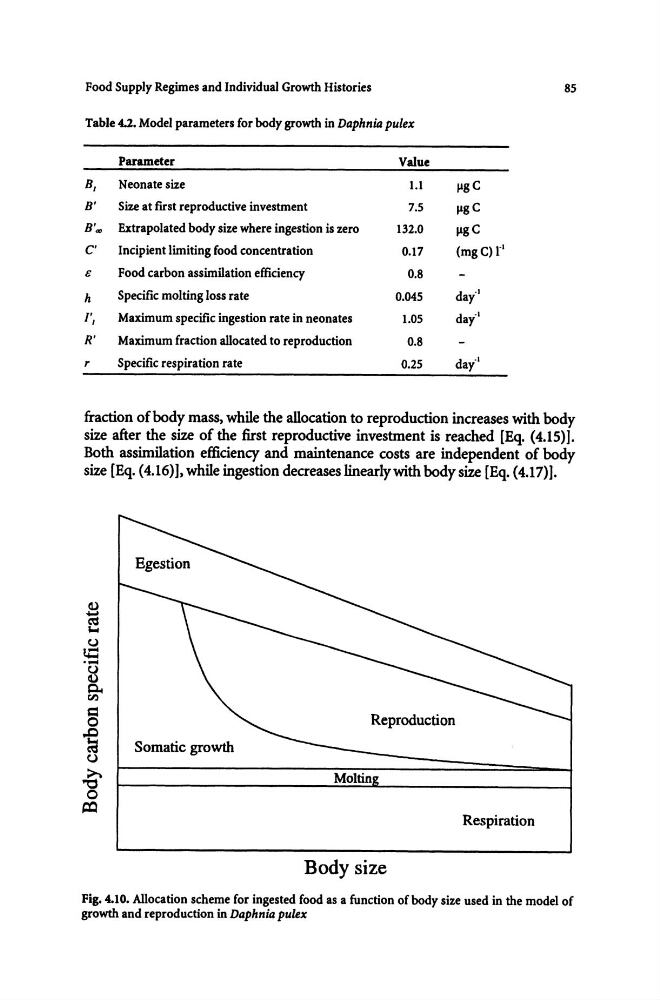
fraction of body mass, while the allocation to reproduction increases with body
size after the size of the first reproductive investment is reached [Eq. (4.15)].
Both assimilation efficiency and maintenance costs are independent of body
size [Eq. (4.16)], while ingestion decreases linearly with body size [Eq. (4.17)].
Reproduction
Somatic growth
Moltin
Respiration
Body size
Fig. 4.10. Allocation scheme for ingested food as a function of body size used in the model of
growth and reproduction in Daphnia pulex
85
Table 4.2. Model parameters for body growth in Daphnia pulex
Parameter
Value
B/
Neonate size
1.1
J!gC
B'
Size at ftrst reproductive investment
7.5
J!g C
B'", Extrapolated body size where ingestion is zero
132.0
J!gC
C'
Incipient limiting food concentration
0.17
(mgC) r 1
e
Food carbon assimilation efftciency
0.8
h
Specific molting loss rate
0.045
day" 1
I' /
Maximum specific ingestion rate in neonates
1.05
day"l
R'
Maximum fraction allocated to reproduction
0.8
r
Specific respiration rate
0.25
day"l
fraction of body mass, while the allocation to reproduction increases with body
size after the size of the first reproductive investment is reached [Eq. (4.15)].
Both assimilation efficiency and maintenance costs are independent of body
size [Eq. (4.16)], while ingestion decreases linearly with body size [Eq. (4.17)].
Reproduction
Somatic growth
Moltin
Respiration
Body size
Fig. 4.10. Allocation scheme for ingested food as a function of body size used in the model of
growth and reproduction in Daphnia pulex