

84
Herbivores and Algae: Food Utilization, Growth and Reproduction •••
The simulations indicate that growth at the three lowest densities in Fig. 4.9
were indistinguishable from unlimited growth in the experiments of Taylor
(1985) and Lynch (1989). Under a semicontinuous feeding regime, all
animals will initially grow at the maximum rate and depart from the unlimited growth curve when reaching a size where the energy requirements
corresponding to maximum growth rate exceed the ration (Fig. 4.9). Body
growth stops when the fraction of the ration energy allocated to somatic
growth is used up by respiration and maintenance in the starvation period
after the food is exhausted. This does not imply that egg production stops,
as one of the main assumptions behind the model is that material allocated
to reproduction before the food is exhausted cannot be reallocated to
maintenance when the starvation period starts. In contrast, under the
constant, suboptimal food conditions of a flow-through system, growth will
follow the same pattern as for animals with sufficient food, but the overall
growth rate will be reduced (Fig. 4.8).
Food-Limited Individual Growth in Daphnia. In the course of this chapter,
a model of individual growth and reproduction in Daphnia has been
formulated, with an emphasis on the major changes in the fate of assimilated energy accompanying maturation. The abundance of experimental
data on Daphnia pulex makes it possible to use this genus as a model
species and to obtain a high degree of consistency between individual parameter estimates. The conformity between model output and experimental
data from several sources indicates that the model captures some of the
essential features of Daphnia biology, although it cannot be taken as a
rigorous validation of the model.
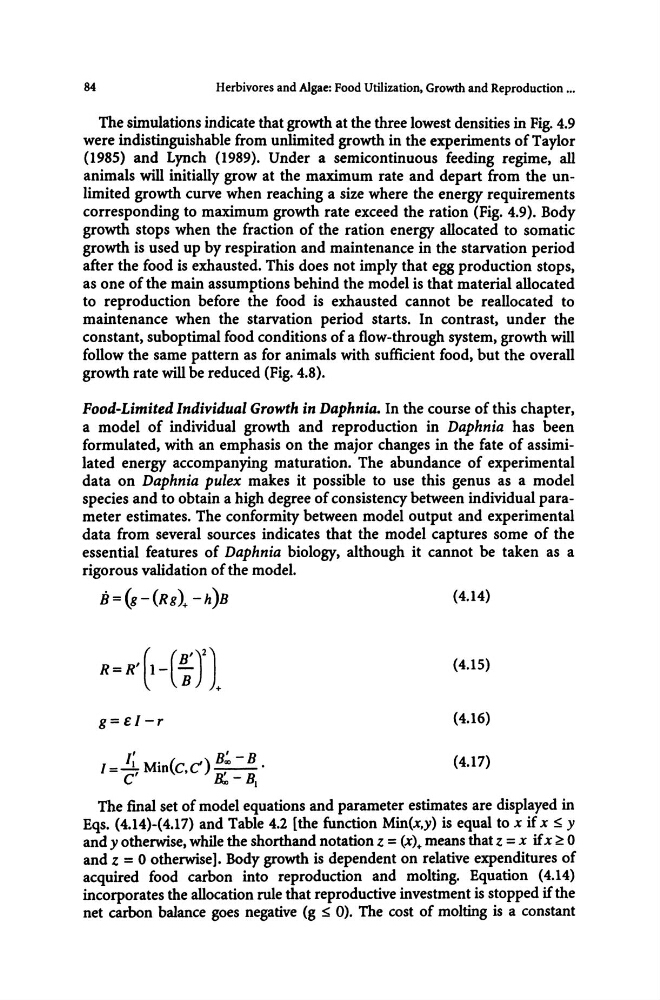
b=(g-(Rgt -h)B
(4.14)
(4.15)
g=el-r
(4.16)
I I: M' (C C') B~ - B .
=-, In, - , - -
C
&-B.
(4.17)
The final set of model equations and parameter estimates are displayed in
Eqs. (4.14)-{4.17) and Table 4.2 [the function Min{x,y) is equal to x if x ~ y
and y otherwise, while the shorthand notation z = (x)+ means that z = x if x ~ 0
and z = 0 otherwise]. Body growth is dependent on relative expenditures of
acquired food carbon into reproduction and molting. Equation (4.14)
incorporates the allocation rule that reproductive investment is stopped if the
net carbon balance goes negative (g ~ 0). The cost of molting is a constant
Herbivores and Algae: Food Utilization, Growth and Reproduction •••
The simulations indicate that growth at the three lowest densities in Fig. 4.9
were indistinguishable from unlimited growth in the experiments of Taylor
(1985) and Lynch (1989). Under a semicontinuous feeding regime, all
animals will initially grow at the maximum rate and depart from the unlimited growth curve when reaching a size where the energy requirements
corresponding to maximum growth rate exceed the ration (Fig. 4.9). Body
growth stops when the fraction of the ration energy allocated to somatic
growth is used up by respiration and maintenance in the starvation period
after the food is exhausted. This does not imply that egg production stops,
as one of the main assumptions behind the model is that material allocated
to reproduction before the food is exhausted cannot be reallocated to
maintenance when the starvation period starts. In contrast, under the
constant, suboptimal food conditions of a flow-through system, growth will
follow the same pattern as for animals with sufficient food, but the overall
growth rate will be reduced (Fig. 4.8).
Food-Limited Individual Growth in Daphnia. In the course of this chapter,
a model of individual growth and reproduction in Daphnia has been
formulated, with an emphasis on the major changes in the fate of assimilated energy accompanying maturation. The abundance of experimental
data on Daphnia pulex makes it possible to use this genus as a model
species and to obtain a high degree of consistency between individual parameter estimates. The conformity between model output and experimental
data from several sources indicates that the model captures some of the
essential features of Daphnia biology, although it cannot be taken as a
rigorous validation of the model.
b=(g-(Rgt -h)B
(4.14)
(4.15)
g=el-r
(4.16)
I I: M' (C C') B~ - B .
=-, In, - , - -
C
&-B.
(4.17)
The final set of model equations and parameter estimates are displayed in
Eqs. (4.14)-{4.17) and Table 4.2 [the function Min{x,y) is equal to x if x ~ y
and y otherwise, while the shorthand notation z = (x)+ means that z = x if x ~ 0
and z = 0 otherwise]. Body growth is dependent on relative expenditures of
acquired food carbon into reproduction and molting. Equation (4.14)
incorporates the allocation rule that reproductive investment is stopped if the
net carbon balance goes negative (g ~ 0). The cost of molting is a constant