

The Allocation of Net Assimilate
67
Assimilated food has to support three main processes in growing animals: the generation of new body mass (somatic growth), the production of
offspring (reproductive growth), and the requirements of maintenance. In
Daphnia, maintenance includes both the costs of basal, cellular metabolism
to support body functions and the cost of regenerating lost material like
exuviae. It is reasonable to assume that maintenance takes priority over the
other processes, so that both somatic growth and reproduction are halted
when food assimilation is inadequate to cover maintenance needs. When
assimilation is sufficient to support growth, experimental evidence suggests
that in Daphnia the relative allocation into somatic and reproductive
growth is dependent only on body size and not on the food supply (Lynch
1989).
4.2 The Allocation of Net Assimilate
Nutrition can be defined as the balance of physiological processes enabling
an animal to survive, grow, and reproduce (Conover 1968). As food carbon
will be the energy source of an animal, we can expect the energy budget of
an animal to be closely related to its carbon mass balance. Under the
assumption of a food source matching all the requirements of the animal,
the main processes involved in animal nutrition can therefore be represented by the carbon mass balance, where ingested food carbon is either
used for growth and reproduction, respired, or egested (e.g., Richman
1958). If we represent carbon egestion as a fraction 1 - & of carbon ingestion, where & is the dimensionless food assimilation efficiency, then the
basic carbon or energy balance can be written in terms of body-carbonspecific rates as
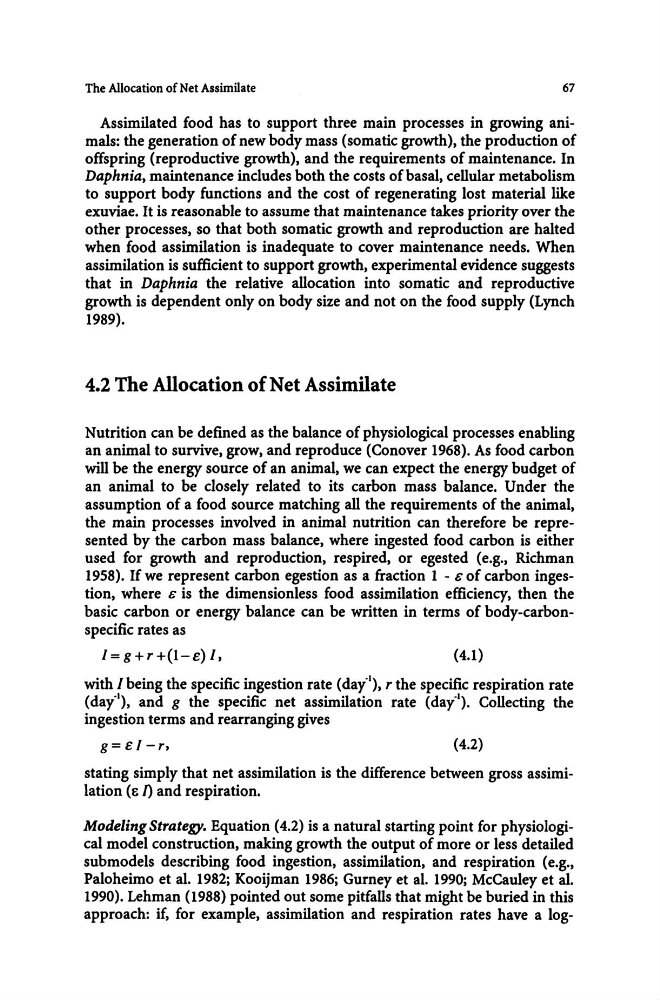
l=g+r+(l-e)l,
(4.1)
with I being the specific ingestion rate (datI), r the specific respiration rate
(datI), and g the specific net assimilation rate (datI). Collecting the
ingestion terms and rearranging gives
g= el-r,
(4.2)
stating simply that net assimilation is the difference between gross assimilation (8 I) and respiration.
ModelingStrategy. Equation (4.2) is a natural starting point for physiological model construction, making growth the output of more or less detailed
submodels describing food ingestion, assimilation, and respiration (e.g.,
Paloheimo et al. 1982; Kooijman 1986; Gurneyet al. 1990; McCauley et al.
1990). Lehman (1988) pointed out some pitfalls that might be buried in this
approach: if, for example, assimilation and respiration rates have a log-
67
Assimilated food has to support three main processes in growing animals: the generation of new body mass (somatic growth), the production of
offspring (reproductive growth), and the requirements of maintenance. In
Daphnia, maintenance includes both the costs of basal, cellular metabolism
to support body functions and the cost of regenerating lost material like
exuviae. It is reasonable to assume that maintenance takes priority over the
other processes, so that both somatic growth and reproduction are halted
when food assimilation is inadequate to cover maintenance needs. When
assimilation is sufficient to support growth, experimental evidence suggests
that in Daphnia the relative allocation into somatic and reproductive
growth is dependent only on body size and not on the food supply (Lynch
1989).
4.2 The Allocation of Net Assimilate
Nutrition can be defined as the balance of physiological processes enabling
an animal to survive, grow, and reproduce (Conover 1968). As food carbon
will be the energy source of an animal, we can expect the energy budget of
an animal to be closely related to its carbon mass balance. Under the
assumption of a food source matching all the requirements of the animal,
the main processes involved in animal nutrition can therefore be represented by the carbon mass balance, where ingested food carbon is either
used for growth and reproduction, respired, or egested (e.g., Richman
1958). If we represent carbon egestion as a fraction 1 - & of carbon ingestion, where & is the dimensionless food assimilation efficiency, then the
basic carbon or energy balance can be written in terms of body-carbonspecific rates as
l=g+r+(l-e)l,
(4.1)
with I being the specific ingestion rate (datI), r the specific respiration rate
(datI), and g the specific net assimilation rate (datI). Collecting the
ingestion terms and rearranging gives
g= el-r,
(4.2)
stating simply that net assimilation is the difference between gross assimilation (8 I) and respiration.
ModelingStrategy. Equation (4.2) is a natural starting point for physiological model construction, making growth the output of more or less detailed
submodels describing food ingestion, assimilation, and respiration (e.g.,
Paloheimo et al. 1982; Kooijman 1986; Gurneyet al. 1990; McCauley et al.
1990). Lehman (1988) pointed out some pitfalls that might be buried in this
approach: if, for example, assimilation and respiration rates have a log-