

66
Herbivores and Algae: Food Utilization, Growth and Reproduction ...
Nutrition and Energy Allocation. The relationships between the major
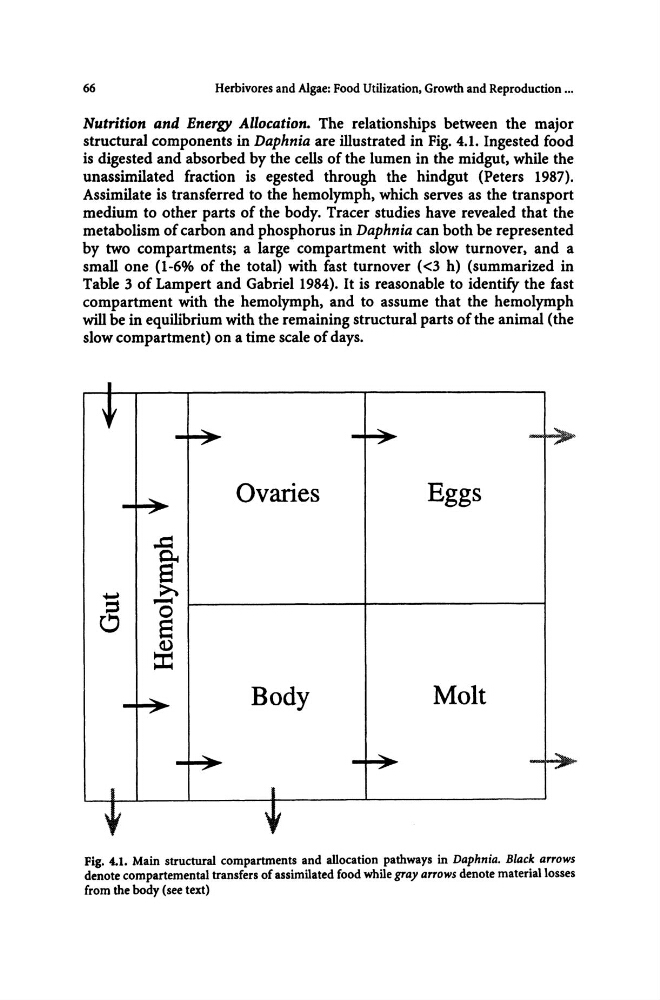
structural components in Daphnia are illustrated in Fig. 4.1. Ingested food
is digested and absorbed by the cells of the lumen in the midgut. while the
unassimilated fraction is egested through the hindgut (Peters 1987).
Assimilate is transferred to the hemolymph, which serves as the transport
medium to other parts of the body. Tracer studies have revealed that the
metabolism of carbon and phosphorus in Daphnia can both be represented
by two compartments; a large compartment with slow turnover, and a
small one (1-6% of the total) with fast turnover «3 h) (summarized in
Table 3 of Lampert and Gabriel 1984). It is reasonable to identify the fast
compartment with the hemolymph, and to assume that the hemolymph
will be in equilibrium with the remaining structural parts of the animal (the
slow compartment) on a time scale of days.
,v
......
......
....
,
; i '
,.
~
Ovaries
Eggs
,
..s::
~
~
~
a
~
0
e
~
::c
......
Body
Molt
,
_ .....
......
.....
.,
,.
,~
'f
Pig. 4.1. Main structural compartments and allocation pathways in Daphnia. Black arrows
denote compartemental transfers of assimilated food while gray arrows denote material losses
from the body (see text)
Herbivores and Algae: Food Utilization, Growth and Reproduction ...
Nutrition and Energy Allocation. The relationships between the major
structural components in Daphnia are illustrated in Fig. 4.1. Ingested food
is digested and absorbed by the cells of the lumen in the midgut. while the
unassimilated fraction is egested through the hindgut (Peters 1987).
Assimilate is transferred to the hemolymph, which serves as the transport
medium to other parts of the body. Tracer studies have revealed that the
metabolism of carbon and phosphorus in Daphnia can both be represented
by two compartments; a large compartment with slow turnover, and a
small one (1-6% of the total) with fast turnover «3 h) (summarized in
Table 3 of Lampert and Gabriel 1984). It is reasonable to identify the fast
compartment with the hemolymph, and to assume that the hemolymph
will be in equilibrium with the remaining structural parts of the animal (the
slow compartment) on a time scale of days.
,v
......
......
....
,
; i '
,.
~
Ovaries
Eggs
,
..s::
~
~
~
a
~
0
e
~
::c
......
Body
Molt
,
_ .....
......
.....
.,
,.
,~
'f
Pig. 4.1. Main structural compartments and allocation pathways in Daphnia. Black arrows
denote compartemental transfers of assimilated food while gray arrows denote material losses
from the body (see text)