

S4
Algae and Nutrients: Uptake and Utilization of Limiting ...
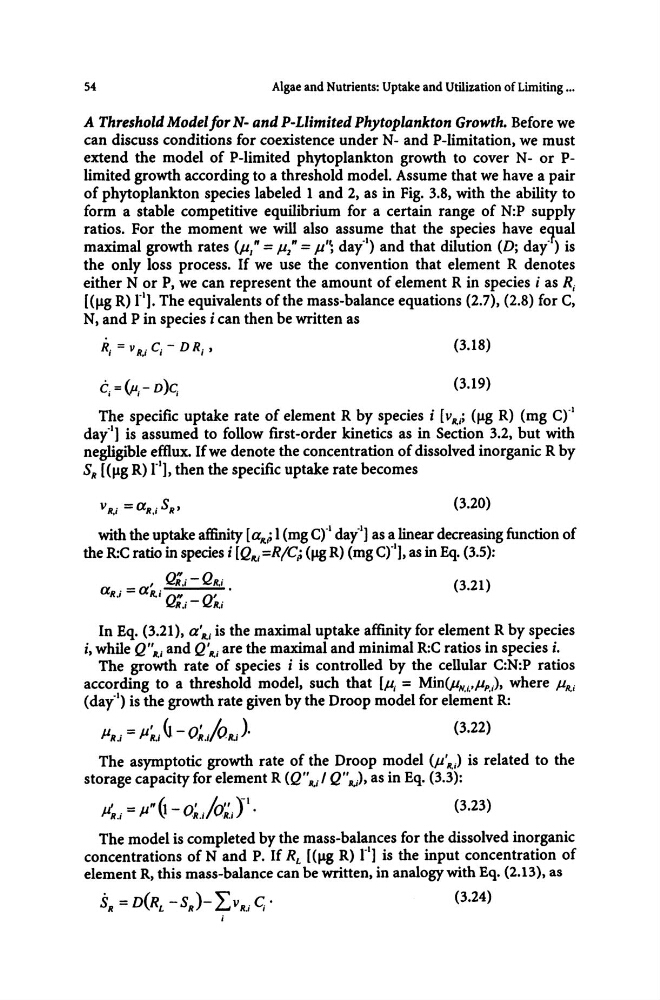
A Threshold Model for N- and P-Llimited Phytoplankton Growth. Before we
can discuss conditions for coexistence under N- and P-Iimitation, we must
extend the model of P-Iimited phytoplankton growth to cover N- or Plimited growth according to a threshold model. Assume that we have a pair
of phytoplankton species labeled 1 and 2, as in Fig. 3.8, with the ability to
form a stable competitive equilibrium for a certain range of N:P supply
ratios. For the moment we will also assume that the species have e~ual
maximal growth rates (Pl" = P2" = p'~ day"l) and that dilution (D; day" ) is
the only loss process. If we use the convention that element R denotes
either N or P, we can represent the amount of element R in species i as R;
[(Ilg R) r l ). The equivalents of the mass-balance equations (2.7), (2.8) for C,
N, and P in species i can then be written as
(3.18)
(3.19)
The specific uptake rate of element R by species i [vR,,'; (Ilg R) (mg C)'I
day"l) is assumed to follow first-order kinetics as in Section 3.2, but with
negligible efflux. If we denote the concentration of dissolved inorganic R by
SR [(Ilg R) rl), then the specific uptake rate becomes
(3.20)
with the uptake affinity [aR,,'; I (mg C)'I day"l) as a linear decreasing function of
the R:C ratio in species i [QR,I =R!C,.; (J.18 R) (mg Cn, as in Eq. (3.5):
(3.21)
In Eq. (3.21), a'R,1 is the maximal uptake affmity for element R by species
i, while Q"R,I and Q'R,I are the maximal and minimal R:C ratios in species i.
The growth rate of species i is controlled by the cellular C:N:P ratios
acco~ding to a threshold model, such that [PI = Min(PN,I,'PP)' where PR,;
(day" ) is the growth rate given by the Droop model for element R:
P R .; = p~.; ~ - O;./OR.i).
(3.22)
The asymptotic growth rate of the Droop model (p'R,;) is related to the
storage capacity for element R (Q"R,j I Q"R,j)' as in Eq. (3.3):
, "'i 0' 1. 0 " )-1
PR.; = P \! - .R.;/(R.; •
(3.23)
The model is completed by the mass-balances for the dissolved inorganic
concentrations of N and P. If RL [(Ilg R) 1'1] is the input concentration of
element R, this mass-balance can be written, in analogy with Eq. (2.13), as
SR = V(R L -SR)- :~::VRj ~.
(3.24)
;
Algae and Nutrients: Uptake and Utilization of Limiting ...
A Threshold Model for N- and P-Llimited Phytoplankton Growth. Before we
can discuss conditions for coexistence under N- and P-Iimitation, we must
extend the model of P-Iimited phytoplankton growth to cover N- or Plimited growth according to a threshold model. Assume that we have a pair
of phytoplankton species labeled 1 and 2, as in Fig. 3.8, with the ability to
form a stable competitive equilibrium for a certain range of N:P supply
ratios. For the moment we will also assume that the species have e~ual
maximal growth rates (Pl" = P2" = p'~ day"l) and that dilution (D; day" ) is
the only loss process. If we use the convention that element R denotes
either N or P, we can represent the amount of element R in species i as R;
[(Ilg R) r l ). The equivalents of the mass-balance equations (2.7), (2.8) for C,
N, and P in species i can then be written as
(3.18)
(3.19)
The specific uptake rate of element R by species i [vR,,'; (Ilg R) (mg C)'I
day"l) is assumed to follow first-order kinetics as in Section 3.2, but with
negligible efflux. If we denote the concentration of dissolved inorganic R by
SR [(Ilg R) rl), then the specific uptake rate becomes
(3.20)
with the uptake affinity [aR,,'; I (mg C)'I day"l) as a linear decreasing function of
the R:C ratio in species i [QR,I =R!C,.; (J.18 R) (mg Cn, as in Eq. (3.5):
(3.21)
In Eq. (3.21), a'R,1 is the maximal uptake affmity for element R by species
i, while Q"R,I and Q'R,I are the maximal and minimal R:C ratios in species i.
The growth rate of species i is controlled by the cellular C:N:P ratios
acco~ding to a threshold model, such that [PI = Min(PN,I,'PP)' where PR,;
(day" ) is the growth rate given by the Droop model for element R:
P R .; = p~.; ~ - O;./OR.i).
(3.22)
The asymptotic growth rate of the Droop model (p'R,;) is related to the
storage capacity for element R (Q"R,j I Q"R,j)' as in Eq. (3.3):
, "'i 0' 1. 0 " )-1
PR.; = P \! - .R.;/(R.; •
(3.23)
The model is completed by the mass-balances for the dissolved inorganic
concentrations of N and P. If RL [(Ilg R) 1'1] is the input concentration of
element R, this mass-balance can be written, in analogy with Eq. (2.13), as
SR = V(R L -SR)- :~::VRj ~.
(3.24)
;