

More Than One Limiting Nutrient - P and N Limitation
.... rn
o
(')
- ....
= o
.I
/
v
'---- Species 2 isocline
Resource I
S3
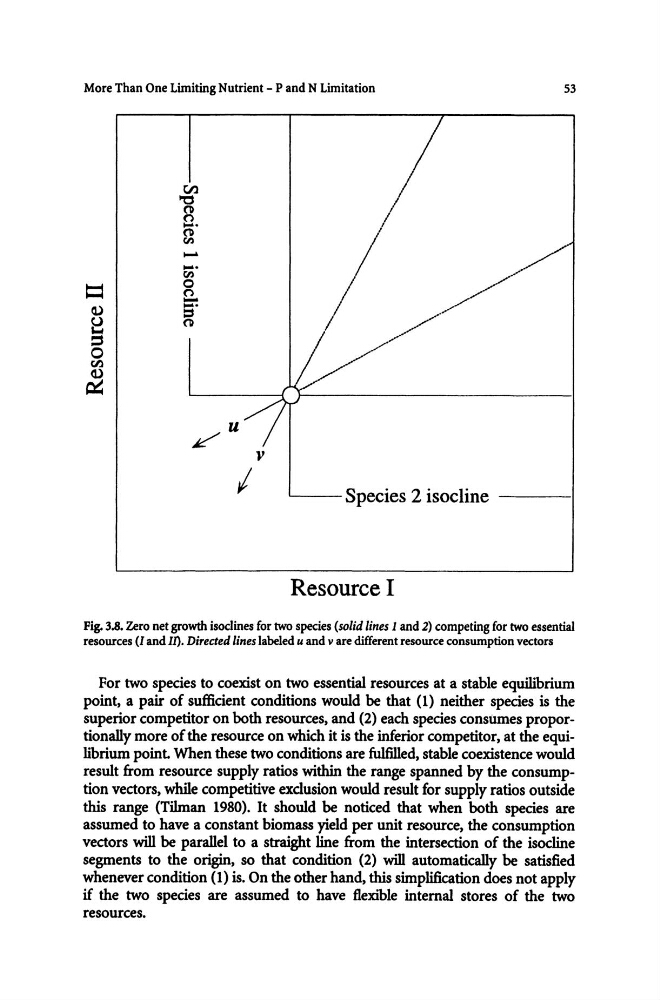
Fig. 3.8. Zero net growth isoclines for two species (solid lines 1 and 2) competing for two essential
resources (1 and 11). Directed lines labeled u and v are different resource consumption vectors
For two species to coexist on two essential resources at a stable equilibrium
point, a pair of sufficient conditions would be that (1) neither species is the
superior competitor on both resources, and (2) each species conS\lll1es proportionally more of the resource on which it is the inferior competitor, at the equilibrium point When these two conditions are fulfilled, stable coexistence would
result from resource supply ratios within the range spanned by the consumption vectors, while competitive exclusion would result for supply ratios outside
this range (Tilman 1980). It should be noticed that when both species are
assumed to have a constant biomass yield per unit resource, the consumption
vectors will be parallel to a straight line from the intersection of the isocline
segments to the origin, so that condition (2) will automatically be satisfied
whenever condition (l) is. On the other hand, this simplification does not apply
if the two species are assumed to have flexible internal stores of the two
resources.
.... rn
o
(')
- ....
= o
.I
/
v
'---- Species 2 isocline
Resource I
S3
Fig. 3.8. Zero net growth isoclines for two species (solid lines 1 and 2) competing for two essential
resources (1 and 11). Directed lines labeled u and v are different resource consumption vectors
For two species to coexist on two essential resources at a stable equilibrium
point, a pair of sufficient conditions would be that (1) neither species is the
superior competitor on both resources, and (2) each species conS\lll1es proportionally more of the resource on which it is the inferior competitor, at the equilibrium point When these two conditions are fulfilled, stable coexistence would
result from resource supply ratios within the range spanned by the consumption vectors, while competitive exclusion would result for supply ratios outside
this range (Tilman 1980). It should be noticed that when both species are
assumed to have a constant biomass yield per unit resource, the consumption
vectors will be parallel to a straight line from the intersection of the isocline
segments to the origin, so that condition (2) will automatically be satisfied
whenever condition (l) is. On the other hand, this simplification does not apply
if the two species are assumed to have flexible internal stores of the two
resources.