

40
Algae and Nutrients: Uptake and Utilization of Limiting ...
On the other hand, if growth is light-limited, Shuter (1979) predicts that the
photosynthetic compartment should decrease with increasing growth rate.
Both light- and nutrient-limited growth should converge to the same allocation rule as growth becomes unlimited. The model predictions by Shuter
(1979) been verified experimentally by, among others, Laws et al. (1983, 1985)
If the photosynthetic compartment has a fixed chla:C ratio, while the
other compartments contain no photosynthetic pigments, then the chla:C
ratio of the whole cell will be proportional to the relative size of this
compartment. If we denote the cellular ratio by qJ [(~g chla) (mg C)-I], the
relationship between chlorophyll a content and nutrient-limited growth
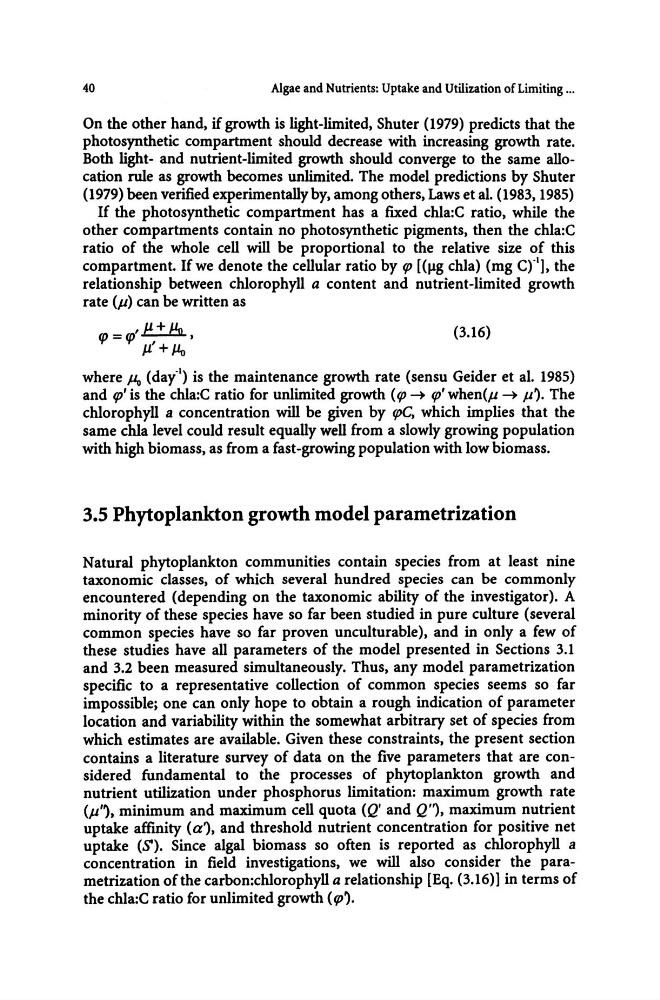
rate (p) can be written as
_ ,.1:!:..:!:..&..,
q> - q> J.l' + J1u
(3.16)
where Po (dati) is the maintenance growth rate (sensu Geider et al. 1985)
and qJ' is the chla:C ratio for unlimited growth (qJ ~ q>' when(p ~ p' . The
chlorophyll a concentration will be given by qJC, which implies that the
same chla level could result equally well from a slowly growing population
with high biomass, as from a fast-growing population with low biomass.
3.5 Phytoplankton growth model parametrization
Natural phytoplankton communities contain species from at least nine
taxonomic classes, of which several hundred species can be commonly
encountered (depending on the taxonomic ability of the investigator). A
minority of these species have so far been studied in pure culture (several
common species have so far proven unculturable), and in only a few of
these studies have all parameters of the model presented in Sections 3.1
and 3.2 been measured simultaneously. Thus, any model parametrization
specific to a representative collection of common species seems so far
impossible; one can only hope to obtain a rough indication of parameter
location and variability within the somewhat arbitrary set of species from
which estimates are available. Given these constraints, the present section
contains a literature survey of data on the five parameters that are considered fundamental to the processes of phytoplankton growth and
nutrient utilization under phosphorus limitation: maximum growth rate
(p", minimum and maximum cell quota (Q' and Q'1, maximum nutrient
uptake affinity (a1, and threshold nutrient concentration for positive net
uptake (S'). Since algal biomass so often is reported as chlorophyll a
concentration in field investigations, we will also consider the parametrization ofthe carbon:chlorophyll a relationship [Eq. (3.16)] in terms of
the chla:C ratio for unlimited growth (qJ'.
Algae and Nutrients: Uptake and Utilization of Limiting ...
On the other hand, if growth is light-limited, Shuter (1979) predicts that the
photosynthetic compartment should decrease with increasing growth rate.
Both light- and nutrient-limited growth should converge to the same allocation rule as growth becomes unlimited. The model predictions by Shuter
(1979) been verified experimentally by, among others, Laws et al. (1983, 1985)
If the photosynthetic compartment has a fixed chla:C ratio, while the
other compartments contain no photosynthetic pigments, then the chla:C
ratio of the whole cell will be proportional to the relative size of this
compartment. If we denote the cellular ratio by qJ [(~g chla) (mg C)-I], the
relationship between chlorophyll a content and nutrient-limited growth
rate (p) can be written as
_ ,.1:!:..:!:..&..,
q> - q> J.l' + J1u
(3.16)
where Po (dati) is the maintenance growth rate (sensu Geider et al. 1985)
and qJ' is the chla:C ratio for unlimited growth (qJ ~ q>' when(p ~ p' . The
chlorophyll a concentration will be given by qJC, which implies that the
same chla level could result equally well from a slowly growing population
with high biomass, as from a fast-growing population with low biomass.
3.5 Phytoplankton growth model parametrization
Natural phytoplankton communities contain species from at least nine
taxonomic classes, of which several hundred species can be commonly
encountered (depending on the taxonomic ability of the investigator). A
minority of these species have so far been studied in pure culture (several
common species have so far proven unculturable), and in only a few of
these studies have all parameters of the model presented in Sections 3.1
and 3.2 been measured simultaneously. Thus, any model parametrization
specific to a representative collection of common species seems so far
impossible; one can only hope to obtain a rough indication of parameter
location and variability within the somewhat arbitrary set of species from
which estimates are available. Given these constraints, the present section
contains a literature survey of data on the five parameters that are considered fundamental to the processes of phytoplankton growth and
nutrient utilization under phosphorus limitation: maximum growth rate
(p", minimum and maximum cell quota (Q' and Q'1, maximum nutrient
uptake affinity (a1, and threshold nutrient concentration for positive net
uptake (S'). Since algal biomass so often is reported as chlorophyll a
concentration in field investigations, we will also consider the parametrization ofthe carbon:chlorophyll a relationship [Eq. (3.16)] in terms of
the chla:C ratio for unlimited growth (qJ'.