

The Dynamics of the Pelagic Phosphorus Cycle
27
the fish playa less conspicuous role in the phosphorus cycle than would be
expected from their share of the standing stock of phosphorus (Nakashima
and Leggett 1980; Den Oude and Gulati 1988; Mazumder et al. 1992). While
the direct effects of planktivorous fish on the phosphorus cycle are omitted
in the present framework, some indirect effects of restructuring the zooplankton community by selective vertebrate predation can still be represented as species substitutions in the zooplankton compartment.
It should be noticed that, while Fig. 2.6 contains no explicit bacterial
compartment, the current consensus on the role of bacteria in the pelagic
phosphorus cycle can still be represented in the framework of the conceptual model. Ifbacteria function more as exploitative competitors for nutrients than as nutrient remineralizers (Currie and Kalff 1984; Glide 1985;
Thingstad 1987), their role in the phosphorus cycle should be functionally
equivalent to the phytoplankton compartment in Fig. 2.6, even if their role
in the carbon cycle is very different from phytoplankton. The zooplankton
compartment is sufficiently general that also specialized bacterial predators
like heterotrophic flagellates can be represented. On the other hand, the
simple flow scheme in Fig. 2.6 is unable to represent omnivory and mixotrophy in the phosphorus cycle, despite the inferred importance of organisms with such feeding modes in some recent studies (Bird and Kalff 1986;
Porter 1988).
Even in the simple system depicted in Fig. 2.6, the close couplings between
the intercompartmental flows make it very difficult to make any predictions
on the partitioning of phosphorus without some kind of dynamic model of
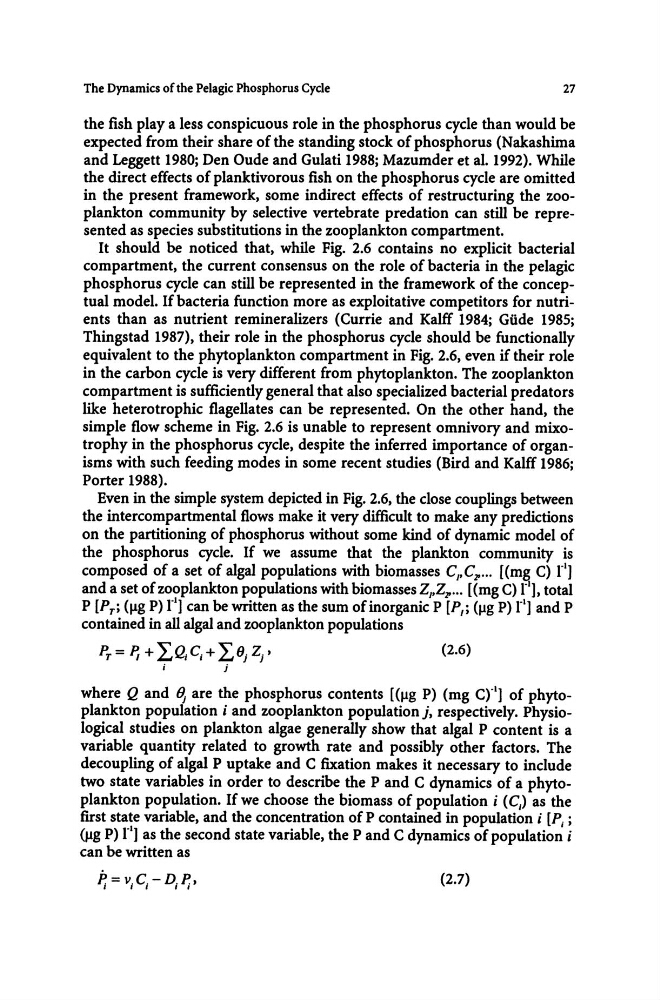
the phosphorus cycle. If we assume that the plankton community is
composed of a set of algal populations with biomasses C/,C r . [(mg C) rl]
and a set ofzooplankton populations with biomasses Z/,Z2'00. [(mg C) rl], total
P [Prj (Ilg P) rl] can be written as the sum of inorganic P [PI; (l1g P) rl] and P
contained in all algal and zooplankton populations
P,. = ~ + LQ; C; + LOj Zj'
(2.6)
;
j
where Q and ~ are the phosphorus contents [(l1g P) (mg C)'I] of phytoplankton population i and zooplankton population j, respectively. Physiological studies on plankton algae generally show that algal P content is a
variable quantity related to growth rate and possibly other factors. The
decoupling of algal P uptake and C fixation makes it necessary to include
two state variables in order to describe the P and C dynamics of a phytoplankton population. If we choose the biomass of population i (C 1 ) as the
first state variable, and the concentration of P contained in population i [Pi;
Utg P) rl] as the second state variable, the P and C dynamics of population i
can be written as
(2.7)
27
the fish playa less conspicuous role in the phosphorus cycle than would be
expected from their share of the standing stock of phosphorus (Nakashima
and Leggett 1980; Den Oude and Gulati 1988; Mazumder et al. 1992). While
the direct effects of planktivorous fish on the phosphorus cycle are omitted
in the present framework, some indirect effects of restructuring the zooplankton community by selective vertebrate predation can still be represented as species substitutions in the zooplankton compartment.
It should be noticed that, while Fig. 2.6 contains no explicit bacterial
compartment, the current consensus on the role of bacteria in the pelagic
phosphorus cycle can still be represented in the framework of the conceptual model. Ifbacteria function more as exploitative competitors for nutrients than as nutrient remineralizers (Currie and Kalff 1984; Glide 1985;
Thingstad 1987), their role in the phosphorus cycle should be functionally
equivalent to the phytoplankton compartment in Fig. 2.6, even if their role
in the carbon cycle is very different from phytoplankton. The zooplankton
compartment is sufficiently general that also specialized bacterial predators
like heterotrophic flagellates can be represented. On the other hand, the
simple flow scheme in Fig. 2.6 is unable to represent omnivory and mixotrophy in the phosphorus cycle, despite the inferred importance of organisms with such feeding modes in some recent studies (Bird and Kalff 1986;
Porter 1988).
Even in the simple system depicted in Fig. 2.6, the close couplings between
the intercompartmental flows make it very difficult to make any predictions
on the partitioning of phosphorus without some kind of dynamic model of
the phosphorus cycle. If we assume that the plankton community is
composed of a set of algal populations with biomasses C/,C r . [(mg C) rl]
and a set ofzooplankton populations with biomasses Z/,Z2'00. [(mg C) rl], total
P [Prj (Ilg P) rl] can be written as the sum of inorganic P [PI; (l1g P) rl] and P
contained in all algal and zooplankton populations
P,. = ~ + LQ; C; + LOj Zj'
(2.6)
;
j
where Q and ~ are the phosphorus contents [(l1g P) (mg C)'I] of phytoplankton population i and zooplankton population j, respectively. Physiological studies on plankton algae generally show that algal P content is a
variable quantity related to growth rate and possibly other factors. The
decoupling of algal P uptake and C fixation makes it necessary to include
two state variables in order to describe the P and C dynamics of a phytoplankton population. If we choose the biomass of population i (C 1 ) as the
first state variable, and the concentration of P contained in population i [Pi;
Utg P) rl] as the second state variable, the P and C dynamics of population i
can be written as
(2.7)