

26
The Biogeochemical Theatre - Phosphorus Cycling and Phosphorus Household in Lakes
> Nctload >
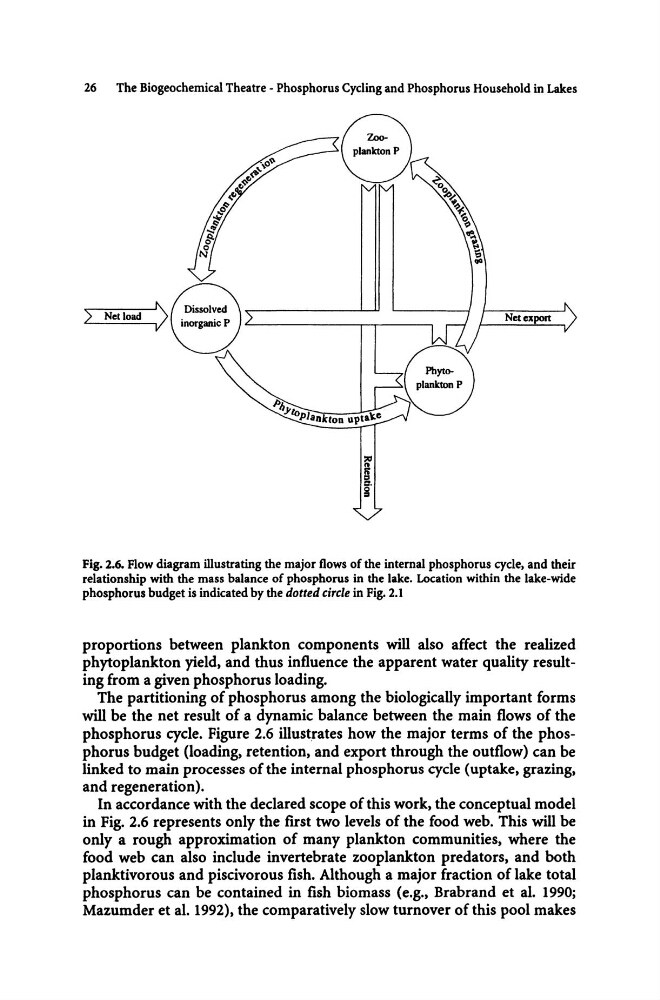
Fig. 1.6. Flow diagram illustrating the major flows of the internal phosphorus cycle, and their
relationship with the mass balance of phosphorus in the lake. Location within the lake-wide
phosphorus budget is indicated by the dotted circle in Fig. 2.1
proportions between plankton components will also affect the realized
phytoplankton yield, and thus influence the apparent water quality resulting from a given phosphorus loading.
The partitioning of phosphorus among the biologically important forms
will be the net result of a dynamic balance between the main flows of the
phosphorus cycle. Figure 2.6 illustrates how the major terms of the phosphorus budget (loading, retention, and export through the outflow) can be
linked to main processes of the internal phosphorus cycle (uptake, grazing,
and regeneration).
In accordance with the declared scope of this work, the conceptual model
in Fig. 2.6 represents only the first two levels of the food web. This will be
only a rough approximation of many plankton communities, where the
food web can also include invertebrate zooplankton predators, and both
planktivorous and piscivorous fish. Although a major fraction of lake total
phosphorus can be contained in fish biomass (e.g., Brabrand et al. 1990;
Mazumder et al. 1992), the comparatively slow turnover of this pool makes
The Biogeochemical Theatre - Phosphorus Cycling and Phosphorus Household in Lakes
> Nctload >
Fig. 1.6. Flow diagram illustrating the major flows of the internal phosphorus cycle, and their
relationship with the mass balance of phosphorus in the lake. Location within the lake-wide
phosphorus budget is indicated by the dotted circle in Fig. 2.1
proportions between plankton components will also affect the realized
phytoplankton yield, and thus influence the apparent water quality resulting from a given phosphorus loading.
The partitioning of phosphorus among the biologically important forms
will be the net result of a dynamic balance between the main flows of the
phosphorus cycle. Figure 2.6 illustrates how the major terms of the phosphorus budget (loading, retention, and export through the outflow) can be
linked to main processes of the internal phosphorus cycle (uptake, grazing,
and regeneration).
In accordance with the declared scope of this work, the conceptual model
in Fig. 2.6 represents only the first two levels of the food web. This will be
only a rough approximation of many plankton communities, where the
food web can also include invertebrate zooplankton predators, and both
planktivorous and piscivorous fish. Although a major fraction of lake total
phosphorus can be contained in fish biomass (e.g., Brabrand et al. 1990;
Mazumder et al. 1992), the comparatively slow turnover of this pool makes