

16
The Biogeochemical Theatre - Phosphorus Cycling and Phosphorus Household in Lakes
Lake content
Gross load
Net load
(
Net export
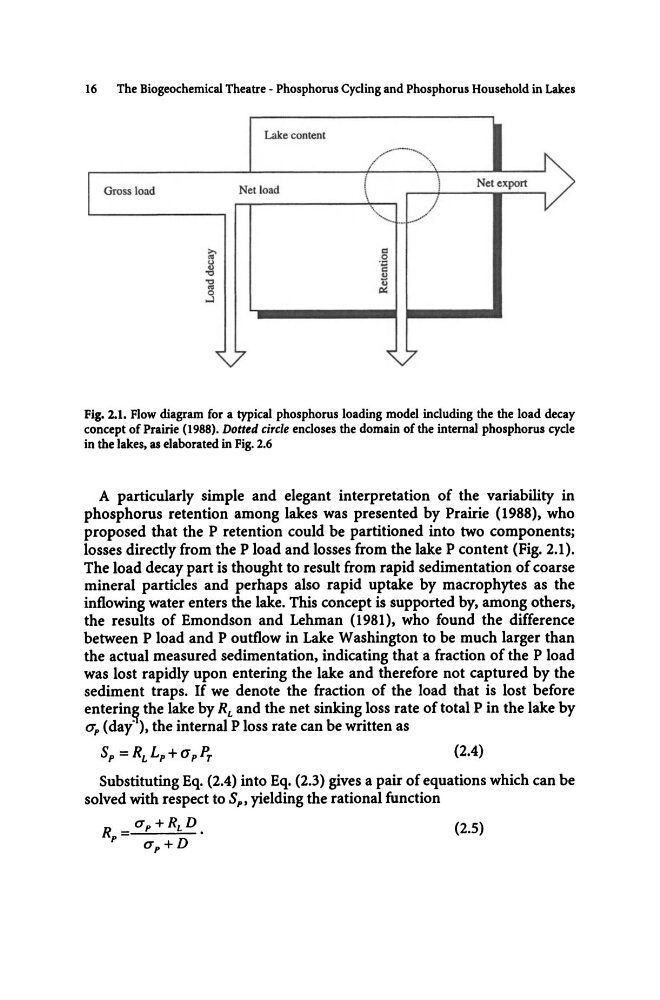
Fig. 2.1. Flow diagram for a typical phosphorus loading model including the the load decay
concept of Prairie (1988). Dotted circle encloses the domain of the internal phosphorus cycle
in the lakes, as elaborated in Fig. 2.6
A particularly simple and elegant interpretation of the variability in
phosphorus retention among lakes was presented by Prairie (1988), who
proposed that the P retention could be partitioned into two components;
losses directly from the P load and losses from the lake P content (Fig. 2.1).
The load decay part is thought to result from rapid sedimentation of coarse
mineral particles and perhaps also rapid uptake by macrophytes as the
inflowing water enters the lake. This concept is supported by, among others,
the results of Emondson and Lehman (1981), who found the difference
between P load and P outflow in Lake Washington to be much larger than
the actual measured sedimentation, indicating that a fraction of the P load
was lost rapidly upon entering the lake and therefore not captured by the
sediment traps. If we denote the fraction of the load that is lost before
enterin§ the lake by RL and the net sinking loss rate of total P in the lake by
CTp (day" ), the internal P loss rate can be written as
Sp = RLLp+ (jpPr
(2.4)
Substituting Eq. (2.4) into Eq. (2.3) gives a pair of equations which can be
solved with respect to Sp, yielding the rational function
(2.5)
The Biogeochemical Theatre - Phosphorus Cycling and Phosphorus Household in Lakes
Lake content
Gross load
Net load
(
Net export
Fig. 2.1. Flow diagram for a typical phosphorus loading model including the the load decay
concept of Prairie (1988). Dotted circle encloses the domain of the internal phosphorus cycle
in the lakes, as elaborated in Fig. 2.6
A particularly simple and elegant interpretation of the variability in
phosphorus retention among lakes was presented by Prairie (1988), who
proposed that the P retention could be partitioned into two components;
losses directly from the P load and losses from the lake P content (Fig. 2.1).
The load decay part is thought to result from rapid sedimentation of coarse
mineral particles and perhaps also rapid uptake by macrophytes as the
inflowing water enters the lake. This concept is supported by, among others,
the results of Emondson and Lehman (1981), who found the difference
between P load and P outflow in Lake Washington to be much larger than
the actual measured sedimentation, indicating that a fraction of the P load
was lost rapidly upon entering the lake and therefore not captured by the
sediment traps. If we denote the fraction of the load that is lost before
enterin§ the lake by RL and the net sinking loss rate of total P in the lake by
CTp (day" ), the internal P loss rate can be written as
Sp = RLLp+ (jpPr
(2.4)
Substituting Eq. (2.4) into Eq. (2.3) gives a pair of equations which can be
solved with respect to Sp, yielding the rational function
(2.5)