

Numerical Considerations and Computational Procedures
263
for all i, before the auxiliary variables were reset to zero (~ = 0) in order to
compute the averages of the next cycle.
Period A verages of Functions of State Variables. If y is a nonlinear function
of the state variables of a dynamic system, such that y = F(x" ... ,x n ), then the
average function value y will in general be different from the value
computed from the averages of the state variables [t~ F(i;, ... , ~),]. This
means, for example, that we cannot compute the cycle average of the algal
growth rate by substituting the cycle averages P and (; into the Droop
equation [Eq. (5.4)]. Cycle averages of a function of the state variables were
therefore computed by solving an augmented system X"""X n ' y. The state
equation for the auxiliary variable y is simply the symbolical derivative of
the function [y = P (x" ... ,x n )], with the initial condition given by the
function value at the start of the trajectory. For example, the auxiliary
equation for computing the cycle average of the algal growth rate p is
found by taking the time derivative of the Droop equation [Eq. (5.4)],
which can, after some manipulation, be written as
p=(p'_ p{~ _ ~).
(A9.3)
If the auxiliary equation is evaluated after the ordinary state equation, it
is more computationally efficient to leave the equation in the form of Eq.
(A9.3). Otherwise, one could of course also substitute the state equations
(5.1) and (5.2), in order to express Eq. (A9.3) simply in terms of the state
variables.
Classification of Trajectories. The system [Eqs. (5.1)-(5.3)] has three
principal modes of dynamic behavior depending on whether the state is
attracted to the central focus, the grazer extinction point, or the limit cycle.
Since attraction to the limit cycle and to the grazer extinction point are
mutually exclusive, the most important distinction is whether the state is
attracted to the central focus or not. Trajectories were classified by
comparing the averages from the last cycle that was completed before the
end of the solution interval, with the analytical solution of the central focus.
If the equilibrium values of the state variables at the focus are denoted by
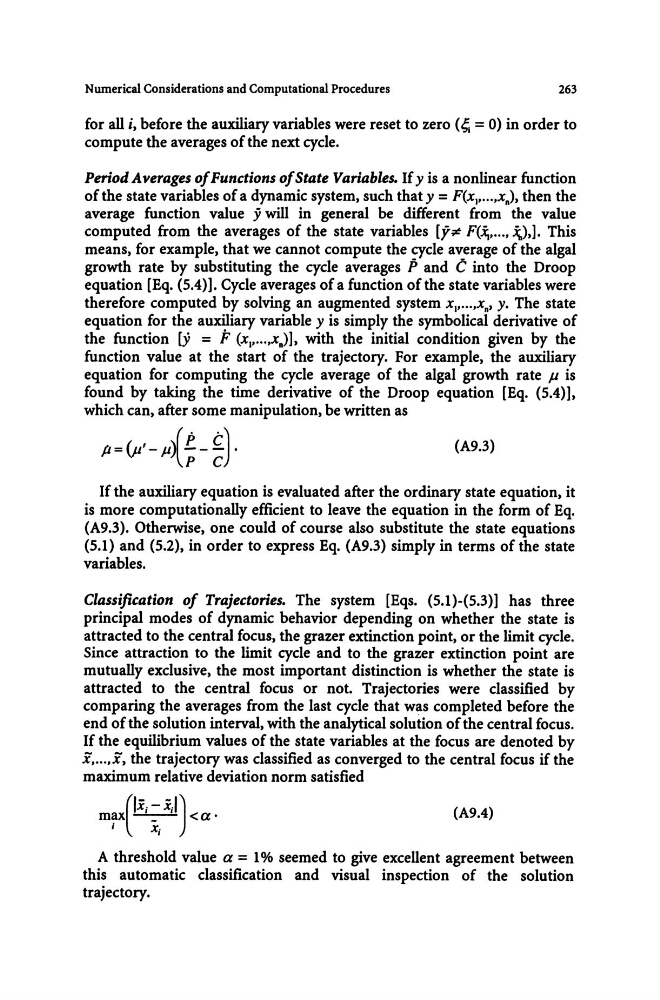
x, ... ,x, the trajectory was classified as converged to the central focus if the
maximum relative deviation norm satisfied
( li.-i.l)
max - ' _-'
Xj
(A9.4)
A threshold value a = 1 % seemed to give excellent agreement between
this automatic classification and visual inspection of the solution
trajectory.
263
for all i, before the auxiliary variables were reset to zero (~ = 0) in order to
compute the averages of the next cycle.
Period A verages of Functions of State Variables. If y is a nonlinear function
of the state variables of a dynamic system, such that y = F(x" ... ,x n ), then the
average function value y will in general be different from the value
computed from the averages of the state variables [t~ F(i;, ... , ~),]. This
means, for example, that we cannot compute the cycle average of the algal
growth rate by substituting the cycle averages P and (; into the Droop
equation [Eq. (5.4)]. Cycle averages of a function of the state variables were
therefore computed by solving an augmented system X"""X n ' y. The state
equation for the auxiliary variable y is simply the symbolical derivative of
the function [y = P (x" ... ,x n )], with the initial condition given by the
function value at the start of the trajectory. For example, the auxiliary
equation for computing the cycle average of the algal growth rate p is
found by taking the time derivative of the Droop equation [Eq. (5.4)],
which can, after some manipulation, be written as
p=(p'_ p{~ _ ~).
(A9.3)
If the auxiliary equation is evaluated after the ordinary state equation, it
is more computationally efficient to leave the equation in the form of Eq.
(A9.3). Otherwise, one could of course also substitute the state equations
(5.1) and (5.2), in order to express Eq. (A9.3) simply in terms of the state
variables.
Classification of Trajectories. The system [Eqs. (5.1)-(5.3)] has three
principal modes of dynamic behavior depending on whether the state is
attracted to the central focus, the grazer extinction point, or the limit cycle.
Since attraction to the limit cycle and to the grazer extinction point are
mutually exclusive, the most important distinction is whether the state is
attracted to the central focus or not. Trajectories were classified by
comparing the averages from the last cycle that was completed before the
end of the solution interval, with the analytical solution of the central focus.
If the equilibrium values of the state variables at the focus are denoted by
x, ... ,x, the trajectory was classified as converged to the central focus if the
maximum relative deviation norm satisfied
( li.-i.l)
max - ' _-'
Xj
(A9.4)
A threshold value a = 1 % seemed to give excellent agreement between
this automatic classification and visual inspection of the solution
trajectory.