

248
Appendices
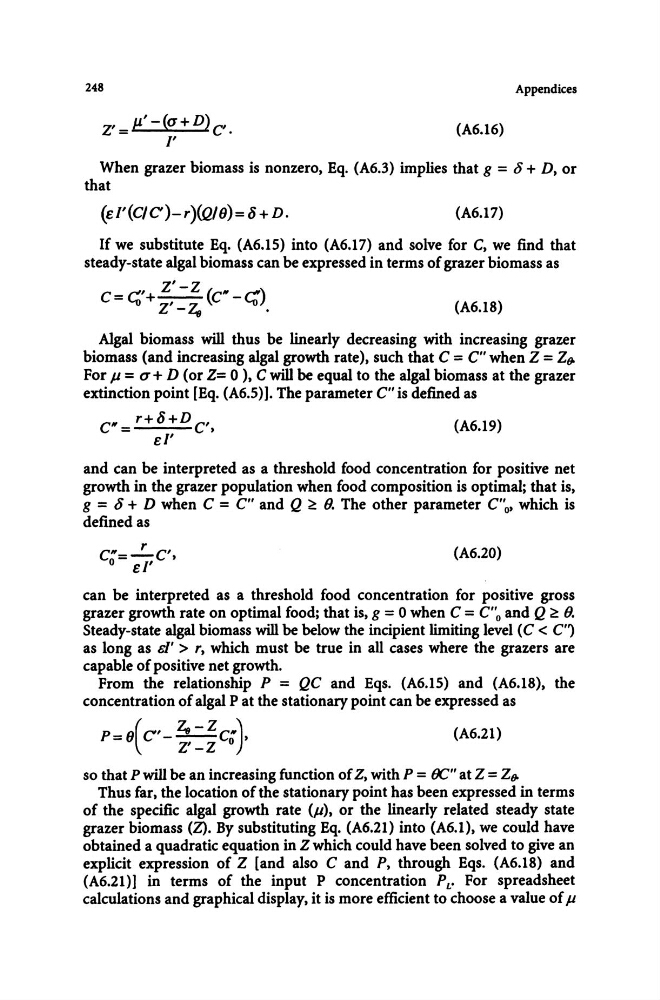
z' = Jl' -(u+D) C.
I'
(A6.16)
When grazer biomass is nonzero, Eq. (A6.3) implies that g = 8 + D, or
that
(el'(C/C)-r)(Q/O) = 6 + D.
(A6.17)
If we substitute Eq. (A6.15) into (A6.17) and solve for C, we find that
steady-state algal biomass can be expressed in terms of grazer biomass as
C= c;,'+ z; -z (C' _q)
z - z , .
(A6.18)
Algal biomass will thus be linearly decreasing with increasing grazer
biomass (and increasing algal growth rate), such that C = C" when Z = Z(Jo
For J.l = CT + D (or Z= 0 ), C will be equal to the algal biomass at the grazer
extinction point [Eq. (A6.5»). The parameter C" is defined as
C" = r + 6 + D C',
e/'
(A6.19)
and can be interpreted as a threshold food concentration for positive net
growth in the grazer population when food composition is optimal; that is,
g = 8 + D when C = C" and Q ~ O. The other parameter C"", which is
defined as
C"=~C"
o e/'
(A6.20)
can be interpreted as a threshold food concentration for positive gross
grazer growth rate on optimal food; that is, g = 0 when C = C"o and Q ~ O.
Steady-state algal biomass will be below the incipient limiting level (C < C'1
as long as &1' > T, which must be true in all cases where the grazers are
capable of positive net growth.
From the relationship P = QC and Eqs. (A6.15) and (A6.18), the
concentration of algal P at the stationary point can be expressed as
P= O(C' _ Z, - z eM),
(A6.21)
Z'-z 0
so that P will be an increasing function of Z, with P = (JC" at Z = Z(Jo
Thus far, the location of the stationary point has been expressed in terms
of the specific algal growth rate (J.l), or the linearly related steady state
grazer biomass (Z). By substituting Eq. (A6.21) into (A6.1), we could have
obtained a quadratic equation in Z which could have been solved to give an
explicit expression of Z [and also C and P, through Eqs. (A6.18) and
(A6.21») in terms of the input P concentration PL' For spreadsheet
calculations and graphical display, it is more efficient to choose a value of J.l
Appendices
z' = Jl' -(u+D) C.
I'
(A6.16)
When grazer biomass is nonzero, Eq. (A6.3) implies that g = 8 + D, or
that
(el'(C/C)-r)(Q/O) = 6 + D.
(A6.17)
If we substitute Eq. (A6.15) into (A6.17) and solve for C, we find that
steady-state algal biomass can be expressed in terms of grazer biomass as
C= c;,'+ z; -z (C' _q)
z - z , .
(A6.18)
Algal biomass will thus be linearly decreasing with increasing grazer
biomass (and increasing algal growth rate), such that C = C" when Z = Z(Jo
For J.l = CT + D (or Z= 0 ), C will be equal to the algal biomass at the grazer
extinction point [Eq. (A6.5»). The parameter C" is defined as
C" = r + 6 + D C',
e/'
(A6.19)
and can be interpreted as a threshold food concentration for positive net
growth in the grazer population when food composition is optimal; that is,
g = 8 + D when C = C" and Q ~ O. The other parameter C"", which is
defined as
C"=~C"
o e/'
(A6.20)
can be interpreted as a threshold food concentration for positive gross
grazer growth rate on optimal food; that is, g = 0 when C = C"o and Q ~ O.
Steady-state algal biomass will be below the incipient limiting level (C < C'1
as long as &1' > T, which must be true in all cases where the grazers are
capable of positive net growth.
From the relationship P = QC and Eqs. (A6.15) and (A6.18), the
concentration of algal P at the stationary point can be expressed as
P= O(C' _ Z, - z eM),
(A6.21)
Z'-z 0
so that P will be an increasing function of Z, with P = (JC" at Z = Z(Jo
Thus far, the location of the stationary point has been expressed in terms
of the specific algal growth rate (J.l), or the linearly related steady state
grazer biomass (Z). By substituting Eq. (A6.21) into (A6.1), we could have
obtained a quadratic equation in Z which could have been solved to give an
explicit expression of Z [and also C and P, through Eqs. (A6.18) and
(A6.21») in terms of the input P concentration PL' For spreadsheet
calculations and graphical display, it is more efficient to choose a value of J.l